Newsweek's Elenor Clift has a list of Five Ways that Barack Obama can be More Like Ronald Regan. She's wasting her time and giving bad advice. She is wasting her time because Reagan and Obama have lived such different lives. Reagan started as a Democrat. During the 1950s he spent years being paid to give patriotic and motivational speeches to factory workers. He wrote all of his own material. This is when he actually defined his political beliefs and came to the conclusion that he was in the wrong party. As a result of this period he knew what he believed in and could explain it to others.
In contrast, Obama has always been a Progressive. He started his career as a Saul Alinsky community organizer. After two years with sparse results, he decided on a change of tactics. He never seriously questioned or explained his core beliefs and, prior to becoming president, he was always playing to a like-minded crowd.
Then there is the matter of experience. Reagan spent eight years as Governor of California where he learned how to work with a Democratic Legislature. Obama is still learning how to get legislation passed with a strong Democratic majority. Next year he will have to start learning how to pass legislation with a reduced majority or a Republican majority in one or both houses. He will be into his second term (assuming that he he reelected) before he really has a handle on Congress.
So, ignoring the fact that Obama is unprepared to be a liberal Reagan, what advice does Clift offer?
1) Get health care done, and then explain to the voters what he's been doing for the last year, and what's in it for them.
Clift has this backwards. Reagan always sold his legislation to the people first then used this to put pressure on the Democrats. He would never try to pass an unpopular bill then sell it.
2) Talk to Hillary Clinton. Ask her how she connected with blue-collar voters during the '08 primaries and racked up a string of victories against Obama.
During the campaign, Hillary was a chameleon. When in the South, she developed a southern drawl. When in the North, she was a life-long fan of the local team. Obama never stops being Obama and looks uncomfortable when he tries - remember when he went bowling?
3) Do concrete things that connect with middle-class voters.
I can't argue with that one but Clift doesn't have any suggestions beyond Cash For Clunkers.
4) Don't forget Bush.
Clift really means "blame Bush" but Obama has never stopped doing that. When SNL and the Daily Show start to joke about blaming Bush, it's time to move on.
5) Don't cloud the message.
She says to leave Immigration and Climate legislation until next year. Does that mean that we are in for a second year of nothing but Health Care? Kill me now.
None of these points have anything to do with Reagan and none are likely to help Obama. He would do better to talk to Bill Clinton. Like Obama, Clinton came into office with a majority in both houses and lofty expectation. Clinton managed to save his presidency through triangulation. Obama has rejected this so far but it is far easier to have a successful presidency from te center than from the left.
Sunday, March 14, 2010

Friday, March 12, 2010
The Myth of Government Jobs
I constantly see pundits saying "It will take years for the private sector to create enough jobs to bring down unemployment so the public sector has to step up." Les Leopold from Huffington asks outright for the government to start creating jobs. The problem is that government-created jobs may do more harm than good for several reasons.
Basic math says that you cannot create something from nothing. If the government creates a job then it has to pay for it somehow. The federal government has three options for this. The first one is to take the money from other people. The second is to print more money. The third is to borrow the money.
The first option is how government is supposed to work. Through taxation, the government takes enough money to pay its bills. This is a straight transfer of funds and can easily become burdensome. There are something like fifteen million unemployed right now. In order to pay them a living wage for a family of two adults and two children, the government would need to spend something like $40,000-$60,000 per year on wages plus Social Security and insurance. Some of that extra would come back in taxes to let's just look at raw wages. Giving everyone who is unemployed a job at $40,000 would cost $600 billion per year. That's $2,000.00 in additional taxes for everyone in the country including children, the retired, and the new additions to the government payroll. Fifteen million people suddenly being unemployed would boost the economy but everyone would have to economize to pay for it. The net effect would be a wash (some economists insist that there is a magic multiplier effect when government spends money but this is nearly impossible to prove).
To avoid the pain of taxing everyone $2,000 per year, the government might just print enough extra money to cover the expenses. That carries its own cost. It eventually leads to inflation. If the government prints too much money, it leads to hyperinflation. You still have the same amount of money but it is worth less than before. Anyone who lived through the 1970s knows how destructive this can be.
The ideal solution would be to borrow during the hard times and pay down the debt in the good times. This actually never happens. Even during the Clinton years, the government showed a surplus on the books largely because of creative bookkeeping involving Social Security funds. While it is on a different scale, government borrowing is not that different from using a credit card. There is a minimum payment that is required each month. With a credit card, that payment includes enough to pay down a small portion of the principal. With the national debt, we just pay the interest and let the principal accumulate. We can keep this up indefinitely as long as the national debt is not increasing faster than the economy is growing. If debt grows too quickly for too long it becomes unsustainable and the country's resources are diverted from being spent on its citizens to making interest payments. This is where Greece is now and where we might end up.
It used to be well-known that there is no such thing as a free lunch and that government spending in one area means pain elsewhere. With the resurgence of the Progressives, that knowledge has been lost or discounted. They have convinced themselves that government spending is benign or that taxes can be raised painlessly as long as they are aimed at the rich. In many cases they just want to help people and don't understand the limits of government power.
Basic math says that you cannot create something from nothing. If the government creates a job then it has to pay for it somehow. The federal government has three options for this. The first one is to take the money from other people. The second is to print more money. The third is to borrow the money.
The first option is how government is supposed to work. Through taxation, the government takes enough money to pay its bills. This is a straight transfer of funds and can easily become burdensome. There are something like fifteen million unemployed right now. In order to pay them a living wage for a family of two adults and two children, the government would need to spend something like $40,000-$60,000 per year on wages plus Social Security and insurance. Some of that extra would come back in taxes to let's just look at raw wages. Giving everyone who is unemployed a job at $40,000 would cost $600 billion per year. That's $2,000.00 in additional taxes for everyone in the country including children, the retired, and the new additions to the government payroll. Fifteen million people suddenly being unemployed would boost the economy but everyone would have to economize to pay for it. The net effect would be a wash (some economists insist that there is a magic multiplier effect when government spends money but this is nearly impossible to prove).
To avoid the pain of taxing everyone $2,000 per year, the government might just print enough extra money to cover the expenses. That carries its own cost. It eventually leads to inflation. If the government prints too much money, it leads to hyperinflation. You still have the same amount of money but it is worth less than before. Anyone who lived through the 1970s knows how destructive this can be.
The ideal solution would be to borrow during the hard times and pay down the debt in the good times. This actually never happens. Even during the Clinton years, the government showed a surplus on the books largely because of creative bookkeeping involving Social Security funds. While it is on a different scale, government borrowing is not that different from using a credit card. There is a minimum payment that is required each month. With a credit card, that payment includes enough to pay down a small portion of the principal. With the national debt, we just pay the interest and let the principal accumulate. We can keep this up indefinitely as long as the national debt is not increasing faster than the economy is growing. If debt grows too quickly for too long it becomes unsustainable and the country's resources are diverted from being spent on its citizens to making interest payments. This is where Greece is now and where we might end up.
It used to be well-known that there is no such thing as a free lunch and that government spending in one area means pain elsewhere. With the resurgence of the Progressives, that knowledge has been lost or discounted. They have convinced themselves that government spending is benign or that taxes can be raised painlessly as long as they are aimed at the rich. In many cases they just want to help people and don't understand the limits of government power.
Palin and Canadian Health Care
It made the news that Sarah Palin admitted that when she was growing up her family would go to Canada for medical care. Is this relevant to today's health care debate? Not in the least for two important reasons:
1) Palin's family lived in a small Alaskan town and the closest (by a long shot) medical facility was in Canada. Closest does not mean best (or worst).
2) Palin says that this was during her first five years of life. She was born in 1964 and Canada did not become single-payer until 1985. No one seems to have picked up on this but it invalidates any arguments about single-payer.
1) Palin's family lived in a small Alaskan town and the closest (by a long shot) medical facility was in Canada. Closest does not mean best (or worst).
2) Palin says that this was during her first five years of life. She was born in 1964 and Canada did not become single-payer until 1985. No one seems to have picked up on this but it invalidates any arguments about single-payer.
Thursday, March 11, 2010
Austerity and Boom Times
Greece and California are deeply in debt forcing them to make huge cuts in services. This is causing mass protests. The protests in California have been fairly restrained but Greece has near-riots. The UK is also facing growing debt. All of these governments are in debt because of the general financial problems but this points out an economic paradox - governments have no incentive to shrink, only grow.
In good times the taxes come rolling in and government expands. No bureaucrat ever wants to let money go unspent. With federal governments, politicians go a step further and spend money that they don't have, running up the national debt.
Bad times inevitably come. President Obama has talked about breaking the boom and bust economic cycle but that is likely impossible. Private businesses respond to economic slumps by downsizing and taking out loans to tide them over. These are repaid when times are better.
Here is the problem. During an economic downswing, there is a lot of pressure on government to keep its spending levels the same. At the same time, it is under economic stress. Costs like unemployment go up while tax revenue goes down.
Many economists on the left say that deficits do not matter. Lead by Paul Krugman, they insist that no level of spending is too high but most are too low. Krugman insists that Japan's Lost Decade was caused because the Japanese government's stimulus spending was too small. He suggests, with a straight face, that a stimulus equaling a country's annual GDP is appropriate, if a little low.
Under pressure from its own citizens and the US (and Krugman), the UK lead Europe in stimulus spending. Now it is in economic trouble.
A major obstacle to government spending cuts during an economic downturn is the fear that it will make the downturn worse. Sometimes taxes are raised but this just creates increased spending during the next boom cycle.
The result of all this is governments spiraling out of control. Sometimes things get bad enough that some cuts can be made. In the late 1970s and early 1980s, Margaret Thatcher made some cuts in the UK. Ronald Reagan made some cuts but these were mainly in the speed of growth.
Right now there is no push for limiting government (except for the Tea parties). The Democrats are trying to increase government size and spending. This will inevitably lead to a crisis. The best we can do for at the moment is to resist growth from the Democrats and hope that a re-energized Republican party will be less spendthrift.
In good times the taxes come rolling in and government expands. No bureaucrat ever wants to let money go unspent. With federal governments, politicians go a step further and spend money that they don't have, running up the national debt.
Bad times inevitably come. President Obama has talked about breaking the boom and bust economic cycle but that is likely impossible. Private businesses respond to economic slumps by downsizing and taking out loans to tide them over. These are repaid when times are better.
Here is the problem. During an economic downswing, there is a lot of pressure on government to keep its spending levels the same. At the same time, it is under economic stress. Costs like unemployment go up while tax revenue goes down.
Many economists on the left say that deficits do not matter. Lead by Paul Krugman, they insist that no level of spending is too high but most are too low. Krugman insists that Japan's Lost Decade was caused because the Japanese government's stimulus spending was too small. He suggests, with a straight face, that a stimulus equaling a country's annual GDP is appropriate, if a little low.
Under pressure from its own citizens and the US (and Krugman), the UK lead Europe in stimulus spending. Now it is in economic trouble.
A major obstacle to government spending cuts during an economic downturn is the fear that it will make the downturn worse. Sometimes taxes are raised but this just creates increased spending during the next boom cycle.
The result of all this is governments spiraling out of control. Sometimes things get bad enough that some cuts can be made. In the late 1970s and early 1980s, Margaret Thatcher made some cuts in the UK. Ronald Reagan made some cuts but these were mainly in the speed of growth.
Right now there is no push for limiting government (except for the Tea parties). The Democrats are trying to increase government size and spending. This will inevitably lead to a crisis. The best we can do for at the moment is to resist growth from the Democrats and hope that a re-energized Republican party will be less spendthrift.
Wednesday, March 10, 2010
Fishing
A story published by ESPN has made a stir. It speculates that the Obama administration is about to ban all commercial and recreational fishing. I doubt that this will happen. I doubt that even the tone-deaf Obama administration would alienate tens of millions of Americans and eliminate hundreds of thousands of jobs. That doesn't mean that fishers have nothing to fear.
What is almost certain is that either strict limits or an outright ban will be placed on bluefin tuna. This will be totally ineffective since Japan is responsible for 75% of the bluefin catch and will opt out.
There may also be new limits on all commercial fishing. Some computer models show that the current fish population is a fraction of what it had been, maybe less than ten percent. Environmentalists have been calling on strict limits on fishing to let the stock rebuild. Here is Greenpeace's position paper. Keep in mind that they have been caught presenting questionable data as established facts.
The ESPN article refers to a document called Transition to Green. I read the section on U.S. Fish and Wildlife as well as some other sections relating to land management but I could not find anything that would apply to recreational fishing. There are several mentions of overfishing. Most are qualified to refer to commercial fishing, fishing beyond the 200 mile limit or fishing as covered by the Magnuson-Stevens Act. A policy recommendation on overfishing on page 369 is not qualified but it appears at the end of a section that does qualify the term to mean commercial fishing. There are also mentions of overfishing under the section on NOAA (National Oceanic and Atmospheric Administration) but I am going to assume that their charter is limited to oceans. The context supports this. Most of Transition to Green is devoted to global warming strategies. The recommendations will probably be devastating to commercial fishing and the price of fish but are not aimed at sport fishers.
The ESPN article mentions that the same group managed to stop bear hunting in Canada but this is tiny compared to sport fishing in America. It also mentions attempts to ban lead fishing tackle but non-lead alternatives already exist.
So why the alarm? I think that some of it is guilt by association. While Transition to Green is fairly mild, it has several radical groups behind it. It also appears that the public input was treated as a formality. This is typical for the Obama administration which seems surprised and annoyed when anyone questions it.
What is almost certain is that either strict limits or an outright ban will be placed on bluefin tuna. This will be totally ineffective since Japan is responsible for 75% of the bluefin catch and will opt out.
There may also be new limits on all commercial fishing. Some computer models show that the current fish population is a fraction of what it had been, maybe less than ten percent. Environmentalists have been calling on strict limits on fishing to let the stock rebuild. Here is Greenpeace's position paper. Keep in mind that they have been caught presenting questionable data as established facts.
The ESPN article refers to a document called Transition to Green. I read the section on U.S. Fish and Wildlife as well as some other sections relating to land management but I could not find anything that would apply to recreational fishing. There are several mentions of overfishing. Most are qualified to refer to commercial fishing, fishing beyond the 200 mile limit or fishing as covered by the Magnuson-Stevens Act. A policy recommendation on overfishing on page 369 is not qualified but it appears at the end of a section that does qualify the term to mean commercial fishing. There are also mentions of overfishing under the section on NOAA (National Oceanic and Atmospheric Administration) but I am going to assume that their charter is limited to oceans. The context supports this. Most of Transition to Green is devoted to global warming strategies. The recommendations will probably be devastating to commercial fishing and the price of fish but are not aimed at sport fishers.
The ESPN article mentions that the same group managed to stop bear hunting in Canada but this is tiny compared to sport fishing in America. It also mentions attempts to ban lead fishing tackle but non-lead alternatives already exist.
So why the alarm? I think that some of it is guilt by association. While Transition to Green is fairly mild, it has several radical groups behind it. It also appears that the public input was treated as a formality. This is typical for the Obama administration which seems surprised and annoyed when anyone questions it.
Monday, March 08, 2010
Michael Moore's argument against big government
Michael Moore posted an open letter to the President in the Huffington Post telling how he would handle being Chief of Staff. Personally, I would love to see this part: "Each morning you and I will do 100 jumping jacks".
At the end, Moore explains how he would handle Republicans.
At the end, Moore explains how he would handle Republicans.
P.S. Just to give you an idea of the new style I'll be bringing with me, when a cornhole like Sen. Ben Nelson tries to hold you up next time, this is what I will tell him in order to get his vote: "You've got exactly 30 seconds to rescind your demand or I will personally make sure that Nebraska doesn't get one more federal dollar for the rest of Obama's term. And then I will let everyone in your state know that you wear Sooner panties, backwards. NOW DROP AND GIVE ME 50!"So, in Moore's perfect world, congressmen would be punished for voting against the President by having their federal funds cut off. So much for the separation of power. This reminds me of a quote:
A government big enough to give you everything you want is a government big enough to take from you everything you have
Gerald R. Ford, August 12, 1974
Attacking the Tea Parties
A year ago the Tea Parties were being dismissed as nothing more than astro-turfed demonstrations paid for and coordinated by Fox News. A year later and they have shown strength and resilience. The Tea Parties had their first anniversary in February. This caused a new series of attacks from several sources, particularly the New York Times. Here is how a few of the attacks were handled.
First up is the nastiest. Bob Cesca of the Huffington Post boiled his attack down to one word - racism.
In todays' world, there isn't a worse thing you can call someone than a racist but how does he justify this attack?
Two problems here. The first is that the Robertson has no standing in any Tea Party groups. The second is that Cesca is asking you to ignore everything that the Tea Parties have done and only pay attention to one guy with one sign.
New York Times columnist Frank Rich uses a similar tactic but is much more subtle. He starts out by associating the nut who rammed his plane into an IRS office with the Tea Parties, even though there is no direct connection at all.
This is guilt by association and this is not a line of attack that Rich really wants to open. For example, he points out that Ron Paul won the CPAC straw-poll then uses Paul to link the Tea Parties to the 9/11 Truth Movement. The implication is that anyone linked to the 9/11 Truthers is a nut-case but the only Truthers elected to Congress or appointed as a Czar but the President have been Democrats. It is easy to hang around the fringes of a protest and find nuts. The piece that Rich linked to does not quote any organizers nor does it try to give a breakdown of the composition of the Tea Parties. That would spoil the message - that you should fear the Tea Parties because they are made up of angry whites with guns.
An interesting comparison is how the Times and other sources covered the anti-Iraq war movement and the March 4th protests last week. Many of these were organized by International ANSWER, a pro-marxist, anti-American group. These people support real, bomb-throwing terrorists like Hamas. Does the Times ever imply that you should be afraid of them?
Finally, for my quick survey, there is Newsweek's Elenor Clift. In a piece entitled Weak Tea (Party), she asks if it will be a lasting force and denigrates its accomplishments. I think that she is too quick to dismiss the effect that the Tea Parties have had on the primaries. Look at Texas, Florida, and Arizona.
To Clift's rhetorical question, "will it last?", I will give a real answer - no, but it's not going away on its own. The Tea Parties have two main components - a call for fiscal restraint, and a counter push to the rise of the Progressives.
First, there is a real constituency for fiscal restraint. Bush never believed in fiscal restraint. That was the point of his "compassionate conservatism". Even ignoring his wars, he ran up the deficit to new heights. The left ran against this as far back as the 2004 MoveOn.org Super Bowl ad. Fiscal restraint was part of the Democratic platforms in 2006 and 2008. With Bush's retirement, the Republicans have again become the Party of Reagan but the Tea Parties are skeptical that they have really reformed. If the Republicans can establish a record of fiscal restraint then they will absorb some of the Tea Partiers. This will take time.
The urgency that created the Tea Parties started with the huge amounts being tossed around in bail-outs, the stimulus, and the 2009 budget. It was given a boost by the economic failure of Portugal, Ireland, Greece, and Spain (the so-called PIGS). Iceland and Italy are in equally bad shape. The Tea Parties look at these countries as examples of the direction that our leadership is taking us.
The other factor is the rise of the Progressives. During the 2007 and 2008 Democratic debates, most of the candidates identified themselves as Progressives instead of Liberals. They also talked about returning to Progressive values and goals. This might have been simple re-branding but it led people like Glenn Beck to look up what the Progressives stood for in the early 20th century. It turned out that Progressivism came from the same root as Communism and Fascism. They all call for a huge expansion of government power. Given Obama's majorities in both Congressional houses and his penchant for taking over industries and appointing Czars, conservatives had reason to be scared. Given President Obama's self-identification as a Progressive, everything that he did was assumed to be part of a Progressive take-over of the country. This is why the Tea Party members seem to see conspiracies everywhere.
The last year has shown that the Obama administration is not competent enough to implement a Progressive agenda but that is not going to sooth the Tea Partiers. They fear tiny incremental changes that will add up over time (something that advocates of the current health care bill are promising). They will not go away until the Progressives are out of power.
First up is the nastiest. Bob Cesca of the Huffington Post boiled his attack down to one word - racism.
Because when you strip away all of the rage, all of the nonsensical loud noises and all of the contradictions, all that's left is race. The tea party is almost entirely about race, and there's no comparative group on the left that's similarly motivated by bigotry, ignorance and racial hatred.
In todays' world, there isn't a worse thing you can call someone than a racist but how does he justify this attack?
Strike that. Correction. TeaParty.org founder Dale Robertson brandished a sign with the (misspelled) word "niggar." So they're not even as restrained as the generally unstrung Atwater anymore.
Two problems here. The first is that the Robertson has no standing in any Tea Party groups. The second is that Cesca is asking you to ignore everything that the Tea Parties have done and only pay attention to one guy with one sign.
New York Times columnist Frank Rich uses a similar tactic but is much more subtle. He starts out by associating the nut who rammed his plane into an IRS office with the Tea Parties, even though there is no direct connection at all.
It is not glib or inaccurate to invoke Oklahoma City in this context, because the acrid stench of 1995 is back in the air. Two days before Stack's suicide mission, The Times published David Barstow's chilling, months-long investigation of the Tea Party movement. Anyone who was cognizant during the McVeigh firestorm would recognize the old warning signs re-emerging from the mists of history. The Patriot movement. "The New World Order," with its shadowy conspiracies hatched by the Council on Foreign Relations and the Trilateral Commission. Sandpoint, Idaho. White supremacists. Militias.
This is guilt by association and this is not a line of attack that Rich really wants to open. For example, he points out that Ron Paul won the CPAC straw-poll then uses Paul to link the Tea Parties to the 9/11 Truth Movement. The implication is that anyone linked to the 9/11 Truthers is a nut-case but the only Truthers elected to Congress or appointed as a Czar but the President have been Democrats. It is easy to hang around the fringes of a protest and find nuts. The piece that Rich linked to does not quote any organizers nor does it try to give a breakdown of the composition of the Tea Parties. That would spoil the message - that you should fear the Tea Parties because they are made up of angry whites with guns.
An interesting comparison is how the Times and other sources covered the anti-Iraq war movement and the March 4th protests last week. Many of these were organized by International ANSWER, a pro-marxist, anti-American group. These people support real, bomb-throwing terrorists like Hamas. Does the Times ever imply that you should be afraid of them?
Finally, for my quick survey, there is Newsweek's Elenor Clift. In a piece entitled Weak Tea (Party), she asks if it will be a lasting force and denigrates its accomplishments. I think that she is too quick to dismiss the effect that the Tea Parties have had on the primaries. Look at Texas, Florida, and Arizona.
To Clift's rhetorical question, "will it last?", I will give a real answer - no, but it's not going away on its own. The Tea Parties have two main components - a call for fiscal restraint, and a counter push to the rise of the Progressives.
First, there is a real constituency for fiscal restraint. Bush never believed in fiscal restraint. That was the point of his "compassionate conservatism". Even ignoring his wars, he ran up the deficit to new heights. The left ran against this as far back as the 2004 MoveOn.org Super Bowl ad. Fiscal restraint was part of the Democratic platforms in 2006 and 2008. With Bush's retirement, the Republicans have again become the Party of Reagan but the Tea Parties are skeptical that they have really reformed. If the Republicans can establish a record of fiscal restraint then they will absorb some of the Tea Partiers. This will take time.
The urgency that created the Tea Parties started with the huge amounts being tossed around in bail-outs, the stimulus, and the 2009 budget. It was given a boost by the economic failure of Portugal, Ireland, Greece, and Spain (the so-called PIGS). Iceland and Italy are in equally bad shape. The Tea Parties look at these countries as examples of the direction that our leadership is taking us.
The other factor is the rise of the Progressives. During the 2007 and 2008 Democratic debates, most of the candidates identified themselves as Progressives instead of Liberals. They also talked about returning to Progressive values and goals. This might have been simple re-branding but it led people like Glenn Beck to look up what the Progressives stood for in the early 20th century. It turned out that Progressivism came from the same root as Communism and Fascism. They all call for a huge expansion of government power. Given Obama's majorities in both Congressional houses and his penchant for taking over industries and appointing Czars, conservatives had reason to be scared. Given President Obama's self-identification as a Progressive, everything that he did was assumed to be part of a Progressive take-over of the country. This is why the Tea Party members seem to see conspiracies everywhere.
The last year has shown that the Obama administration is not competent enough to implement a Progressive agenda but that is not going to sooth the Tea Partiers. They fear tiny incremental changes that will add up over time (something that advocates of the current health care bill are promising). They will not go away until the Progressives are out of power.
Thursday, March 04, 2010
Obama the Arrogant
The President has repeatedly called the Republicans "the Party of 'no'" but he is turning out to be the President of "no compromise". A recent Washington Post piece by Jason Horowitz paints the President as arrogant and unwilling to bend on his historic, far-reaching goals. This should not come as a surprise to anyone. During the campaign, Obama made it clear that he expected to be another transformative president like Reagen and FDR. He made a point of modeling his cabinet on Lincoln's "cabinet of rivals". Horowitz has pointed out that in the reaction to his piece, no one argued with his description of the President.
What does this mean to Obama's presidency? Obama and his inner circle have convinced themselves that the rise of the Democrats in the last two elections means that the country has moved to the left. They ignore the alternate explanation that the voters were disgusted with Bush's wars and Republican corruption and spending.
The President and his advisers are all believers in What's the Matter with Kansas? which advances the thesis that Republicans use edge issues to convince people to vote against their own best interests. This mindset lets them ignore polls since the people do not know what is good for them. This behavior was on display in the health care debate. The White House ignored the results of all major polls which shows a solid majority of the country against the current bill. Instead they pointed to some individual issues that the public supports in principle. Their reasoning is that, once the bill is passed, it will become overwhelmingly popular and will become a monument to the Obama presidency.
This arrogance and single-mindedness is hurting the Democrats. The entire House comes up for election every other year including this year. They worry that the White House's concentration on health care over the economy will give the Republicans a huge advantage.
Obama's arrogance shows up constantly in foreign policy. He takes long-standing allies for granted and has snubbed many of them. The United Kingdom has been our closest ally for a century but he has personally slighted its Prime Minister, Gordon Brown. Just this month, the US reversed its long-standing support of British ownership of the Falkland Islands in favor of hands-off neutrality. At the same time, the White House has counted on Obama's aura of destiny to persuade hostile countries to be more friendly. So far, his efforts have done little more than make us look weak and faithless.
For those opposed to Obama's over-all goals, his arrogance is a blessing. Where Rahm Emanuel has pushed for incremental changes that could pass with bipartisan support, Obama has instead gone for hard-to-pass, major reforms. The White House originally planned a "wave" strategy of building political capitol by passing a wave of bills, each reaching further than the next with the idea that each victory would make the next one easier to achieve. They overestimated their reach and had used all of their political capital by the time they got to health care.
When Obama has made a show of bipartisanship, it has been more of a sham. He seems to expect that the Republicans will abandon their principles if he approaches them directly. This happened when he met with Republicans about the stimulus and again when he met with them over health care. He was willing to talk to them but not to change his legislation. When the Republicans explained their objections to the stimulus he simply told them to stop listening to Rush Limbaugh.
This attitude has hurt Obama. Some Republicans were willing to work with him on closing Guantanamo as long as it did not force terrorists into the criminal court system. Obama ignored this in order to have a show trial for KSM (he then announced that he expects KSM to be found guilty and executed). This became a Republican rallying point and united the Republican opposition to closing Guantanamo.
While Obama's arrogance and tone-deafness may hinder his agenda, it is not good for the country in general to have a chief executive who has crippled himself. Clinton displayed some of the same arrogance in his first two years. After losing Congress, he moderated and managed to secure some successes. George W. Bush lost Congress in 2006 but managed to preserve a working majority by reaching out to moderate Democrats. Unfortunately, Obama has already rejected these models for governing.
What does this mean to Obama's presidency? Obama and his inner circle have convinced themselves that the rise of the Democrats in the last two elections means that the country has moved to the left. They ignore the alternate explanation that the voters were disgusted with Bush's wars and Republican corruption and spending.
The President and his advisers are all believers in What's the Matter with Kansas? which advances the thesis that Republicans use edge issues to convince people to vote against their own best interests. This mindset lets them ignore polls since the people do not know what is good for them. This behavior was on display in the health care debate. The White House ignored the results of all major polls which shows a solid majority of the country against the current bill. Instead they pointed to some individual issues that the public supports in principle. Their reasoning is that, once the bill is passed, it will become overwhelmingly popular and will become a monument to the Obama presidency.
This arrogance and single-mindedness is hurting the Democrats. The entire House comes up for election every other year including this year. They worry that the White House's concentration on health care over the economy will give the Republicans a huge advantage.
Obama's arrogance shows up constantly in foreign policy. He takes long-standing allies for granted and has snubbed many of them. The United Kingdom has been our closest ally for a century but he has personally slighted its Prime Minister, Gordon Brown. Just this month, the US reversed its long-standing support of British ownership of the Falkland Islands in favor of hands-off neutrality. At the same time, the White House has counted on Obama's aura of destiny to persuade hostile countries to be more friendly. So far, his efforts have done little more than make us look weak and faithless.
For those opposed to Obama's over-all goals, his arrogance is a blessing. Where Rahm Emanuel has pushed for incremental changes that could pass with bipartisan support, Obama has instead gone for hard-to-pass, major reforms. The White House originally planned a "wave" strategy of building political capitol by passing a wave of bills, each reaching further than the next with the idea that each victory would make the next one easier to achieve. They overestimated their reach and had used all of their political capital by the time they got to health care.
When Obama has made a show of bipartisanship, it has been more of a sham. He seems to expect that the Republicans will abandon their principles if he approaches them directly. This happened when he met with Republicans about the stimulus and again when he met with them over health care. He was willing to talk to them but not to change his legislation. When the Republicans explained their objections to the stimulus he simply told them to stop listening to Rush Limbaugh.
This attitude has hurt Obama. Some Republicans were willing to work with him on closing Guantanamo as long as it did not force terrorists into the criminal court system. Obama ignored this in order to have a show trial for KSM (he then announced that he expects KSM to be found guilty and executed). This became a Republican rallying point and united the Republican opposition to closing Guantanamo.
While Obama's arrogance and tone-deafness may hinder his agenda, it is not good for the country in general to have a chief executive who has crippled himself. Clinton displayed some of the same arrogance in his first two years. After losing Congress, he moderated and managed to secure some successes. George W. Bush lost Congress in 2006 but managed to preserve a working majority by reaching out to moderate Democrats. Unfortunately, Obama has already rejected these models for governing.
Wednesday, March 03, 2010
Responsibility
Rep. Charles Rangel, D-N.Y came up with an interesting defense for his ethics violation - he should not be held responsible for things that his staff knew, even if they wrote him two memos and a letter.
Even more interesting is that Speaker of the House, Nancy Pelosi, backed him up on this.
Accountability starts at the top. Rangel broke the rules by accepting corporate money (twice) for trips to a Caribbean conference. His staff notified him that he was breaking rules. His defense comes down to insisting that he doesn't pay attention to memos and letters that his staff sends him. Remember, this is one of the most powerful men in Congress.
This should come as no surprise. When people started making a fuss about Congressmen not reading the bills the voted into law, many bristled, insisting that they couldn't understand the laws, anyway. Ironically, they said that they left it to their staffs to decipher and summarize the laws for them. Of course, that implies that they actually read their staffs' recommendations.
In the rest of the world, the person on top is held responsible for his staff knowledge. That includes making sure that his staff notifies him before he violates rules or breaks laws.
Just imagine if the head of Toyota testified to Congress that he shouldn't be held responsible for things that his company did.
Or, imagine trying to tell a policeman that you shouldn't get a speeding ticket because your passenger didn't tell you that you were over the limit.
Rangel is off of his committee but he insists that he is only taking a leave. He probably expects to let the flap blow over then go back to being powerful.
"Members of Congress should not be held responsible for what could be the wrongdoings or mistakes or errors of staff," Rangel said.
Even more interesting is that Speaker of the House, Nancy Pelosi, backed him up on this.
"I think it's quite a statement to hold members accountable for what their staffs knew," Pelosi said. "I would be interested to see how that reverberates. But we have to place our confidence appropriately, and we're held responsible for that."
Accountability starts at the top. Rangel broke the rules by accepting corporate money (twice) for trips to a Caribbean conference. His staff notified him that he was breaking rules. His defense comes down to insisting that he doesn't pay attention to memos and letters that his staff sends him. Remember, this is one of the most powerful men in Congress.
This should come as no surprise. When people started making a fuss about Congressmen not reading the bills the voted into law, many bristled, insisting that they couldn't understand the laws, anyway. Ironically, they said that they left it to their staffs to decipher and summarize the laws for them. Of course, that implies that they actually read their staffs' recommendations.
In the rest of the world, the person on top is held responsible for his staff knowledge. That includes making sure that his staff notifies him before he violates rules or breaks laws.
Just imagine if the head of Toyota testified to Congress that he shouldn't be held responsible for things that his company did.
Or, imagine trying to tell a policeman that you shouldn't get a speeding ticket because your passenger didn't tell you that you were over the limit.
Rangel is off of his committee but he insists that he is only taking a leave. He probably expects to let the flap blow over then go back to being powerful.
Monday, March 01, 2010
Health Care Stories
I constantly see stories on TV or read letters to the editor in favor of health care reform. They are always similar. They tell a sad story about someone who needs insurance but is unable to afford it. The central person is sure that, if health care reform only passes, then everything will be fine.
The trouble is that the plans under consideration will not help these people. It will only make things worse for them.
That's because most of the people writing or being reported on are solidly middle class. They do not make enough money to qualify for subsidies under the plans and even if they did, they would find the plans burdensome. Worse, right now they have the option of carrying no insurance or only catastrophic insurance. The current plans would force them to cover comprehensive insurance.
So why are they in favor of reform? They think that someone else will pay for their insurance. It's as simple as that. If President Obama gets his way then they will be really outraged. But that's ok with him. The provisions will be phased in after the 2012 election.
The trouble is that the plans under consideration will not help these people. It will only make things worse for them.
That's because most of the people writing or being reported on are solidly middle class. They do not make enough money to qualify for subsidies under the plans and even if they did, they would find the plans burdensome. Worse, right now they have the option of carrying no insurance or only catastrophic insurance. The current plans would force them to cover comprehensive insurance.
So why are they in favor of reform? They think that someone else will pay for their insurance. It's as simple as that. If President Obama gets his way then they will be really outraged. But that's ok with him. The provisions will be phased in after the 2012 election.
Friday, February 26, 2010
Reconciliation is Wrong
President Obama and Congressional leaders are talking about passing their unpopular health care reform through the process known as reconciliation. This would only require a simple majority vote instead of a super majority of 60 votes.
This is a mistake for several reasons.
First, the bill itself is deeply and fundamentally flawed. It is an example of the worst sort of deal making. It will raise taxes and costs. The main beneficiaries will be insurance companies and government bureaucrats.
Second, the bill is deeply unpopular. Polls show that more people are in favor of keeping things the way that they are than passing this bill. Using parliamentary tricks to pass unpopular legislation will hurt the Democrats in the long-run.
Third, it sets a terrible precedent. When they controlled Congress, the Republicans sometimes talked about bypassing the filibuster and doing things (in this case, approving appointments) through simple majority. They were stopped by a bipartisan group. This needs to happen again. The Democrats will not control the Senate forever. They may not control it next year. If they set this precedent now, the Republicans will use it against them later and partisanship will only get worse.
Failure to pass this bill will hurt the Obama administration which will only last for another 3-7 years. Setting a bad president will hurt the nation for decades to come.
This is a mistake for several reasons.
First, the bill itself is deeply and fundamentally flawed. It is an example of the worst sort of deal making. It will raise taxes and costs. The main beneficiaries will be insurance companies and government bureaucrats.
Second, the bill is deeply unpopular. Polls show that more people are in favor of keeping things the way that they are than passing this bill. Using parliamentary tricks to pass unpopular legislation will hurt the Democrats in the long-run.
Third, it sets a terrible precedent. When they controlled Congress, the Republicans sometimes talked about bypassing the filibuster and doing things (in this case, approving appointments) through simple majority. They were stopped by a bipartisan group. This needs to happen again. The Democrats will not control the Senate forever. They may not control it next year. If they set this precedent now, the Republicans will use it against them later and partisanship will only get worse.
Failure to pass this bill will hurt the Obama administration which will only last for another 3-7 years. Setting a bad president will hurt the nation for decades to come.
Tuesday, February 23, 2010
Insurance as a Utility
Yesterday the White House released it's version of health care which the President expects Congress to pass as is. This is largely based on the Senate version and probably on what was being written in the secret reconciliation meetings in January. One notable section would regulate insurance rate increases.
This continues the movement to turn medical coverage into a regulated utility. Is this a good thing? The justification was the recent announcement that insurance companies in four states are planning sharp increases in their rates with one company raising their rates 39%. Will the White House plan stop such increases?
History says no. Regulated utilities are allowed to charge rates that cover their expenses and make a prescribed profit. If the insurance companies are being honest about their rising costs then they will be allowed to raise their rates.
Strengthen Oversight of Insurance Premium Increases. Both the House and Senate bills include significant reforms to make insurance fair, accessible, and affordable to all people, regardless of pre-existing conditions. One essential policy is "rate review" meaning that health insurers must submit their proposed premium increases to the State authority or Secretary for review. The President's Proposal strengthens this policy by ensuring that, if a rate increase is unreasonable and unjustified, health insurers must lower premiums, provide rebates, or take other actions to make premiums affordable. A new Health Insurance Rate Authority will be created to provide needed oversight at the Federal level and help States determine how rate review will be enforced and monitor insurance market behavior.
This continues the movement to turn medical coverage into a regulated utility. Is this a good thing? The justification was the recent announcement that insurance companies in four states are planning sharp increases in their rates with one company raising their rates 39%. Will the White House plan stop such increases?
History says no. Regulated utilities are allowed to charge rates that cover their expenses and make a prescribed profit. If the insurance companies are being honest about their rising costs then they will be allowed to raise their rates.
Friday, February 19, 2010
The Wierding of Thomas Friedman
First, the recent snowstorms that hit DC were a product of an el Nino event. These have been documented going back centuries and are known to cause heavy snowfall. Things were made worse by a stagnant air mass over Canada which is causing storms to track further north than usual and which has caused a snow-less Winter Olympics. That said, warming skeptics should still be allowed a victory lap since just a year and a half ago, RFK Jr was writing about how DC will never know another Winter.
Enter Thomas Friedman, a true believer of global warming. In a recent column, he threw a hissy fit. In Friedman's world, a handful of brave climate scientists are fighting a losing battle against a sea of crazy skeptics who are awash in funding from oil and coal companies and the Chamber of Commerce.
That was supposed to be the job of the IPCC. Unfortunately, its sources turned out to be impeachable. The actual science says that warming to date has been mild and beneficial. All talk of uncontrollable warming in the future are based on computer models which are unverifiable and are coded to assume that the worst outcome is also the most likely. An honest discussion about the climate would have ten pages of "What we know" and forty pages of "What we don't know."
This works both ways. I would like to see a summary of all of the errors and wild exagerations made by the warmists and where they get their funding. Twenty years ago James Hansen predicted that the sea level would have risen enough by now that part of Manhattan would be flooded. Al Gore believes that the IPCC is too conservative and has his set of preferred scientists whose predictions are scarier. The head of the IPCC knew that predictions about Himalayan glaciers were wrong but did not admit it because he had grants to study these glaciers based on this false prediction. Is Friedman willing to disown these wild exaggerations?
Among Friedman's points:
That makes it easier to implicate any unusual weather.
I agree with Friedman. This is a matter for debate. The thing is, he doesn't want a debate. He wants the other side to shut up and go home.
We could import less oil if we were more aggressive about exploiting our own oil and coal reserves and if we used more nuclear power. Most of these options are off the table because of the pipe dream of renewable energy.
Friedman is hedging his bet. If you want to do something because of population growth then make your case but don't throw that into a discussion about global warming (excuse me, "weirding".
Friedman closes with one of his many comparisons with China and how much better they are than us.
Friedman is a big believer in an elite government that sees what needs to be done and does it without all of the messiness that democracy entails.
Another aspect of China that he probably approves of - the intelligentsia don't have to live by the same rules as the rest of us. Friedman preaches green living but he lives in a huge mansion and jets all over the world. His carbon emission is many times that of regular people.
Enter Thomas Friedman, a true believer of global warming. In a recent column, he threw a hissy fit. In Friedman's world, a handful of brave climate scientists are fighting a losing battle against a sea of crazy skeptics who are awash in funding from oil and coal companies and the Chamber of Commerce.
In my view, the climate-science community should convene its top experts — from places like NASA, America's national laboratories, the Massachusetts Institute of Technology, Stanford, the California Institute of Technology and the U.K. Met Office Hadley Centre — and produce a simple 50-page report. They could call it "What We Know," summarizing everything we already know about climate change in language that a sixth grader could understand, with unimpeachable peer-reviewed footnotes.
That was supposed to be the job of the IPCC. Unfortunately, its sources turned out to be impeachable. The actual science says that warming to date has been mild and beneficial. All talk of uncontrollable warming in the future are based on computer models which are unverifiable and are coded to assume that the worst outcome is also the most likely. An honest discussion about the climate would have ten pages of "What we know" and forty pages of "What we don't know."
At the same time, they should add a summary of all the errors and wild exaggerations made by the climate skeptics — and where they get their funding. It is time the climate scientists stopped just playing defense.
This works both ways. I would like to see a summary of all of the errors and wild exagerations made by the warmists and where they get their funding. Twenty years ago James Hansen predicted that the sea level would have risen enough by now that part of Manhattan would be flooded. Al Gore believes that the IPCC is too conservative and has his set of preferred scientists whose predictions are scarier. The head of the IPCC knew that predictions about Himalayan glaciers were wrong but did not admit it because he had grants to study these glaciers based on this false prediction. Is Friedman willing to disown these wild exaggerations?
Among Friedman's points:
1) Start calling it "global weirding" instead of "global warming".
That makes it easier to implicate any unusual weather.
2) What the current debate is about is whether humans — by emitting so much carbon and thickening the greenhouse-gas blanket around the earth so that it traps more heat — are now rapidly exacerbating nature's natural warming cycles to a degree that could lead to dangerous disruptions.
I agree with Friedman. This is a matter for debate. The thing is, he doesn't want a debate. He wants the other side to shut up and go home.
3) Those who favor taking action are saying: "Because the warming that humans are doing is irreversible and potentially catastrophic, let's buy some insurance — by investing in renewable energy, energy efficiency and mass transit — because this insurance will also actually make us richer and more secure." We will import less oil, invent and export more clean-tech products, send fewer dollars overseas to buy oil and, most importantly, diminish the dollars that are sustaining the worst petro-dictators in the world who indirectly fund terrorists and the schools that nurture them.
We could import less oil if we were more aggressive about exploiting our own oil and coal reserves and if we used more nuclear power. Most of these options are off the table because of the pipe dream of renewable energy.
4) Even if climate change proves less catastrophic than some fear, in a world that is forecast to grow from 6.7 billion to 9.2 billion people between now and 2050, more and more of whom will live like Americans, demand for renewable energy and clean water is going to soar. It is obviously going to be the next great global industry.
Friedman is hedging his bet. If you want to do something because of population growth then make your case but don't throw that into a discussion about global warming (excuse me, "weirding".
Friedman closes with one of his many comparisons with China and how much better they are than us.
China, of course, understands that, which is why it is investing heavily in clean-tech, efficiency and high-speed rail. It sees the future trends and is betting on them. Indeed, I suspect China is quietly laughing at us right now.
Friedman is a big believer in an elite government that sees what needs to be done and does it without all of the messiness that democracy entails.
Another aspect of China that he probably approves of - the intelligentsia don't have to live by the same rules as the rest of us. Friedman preaches green living but he lives in a huge mansion and jets all over the world. His carbon emission is many times that of regular people.
Wednesday, February 17, 2010
The new polarities
For most of my life the political polls have been between liberals and conservatives. In the last few years the traditional political axis has shifted. Liberals are gone, replaced by progressives. The opposition to the progressives is still in flux but it is lead by the Tea Party movement and the Reagan Republicans.
It is easier to define the progressive movement since it has a defined leader, Barrack Obama, as well as a set of historic goals. The core belief of the progressives is that they can solve all of humanity's problems through government intervention. I have described them previously as thinking of themselves as the smartest people who ever lived. They are not anti-business but they want business strictly controlled. If you examine the relationship between the Obama administration and Wall Street, this becomes obvious. Their planned expansion of health care also follows this model. They will not replace big business in the form of the insurance companies but they will make them into a public utility under heavy regulation.
Progressives are not in favor of general expansion of government, just the executive portion. Obama is no believer in the separation of powers. The Supreme Court issued a ruling he disagreed with so he misrepresented it in his State of the Union speech and called on Congress to overturn the Supreme Court. When Congress failed to pass his commission on balancing the budget he simply created it anyway as an executive order. There was no legislation enabling him to take over GM and Chrysler. He simply did it. The law that created the TARP said that money returned will be used to repay the Treasury. Obama has proposed alternate uses for this without going to Congress.
This is in keeping with the progressive movement. They have always been in favor of taking government out of the hands of amateurs and turning it over to the professionals. On the local level this consisted of taking power away from mayors and city councils and giving it to city managers. On the state and federal levels it involved creating sprawling departments that turn out reams of regulations that have the force of law. Obama has proposed expanding the reach of these departments.
Even that is not enough for some progressives. Columnist Thomas Friedman has written about how much better the Chinese government works since it only has a single party with no checks and balances. If the Chinese government decides to do something, it does it.
The movement opposing the progressives is disorganized but it has some important central issues. The biggest one is that government has already grown too big and expensive. They would like to see the government live within its means. They see Obama's stimulus as nothing but patronage on an unprecedented scale and they worry about Obama's talk of redistributing wealth.
Glenn Beck has had a great influence on this movement as has Jonah Goldberg's book Liberal Fascism. Beck used this a starting point and started researching the progressive movement from the early 20th century. To Beck's surprise, the progressive movement had the same roots as communism and fascism.
This should come as no surprise. The goal of progressives is to centralize power into the government. Communism and fascism are what happen when the government has unlimited power. I do not believe that the Obama administration intends anything like this but remember the old maxim about power corrupting. Also, keep in mind how much corruption exists in the government today. Neither party has distinguished itself as paragons of virtue in the last few years. Democrats came to power promising to improve transparency and eliminate the influence of lobbyists. Ask yourself, how much power can these people be trusted with?
The opposition has many problems. Early on the Tea Party organizers decided on a big tent approach. This attracted a variety of anti-government groups. Some of them are hard right. Some of them had been anti-Bush - for example, anti-Patriot Act groups. They share a common distrust of big government but disagree on all sorts of particulars. This also makes it easy for the progressives to criticize the Tea Parties. They can point to the radical fringe and insist that it characterizes the entire movement.
One thing that puzzles progressives is the Tea Party movement's attitude to George W. Bush. They assume that the Tea Partiers are an off-shoot of the Republicans and ask why they object to Obama policies that are continuations of the Bush administration. The answer is subtle. First, Obama promised to be different from Bush. When you disagree with one party you can vote for the other. When you disagree with both parties then you take to the street. Second part of this is that the Tea Party is separate from the Republicans. Republican leaders hope to capitalize on the Tea Parties but it is an uphill battle. The Tea Partiers have not forgotten that John McCain supported CO2 caps and campaign finance reform - both expansions of government.
One paradox is how disunited the opposition to the progressives is. The Libertarians should be the natural allies of the Tea Party. They both promote smaller government and both are heavily inspired by Ayn Rand. This is not enough. The Libertarians look down their noses at the Tea Party. An editor of Reason Magazine, writing about the Tea Party convention, said that he would not vote for Sarah Palin if a gun was at his head.
Regardless, this reflects new political realities. The Netroots are trying to dump Democrats who are not progressives and the Tea Partiers have declared war on big government Republicans.
It is easier to define the progressive movement since it has a defined leader, Barrack Obama, as well as a set of historic goals. The core belief of the progressives is that they can solve all of humanity's problems through government intervention. I have described them previously as thinking of themselves as the smartest people who ever lived. They are not anti-business but they want business strictly controlled. If you examine the relationship between the Obama administration and Wall Street, this becomes obvious. Their planned expansion of health care also follows this model. They will not replace big business in the form of the insurance companies but they will make them into a public utility under heavy regulation.
Progressives are not in favor of general expansion of government, just the executive portion. Obama is no believer in the separation of powers. The Supreme Court issued a ruling he disagreed with so he misrepresented it in his State of the Union speech and called on Congress to overturn the Supreme Court. When Congress failed to pass his commission on balancing the budget he simply created it anyway as an executive order. There was no legislation enabling him to take over GM and Chrysler. He simply did it. The law that created the TARP said that money returned will be used to repay the Treasury. Obama has proposed alternate uses for this without going to Congress.
This is in keeping with the progressive movement. They have always been in favor of taking government out of the hands of amateurs and turning it over to the professionals. On the local level this consisted of taking power away from mayors and city councils and giving it to city managers. On the state and federal levels it involved creating sprawling departments that turn out reams of regulations that have the force of law. Obama has proposed expanding the reach of these departments.
Even that is not enough for some progressives. Columnist Thomas Friedman has written about how much better the Chinese government works since it only has a single party with no checks and balances. If the Chinese government decides to do something, it does it.
The movement opposing the progressives is disorganized but it has some important central issues. The biggest one is that government has already grown too big and expensive. They would like to see the government live within its means. They see Obama's stimulus as nothing but patronage on an unprecedented scale and they worry about Obama's talk of redistributing wealth.
Glenn Beck has had a great influence on this movement as has Jonah Goldberg's book Liberal Fascism. Beck used this a starting point and started researching the progressive movement from the early 20th century. To Beck's surprise, the progressive movement had the same roots as communism and fascism.
This should come as no surprise. The goal of progressives is to centralize power into the government. Communism and fascism are what happen when the government has unlimited power. I do not believe that the Obama administration intends anything like this but remember the old maxim about power corrupting. Also, keep in mind how much corruption exists in the government today. Neither party has distinguished itself as paragons of virtue in the last few years. Democrats came to power promising to improve transparency and eliminate the influence of lobbyists. Ask yourself, how much power can these people be trusted with?
The opposition has many problems. Early on the Tea Party organizers decided on a big tent approach. This attracted a variety of anti-government groups. Some of them are hard right. Some of them had been anti-Bush - for example, anti-Patriot Act groups. They share a common distrust of big government but disagree on all sorts of particulars. This also makes it easy for the progressives to criticize the Tea Parties. They can point to the radical fringe and insist that it characterizes the entire movement.
One thing that puzzles progressives is the Tea Party movement's attitude to George W. Bush. They assume that the Tea Partiers are an off-shoot of the Republicans and ask why they object to Obama policies that are continuations of the Bush administration. The answer is subtle. First, Obama promised to be different from Bush. When you disagree with one party you can vote for the other. When you disagree with both parties then you take to the street. Second part of this is that the Tea Party is separate from the Republicans. Republican leaders hope to capitalize on the Tea Parties but it is an uphill battle. The Tea Partiers have not forgotten that John McCain supported CO2 caps and campaign finance reform - both expansions of government.
One paradox is how disunited the opposition to the progressives is. The Libertarians should be the natural allies of the Tea Party. They both promote smaller government and both are heavily inspired by Ayn Rand. This is not enough. The Libertarians look down their noses at the Tea Party. An editor of Reason Magazine, writing about the Tea Party convention, said that he would not vote for Sarah Palin if a gun was at his head.
Regardless, this reflects new political realities. The Netroots are trying to dump Democrats who are not progressives and the Tea Partiers have declared war on big government Republicans.
Friday, February 12, 2010
Captain America Goes to a Tea Party
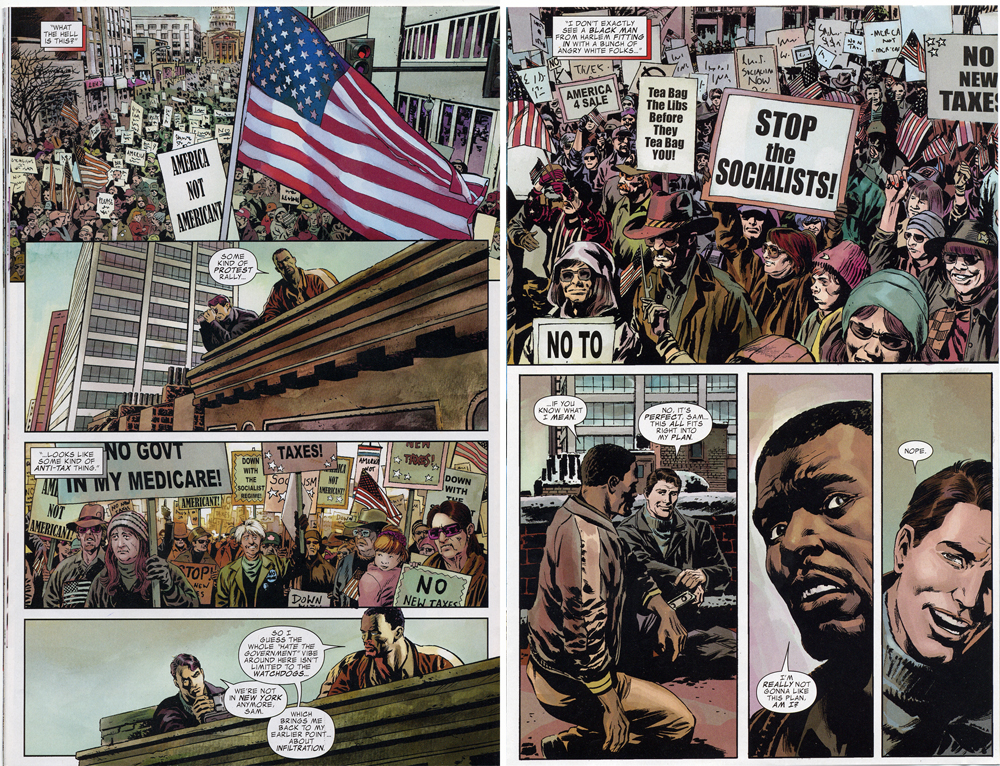
In Captain America 602, Cap and the Falcon pursue the evil, intolerant, right-wing group the Watchdogs to that hotbed of subversion, Idaho. While there, they find the streets full of Tea Party protesters. The Falcon (who is black) says, “So I guess this whole ‘hate the government’ vibe around here isn’t limited to the Watchdogs.” and “I don’t exactly see a black man from Harlem fitting in with a bunch of angry white folks." See it for yourself here.
Marvel's Editor in Chief, Joe Quesada, apologized for the protest signs that clearly identified the protesters as Tea Party members. He explained that it was a last minute addition. Someone realized that some of the signs were blank and had a letterer fill them in quickly. He stressed that the letterer is apolitical and didn't realize how it would be taken.
That's fine as far as it goes but it completely misses a couple of other points. Since the Tea Party began last year, the left has characterized it as being a racist reaction to a black president. So what did Marvel do? They sent Captain America after some racists and he finds the streets of fly-over country full of anti-government, angry whites (at least they threw some women in). This comes across as an affirmation of everything bad the left has said about the Tea Party and Quesada didn't even realize it. Making the protest more generic would not remove the message that "red" states are full of angry white bigots.
I hate it when a general medium starts preaching or being judgmental, especially when they use someone like Captain America to do it. Steve Englehart did the same thing during Watergate. A master villain turned out to be Nixon (it was only implied but there was no doubt). After being revealed, he ran into the White House and killed himself. Steve Rogers gave up being Captain America for some time after that. It was a poor storyline.
After the Iran/Contra scandal, some operatives in the basement of the White House tried to force Captain America to take his orders. Steve Rogers refused and stopped being Captain America again. This plot was more balanced. Rogers got to be Cap again after President Reagan stumbled on the operation and ordered them to end it.
Marvel's Editor in Chief, Joe Quesada, apologized for the protest signs that clearly identified the protesters as Tea Party members. He explained that it was a last minute addition. Someone realized that some of the signs were blank and had a letterer fill them in quickly. He stressed that the letterer is apolitical and didn't realize how it would be taken.
That's fine as far as it goes but it completely misses a couple of other points. Since the Tea Party began last year, the left has characterized it as being a racist reaction to a black president. So what did Marvel do? They sent Captain America after some racists and he finds the streets of fly-over country full of anti-government, angry whites (at least they threw some women in). This comes across as an affirmation of everything bad the left has said about the Tea Party and Quesada didn't even realize it. Making the protest more generic would not remove the message that "red" states are full of angry white bigots.
I hate it when a general medium starts preaching or being judgmental, especially when they use someone like Captain America to do it. Steve Englehart did the same thing during Watergate. A master villain turned out to be Nixon (it was only implied but there was no doubt). After being revealed, he ran into the White House and killed himself. Steve Rogers gave up being Captain America for some time after that. It was a poor storyline.
After the Iran/Contra scandal, some operatives in the basement of the White House tried to force Captain America to take his orders. Steve Rogers refused and stopped being Captain America again. This plot was more balanced. Rogers got to be Cap again after President Reagan stumbled on the operation and ordered them to end it.
Wednesday, February 10, 2010
Blizzards and Global Warming
Washington DC is covered in snow. A new record has been set. Does this mean that global warming has stopped? Or is the unusual snowfall actually caused by global warming?
I'll take the second question first - did global warming cause the massive snowstorm?
Is that what happened here? No. A 2003 study has little to do with actual conditions in 2010. Remember, the northern hemisphere spent January in a cold wave unseen since the 1970s. But that isn't where these storms came from, anyway. They came from the south.
There are some problems in this statement, also. It conflated storms tracking further north than previously with warming air without bothering to establish any connection between the two. What we are left with is that these storms would ordinarily have tracked further south where they would have dumped their moisture as rain instead of snow. Was this caused by global warming or by natural, cyclical changed like the multi-decadal oscillations? You aren't going to even hear this as a possibility.
So what does this mean for global warming? Nothing. Its a weather event, not a climate. To quote RFK jr:
There is a very real possibility that we have been watching the tide come in and assuming that the land is sinking when it is just the tide. Kennedy will not admit it but there is some evidence that the tide peaked a few years ago and is on the way out. In the meantime, global warming alarmists are trying to have it both ways. A lack of snow in Canada and a surplus of snow in DC are both given as signs of global warming. They are not. Weather happens and records are broken.
I'll take the second question first - did global warming cause the massive snowstorm?
But as far as winter storms go, shouldn't climate change make it too warm for snow to fall? Eventually that is likely to happen - but probably not for a while. In the meantime, warmer air could be supercharged with moisture and, as long as the temperature remains below 32°F, it will result in blizzards rather than drenching winter rainstorms. And while the mid-Atlantic has borne the brunt of the snowfall so far this winter, areas near lakes may get hit even worse. As global temperatures have risen, the winter ice cover over the Great Lakes has shrunk, which has led to even more moisture in the atmosphere and more snow in the already hard-hit Great Lakes region, according to a 2003 study in the Journal of Climate. (Read "Climate Accord Suggests a Global Will, if Not a Way.")
Is that what happened here? No. A 2003 study has little to do with actual conditions in 2010. Remember, the northern hemisphere spent January in a cold wave unseen since the 1970s. But that isn't where these storms came from, anyway. They came from the south.
But there have been hints that it was coming. The 2009 U.S. Climate Impacts Report found that large-scale cold-weather storm systems have gradually tracked to the north in the U.S. over the past 50 years. While the frequency of storms in the middle latitudes has decreased as the climate has warmed, the intensity of those storms has increased. That's in part because of global warming - hotter air can hold more moisture, so when a storm gathers it can unleash massive amounts of snow. Colder air, by contrast, is drier; if we were in a truly vicious cold snap, like the one that occurred over much of the East Coast during parts of January, we would be unlikely to see heavy snowfall.
There are some problems in this statement, also. It conflated storms tracking further north than previously with warming air without bothering to establish any connection between the two. What we are left with is that these storms would ordinarily have tracked further south where they would have dumped their moisture as rain instead of snow. Was this caused by global warming or by natural, cyclical changed like the multi-decadal oscillations? You aren't going to even hear this as a possibility.
So what does this mean for global warming? Nothing. Its a weather event, not a climate. To quote RFK jr:
...If you sit on a beach for a few minutes and watch the waves come in, you'll see lots of waves of different sizes. If you sit there for six hours, you'll see the tides going in and out. ...
There is a very real possibility that we have been watching the tide come in and assuming that the land is sinking when it is just the tide. Kennedy will not admit it but there is some evidence that the tide peaked a few years ago and is on the way out. In the meantime, global warming alarmists are trying to have it both ways. A lack of snow in Canada and a surplus of snow in DC are both given as signs of global warming. They are not. Weather happens and records are broken.
Obama, the Campaign Worker and the T Shirt
This was part of a recent speech given by President Obama:
There is a lot more to this than the President is telling and these details tell us everything about Obamacare.
The missing details are that she did have some health care - she had catastrophic care coverage which has a very high deductible. Why didn't she have better insurance? Because she and her husband were using all available cash to start up a business. Like many young people, they took a gamble. They got enough insurance to cover a major illness and hoped that nothing else would come up.
She took a second, more serious gamble. She knew that she had breast lumps and she gambled that they were harmless. There are unknowns here. Would she have had the lumps checked in time if she had insurance that covered doctor visits and testing? Maybe so, maybe not. Regardless, by the time her cancer was diagnosed, it had spread all over her body.
She did have Medicaid by then but she was told that one treatment her doctor recommended was not covered. The article I linked to doesn't say what it was. It may have been an experimental program - lots of people enroll in these. It may have been something more mainstream. Whatever it was, she was already doomed. Once cancer stats invading multiple organs it is unstoppable by today's medicine.
So, where does Obamacare fit into this? If it had passed then she would either have put her money into insurance instead of her business or she would have still gone for the catastrophic policy and paid the fine for being under-insured. No one with enough money to start a business should be getting government assistance in paying for coverage. That might sound cruel, but that's how Obamacare will work. A very large percentage of the people it is aimed at will be required to purchase coverage but will not get any assistance for it.
I doubt that this is what she expected or why she wanted to be buried in her Obama T shirt. I suspect that, like many supporters of health care reform, she thought that the government would pay for her insurance. Since she government gets its money from other people, she wanted other people to pay for her insurance. That isn't going to happen with Obamacare for most of the uninsured. There just isn't enough money.
So we have a woman who died believing that Obama would deliver something that he will not and Obama is using her belief in him to try to shame the country into passing Obamacare.
Can we wrap this legislation in an Obama T shirt and bury it, too?
I got a letter -- I got a note today from one of my staff -- they forwarded it to me -- from a woman in St. Louis who had been part of our campaign, very active, who had passed away from breast cancer. She didn't have insurance. She couldn't afford it, so she had put off having the kind of exams that she needed. And she had fought a tough battle for four years. All through the campaign she was fighting it, but finally she succumbed to it. And she insisted she's going to be buried in an Obama t-shirt.
There is a lot more to this than the President is telling and these details tell us everything about Obamacare.
The missing details are that she did have some health care - she had catastrophic care coverage which has a very high deductible. Why didn't she have better insurance? Because she and her husband were using all available cash to start up a business. Like many young people, they took a gamble. They got enough insurance to cover a major illness and hoped that nothing else would come up.
She took a second, more serious gamble. She knew that she had breast lumps and she gambled that they were harmless. There are unknowns here. Would she have had the lumps checked in time if she had insurance that covered doctor visits and testing? Maybe so, maybe not. Regardless, by the time her cancer was diagnosed, it had spread all over her body.
She did have Medicaid by then but she was told that one treatment her doctor recommended was not covered. The article I linked to doesn't say what it was. It may have been an experimental program - lots of people enroll in these. It may have been something more mainstream. Whatever it was, she was already doomed. Once cancer stats invading multiple organs it is unstoppable by today's medicine.
So, where does Obamacare fit into this? If it had passed then she would either have put her money into insurance instead of her business or she would have still gone for the catastrophic policy and paid the fine for being under-insured. No one with enough money to start a business should be getting government assistance in paying for coverage. That might sound cruel, but that's how Obamacare will work. A very large percentage of the people it is aimed at will be required to purchase coverage but will not get any assistance for it.
I doubt that this is what she expected or why she wanted to be buried in her Obama T shirt. I suspect that, like many supporters of health care reform, she thought that the government would pay for her insurance. Since she government gets its money from other people, she wanted other people to pay for her insurance. That isn't going to happen with Obamacare for most of the uninsured. There just isn't enough money.
So we have a woman who died believing that Obama would deliver something that he will not and Obama is using her belief in him to try to shame the country into passing Obamacare.
Can we wrap this legislation in an Obama T shirt and bury it, too?
Friday, February 05, 2010
Pro-Choice and the Superbowl Ad
This year's Superbowl will include an ad concerning abortion. The ad has not been shown yet but here is a description of it:
Predictably, the women's movement is outraged. Here's an example from the Huffington Post:
From the description, the ad is designed to sway a woman who is considering an abortion to have the baby. It says nothing about outlawing abortion. It simply advocates a choice. That's not how the women's groups see it. To them, any message that is not in favor of an abortion must be anti-choice.
This aspect of the women's movement has bothered me for decades. They call themselves "pro-choice" but, to them, the choice is always to have an abortion. They do not want a choice, they want an abortion. The term "pro-choice" is for public relations, only. Their real agenda is pro-abortion. They see children as nothing more than a drag on a woman's career. Usually this aspect of the movement is well-disguised but every now and then it shows itself in all its ugliness.
There is nothing in the ad that conflicts with this. The choice still remains with the woman. The ad is nothing but a reminder that the alternative to an abortion is a living human being who can go on to make his mother proud.
Update: The actual ad is so innocuous that you can blink and miss its message. All of the fuss in advance probably did far more to advance its message than the actual ad.
The ad shows Tebow and his mother Pam discussing her decision not to end a difficult pregnancy in 1987. Pam carried the baby to term against her doctors' recommendations, and her child grew up to be the Heisman-trophy winning University of Florida quarterback, who many consider the best college football player in a generation.
Predictably, the women's movement is outraged. Here's an example from the Huffington Post:
The Women's Media Center and a coalition of organizations dedicated to reproductive rights, tolerance, and social justice is calling on CBS and the NFL to pull Focus on the Family's anti-choice propaganda ad. We do not have to see the ad to know Focus on the Family's real agenda. While pretending its message is a "celebration of life," their true intent is to have the government intrude in women's reproductive health decisions. The subliminal messaging of the ad is also a thinly veiled effort to shame the one in three American women who have an abortion and a dangerous suggestion that choosing to carry a pregnancy to term -- regardless of the risks -- is the right decision for all women.
From the description, the ad is designed to sway a woman who is considering an abortion to have the baby. It says nothing about outlawing abortion. It simply advocates a choice. That's not how the women's groups see it. To them, any message that is not in favor of an abortion must be anti-choice.
Focus on the Family's ad is surrealistic in its argument that a woman who chooses not to have a child may be depriving the Super Bowl of a football player. It uses one family's story to dictate morality to the American public, and encourages young women to disregard medical advice, putting their lives at risk.In general, I am pro-choice but that means that the choice can go either way. I find it surrealistic that anything that does not urge a woman to have an abortion is anti-choice.
This aspect of the women's movement has bothered me for decades. They call themselves "pro-choice" but, to them, the choice is always to have an abortion. They do not want a choice, they want an abortion. The term "pro-choice" is for public relations, only. Their real agenda is pro-abortion. They see children as nothing more than a drag on a woman's career. Usually this aspect of the movement is well-disguised but every now and then it shows itself in all its ugliness.
Focus on the Family's ad goes against the approximately 70% majority American view that reproductive decisions should be left up to a woman and her physician; against the decision by the U.S. Supreme Court that such decisions are protected by a constitutionally guaranteed right to privacy;...
There is nothing in the ad that conflicts with this. The choice still remains with the woman. The ad is nothing but a reminder that the alternative to an abortion is a living human being who can go on to make his mother proud.
Update: The actual ad is so innocuous that you can blink and miss its message. All of the fuss in advance probably did far more to advance its message than the actual ad.
Thursday, February 04, 2010
Who Is Rich?
Who is rich? This topic comes up regularly, mainly when Democrats draw a lower limit on who is wealthy and therefore whould be punished for it through higher taxes. Democrats have set the limit as low as $100,000 per year but President Obama has consistently set it at $250,000 per year. Daniel Gross of Newsweek and Slate recently chimed in that, yes indeed, $250,000 per year makes you rich. His case is in two parts. The first one is a numbers game - if you are making five times the median income and more than 98% of the population then you must be rich. The second is that someone with this income level can afford to live in the most expensive communities although he admits that it would be a stretch.
I've written about this before, also and I have two rebuttals.
First, annual income is a poor indicator of wealth. Total assets is a much better indicator. Who is richer - someone who makes $250,000 per year but has a mortgage on his $4,000,000 house or someone who makes $250,000 per year and owns his $4,000,000 house outright? Or someone who makes $200,000 per year but owns a $5,000,0000 house outright? Obama and Gross count the first two as being identically rich and the third one as being middle-class.
Second, even if you make more than 98% of the population, you still can't live like someone who is rich. You might be able to afford a McMansion (with a mortgage) but you cann't afford a palatial spread like Al Gore or John Edwards. You might be able to afford an illegal immigrant cleaning woman but you aren't going to have a full-time staff. You can afford a private plane as long as it's a Cesna and you fly it yourself but you are not going to be collecting jets like John Travolta.
The truly rich are not the upper 2% of the population, they are the upper 0.1% of the population. They make many times $250,000.
Clearly, Obama, the Democrats, and Gross are playing with statistics in order to inflate the number of rich. Why? Because there are not enough truly rich to fill their coffers. This is all class warfare games. Obama needs more taxes so he is trying to hit a sweet spot where he gets enough taxes to be useful without causing a tax revolt.
I've written about this before, also and I have two rebuttals.
First, annual income is a poor indicator of wealth. Total assets is a much better indicator. Who is richer - someone who makes $250,000 per year but has a mortgage on his $4,000,000 house or someone who makes $250,000 per year and owns his $4,000,000 house outright? Or someone who makes $200,000 per year but owns a $5,000,0000 house outright? Obama and Gross count the first two as being identically rich and the third one as being middle-class.
Second, even if you make more than 98% of the population, you still can't live like someone who is rich. You might be able to afford a McMansion (with a mortgage) but you cann't afford a palatial spread like Al Gore or John Edwards. You might be able to afford an illegal immigrant cleaning woman but you aren't going to have a full-time staff. You can afford a private plane as long as it's a Cesna and you fly it yourself but you are not going to be collecting jets like John Travolta.
The truly rich are not the upper 2% of the population, they are the upper 0.1% of the population. They make many times $250,000.
Clearly, Obama, the Democrats, and Gross are playing with statistics in order to inflate the number of rich. Why? Because there are not enough truly rich to fill their coffers. This is all class warfare games. Obama needs more taxes so he is trying to hit a sweet spot where he gets enough taxes to be useful without causing a tax revolt.
Monday, February 01, 2010
The IPCC and the WWF
A couple of weeks ago it came out that part of the IPCC's 2007 report was exaggerated. The report claimed that Himalayan glaciers would melt completely by 2035 and it claimed a 90% confidence in that claim. It turned out that this claim started as an off-the-cuff remark by an activist. It was included in an article and picked up by a position paper put out by the World Wildlife Fund (WWF). The truth is that it is impossible for the glaciers to melt that fast and only a small subset of the Himalayan glaciers are even being monitored.
The IPCC claimed that this was a last-minute addition to the report which had bypassed the normal review process. That left the hanging question, was this an isolated incident? The answer is that it was not isolated.
The IPCC report claimed that 40% of the world's rain forests will be destroyed by global warming. The basis for this claim? Another paper produced by the WWF. Again, the WWF quoted a paper that was fundamentally flawed. In this case, it used figures from logging and drought and applied them to climate.
When the IPCC report report was released in 2007, there were rumors that the original draft hadn't been scary enough and that they were under pressure to make global warming sound much more dangerous and to assign confidence levels to the findings. I'm going to take the IPCC's word that the glacier claim was a last-minute addition and I'm going to speculate that the rain forest claim was a similar late addition.
The implication is that the original report was not going to force governments to make fundamental and painful changes. The authors of the various chapters were told to go back and include worst-case projections as the most likely. They may have been given a stack of WWF position papers. Regardless, bad information from pressure groups found its way into at least two chapters of the IPCC report.
It should come as no surprise that the WWF cherry-picks its figures to make a stronger case than the evidence supports. What is surprising is that anyone from the IPCC would rely on these papers. This should call into question everything in the IPCC report.
UPDATE: As I expected, there are dozens of places where the IPCC's only cited source is the WWF. See Donna Laframboise's blog for details.
UPDATE 2: Remember Climategate - the leaked emails from the prestigious Climate Research Unit of East Anglia University? The Guardian has poured through them and found that the figures the IPCC used for China were seriously flawed. China doesn't have a lot of weather stations. The question was how man of them were influenced by urban expansion as opposed to climate change. The IPCC relied on a paper that had problems. The words "screwed up" were used. This is the first real link between the leaked emails and the IPCC but, in the tiny world of climatologists, it probably will not be the last one.
The IPCC claimed that this was a last-minute addition to the report which had bypassed the normal review process. That left the hanging question, was this an isolated incident? The answer is that it was not isolated.
The IPCC report claimed that 40% of the world's rain forests will be destroyed by global warming. The basis for this claim? Another paper produced by the WWF. Again, the WWF quoted a paper that was fundamentally flawed. In this case, it used figures from logging and drought and applied them to climate.
When the IPCC report report was released in 2007, there were rumors that the original draft hadn't been scary enough and that they were under pressure to make global warming sound much more dangerous and to assign confidence levels to the findings. I'm going to take the IPCC's word that the glacier claim was a last-minute addition and I'm going to speculate that the rain forest claim was a similar late addition.
The implication is that the original report was not going to force governments to make fundamental and painful changes. The authors of the various chapters were told to go back and include worst-case projections as the most likely. They may have been given a stack of WWF position papers. Regardless, bad information from pressure groups found its way into at least two chapters of the IPCC report.
It should come as no surprise that the WWF cherry-picks its figures to make a stronger case than the evidence supports. What is surprising is that anyone from the IPCC would rely on these papers. This should call into question everything in the IPCC report.
UPDATE: As I expected, there are dozens of places where the IPCC's only cited source is the WWF. See Donna Laframboise's blog for details.
UPDATE 2: Remember Climategate - the leaked emails from the prestigious Climate Research Unit of East Anglia University? The Guardian has poured through them and found that the figures the IPCC used for China were seriously flawed. China doesn't have a lot of weather stations. The question was how man of them were influenced by urban expansion as opposed to climate change. The IPCC relied on a paper that had problems. The words "screwed up" were used. This is the first real link between the leaked emails and the IPCC but, in the tiny world of climatologists, it probably will not be the last one.
Tuesday, January 26, 2010
The Republicans' Dilemma
The Republicans are rising in the polls. A Republican won a Senate seat in Massachusetts that had been in Democratic hands for a century. Things are looking up for the Republicans. The only thing is, they didn't have anything to do with this rise.
The Republicans lost favor four years ago because of several factors. A big one was President George W. Bush. By his sixth year, Bush was a drag on the ticket. The war in Iraq also hurt them. The public was sick of it. They were spending like Democrats (you know that the Republican Party has lost its way when Nancy Pelosi can run as a fiscal conservative with a straight face). What hurt them the most, though, was corruption and scandal. Multiple scandals gave the impression that the whole party was corrupt.
This not only influenced independents, it also dispirited the Republican base and drive a wedge between Republicans and their natural allies, the Libertarians. Many high-profile Libertarians voted for Obama as a protest vote against McCain's record as a big government Republican. This is nothing new. Bush was far more centrist than he is given credit for and the conservative purists never forgave him for it. Similarly, Gore lost a lot of votes because of Clinton's centrism.
The Republicans have not redeemed themselves in the last four years. Rather, the Democrats have torn themselves down.
A year ago the Democrats announced their "wave" strategy. They would bring their entire agenda to a vote as quickly as possible starting with small pieces. As the legislation passed and the public saw progress, the Democrats' agenda would gain popularity forcing Republicans to either start voting with the Democrats or put themselves on record as being against popular reforms.
Obviously the wave didn't work. The Democrats thought that their success in 2006 and 2008 meant that the country had moved to the left. They were wrong. Much of the country was against their agenda. The rest was amazed at the Democrats' tone-deafness. Unemployment and the economy were the top two priorities for nearly everyone not in the Democratic Caucus. The more the Democrats focused on their agenda the more out-of-touch they seemed.
On top of that, the Democrats' execution of their wave strategy was flawed. The idea was to build on successes but they ended up tripping over themselves in the news cycles. They would pass something and move on. By the time Obama signed it into law, they had begun something new. Newcasts prefer the drama of open debate over Presidential signing ceremonies. It was easy for the successes to get lost in the noise. And none of the successes were pure. Credit card reform should have been popular but the Democrats gave the banks major concessions including six months to implement the new rules. The result is that most people saw their credit card rates go up because of Congress. The Stimulus was supposed to be "pork free" but simply hid it better than most bills. Nearly a year later, most people think that it was a failure.
While the Democrats were tearing themselves down, the Republicans stayed on the sidelines, voting against Obama. This is a tactic, not a strategy.
Come November, the Republicans are going to have to stand for something more than a "no" vote. Right now the Tea Party movement is the most vocal in the country and they have not forgiven the Republicans for their spending excesses durng the Bush years. The Republicans are going to have to come to terms with the Tea Party if they want to win. They are also going to have to exercise some discipline if they want to stay in power once they regain it.
The Republicans lost favor four years ago because of several factors. A big one was President George W. Bush. By his sixth year, Bush was a drag on the ticket. The war in Iraq also hurt them. The public was sick of it. They were spending like Democrats (you know that the Republican Party has lost its way when Nancy Pelosi can run as a fiscal conservative with a straight face). What hurt them the most, though, was corruption and scandal. Multiple scandals gave the impression that the whole party was corrupt.
This not only influenced independents, it also dispirited the Republican base and drive a wedge between Republicans and their natural allies, the Libertarians. Many high-profile Libertarians voted for Obama as a protest vote against McCain's record as a big government Republican. This is nothing new. Bush was far more centrist than he is given credit for and the conservative purists never forgave him for it. Similarly, Gore lost a lot of votes because of Clinton's centrism.
The Republicans have not redeemed themselves in the last four years. Rather, the Democrats have torn themselves down.
A year ago the Democrats announced their "wave" strategy. They would bring their entire agenda to a vote as quickly as possible starting with small pieces. As the legislation passed and the public saw progress, the Democrats' agenda would gain popularity forcing Republicans to either start voting with the Democrats or put themselves on record as being against popular reforms.
Obviously the wave didn't work. The Democrats thought that their success in 2006 and 2008 meant that the country had moved to the left. They were wrong. Much of the country was against their agenda. The rest was amazed at the Democrats' tone-deafness. Unemployment and the economy were the top two priorities for nearly everyone not in the Democratic Caucus. The more the Democrats focused on their agenda the more out-of-touch they seemed.
On top of that, the Democrats' execution of their wave strategy was flawed. The idea was to build on successes but they ended up tripping over themselves in the news cycles. They would pass something and move on. By the time Obama signed it into law, they had begun something new. Newcasts prefer the drama of open debate over Presidential signing ceremonies. It was easy for the successes to get lost in the noise. And none of the successes were pure. Credit card reform should have been popular but the Democrats gave the banks major concessions including six months to implement the new rules. The result is that most people saw their credit card rates go up because of Congress. The Stimulus was supposed to be "pork free" but simply hid it better than most bills. Nearly a year later, most people think that it was a failure.
While the Democrats were tearing themselves down, the Republicans stayed on the sidelines, voting against Obama. This is a tactic, not a strategy.
Come November, the Republicans are going to have to stand for something more than a "no" vote. Right now the Tea Party movement is the most vocal in the country and they have not forgiven the Republicans for their spending excesses durng the Bush years. The Republicans are going to have to come to terms with the Tea Party if they want to win. They are also going to have to exercise some discipline if they want to stay in power once they regain it.
Monday, January 25, 2010
Democrats' Dilemma
A year ago, in the wake of the inauguration of Barack Obama, Democrats told themselves that they were the wave of the future - that the Republicans were doomed to be an increasingly regional party representing a single, shrinking ethnic group (white men). When the Tea Party protests started, they told themselves that this was nothing but racist whites protesting a black president. The first couple of special elections went the Democrats' way, bolstering their opinions. When polls showed that their popularity in general and their agenda in specific were unpopular they ignored it.
In the November elections the Democrats lost two governorships but gained a house seat in an unusual special election. Democrats pointed out that those states usually elected a governor from the party not in the White House and insisted that the special election was more important.
With last week's special election for Ted Kennedy's seat, Democrats finally have to face reality. They and their policies are deeply unpopular. The question is if they can rebuild the party's image in nine months?
There are significant obstacles. In 2006 they ran promising to end the war, balance the budget, and, possibly, impeach Bush. None of that happened. Bush was too powerful, they said. They had to have their own man in the White House in order to effect change.
In 2008 they ran on a platform of ending the war, balancing the budget, universal health care, and general change. They won the White House and the biggest majorities in both houses seen in generations. This time they can no longer run on promises. They have to run on results and things don't look good for them.
Last week, President Obama said that the same voter discontent that swept him into office also swept Brown into the Senate. On the face of it, this is a strange remark but I think that he has a point. Fiscal conservatives were unhappy during most of Bush's administration. He took a surplus and turned it into a deficit. Granted, he had an economic downturn and a couple of wars that were not included in the projections he inherited from Clinton, but spending under Bush went way up. This was a source of irritation rather than a cause until 2008 but the Democrats included it in their campaigns, anyway. It worked. Many Libertarians voted for Obama, figuring that he would spend less than McCain.
Things changed in the Fall of 2008. Between bailouts and the TARP, voters were suddenly shocked by the sums being thrown around. Obama continued and expanded this. The Democrats held off passing the 2009 budget until Obama was in office because it was so bloated that Bush would never have signed it but Obama never batted an eye. Leading economic authorities including some on Obama's team had previously said that government stimulus spending had never worked because it was never spent in the right place at the right time. Obama and the Democrats ignored history and passed a huge stimulus.
Then their is the health care bill which is in limbo right now. Obama called it a significant deficit reduction tool but anyone who has been paying attention knows that it employs budgeting tricks and future, unnamed cuts. In reality, it will increase the deficit.
So, right now, the most motivated group of voters is the Tea Party. These are people who are outraged by the growth of government and debt. By themselves, this group would be more of an annoyance than a threat. That's where the Democrats' record hurts them. They made a lot of promises in the last few years and delivered on very few. Even if health care passes, it is so far from what the Democrats' base expected that most are calling it useless. Obama's other major initiative, green energy, seems doomed to the same fate. Plus the war in Iraq is winding down on Bush's terms and the war in Afghanistan has escalated. None of this is going to energize the Progressive left to turn out and vote.
Finally, there is the great mass of voters who are not committed to specific ideals. Their biggest priority is unemployment and has been all year. Obama ignored this. All these people have heard from Washington since July has been the push for health care reform (and it's been confusing and ugly). Even when the House passed a massive jobs bill, the news was overshadowed by the Senate health care debate and hardly anyone knows about it.
Obama is trying to recalibrate himself against bankers and big business and for the middle class. His record is going to hurt him here. His first year was typified by bailouts and deals.
To further complicate things, anything that Obama does to mollify the Tea Party will outrage the Progressives and vice versa. Tax credits for child care are all well and good, if they actually pass, but they will not bring the unemployment rate down.
Obama is talking about a commission to find ways to balance the budget but it will not meet until after the election. It may end up being more smoke and mirrors when Obama needs some popular successes.
In the November elections the Democrats lost two governorships but gained a house seat in an unusual special election. Democrats pointed out that those states usually elected a governor from the party not in the White House and insisted that the special election was more important.
With last week's special election for Ted Kennedy's seat, Democrats finally have to face reality. They and their policies are deeply unpopular. The question is if they can rebuild the party's image in nine months?
There are significant obstacles. In 2006 they ran promising to end the war, balance the budget, and, possibly, impeach Bush. None of that happened. Bush was too powerful, they said. They had to have their own man in the White House in order to effect change.
In 2008 they ran on a platform of ending the war, balancing the budget, universal health care, and general change. They won the White House and the biggest majorities in both houses seen in generations. This time they can no longer run on promises. They have to run on results and things don't look good for them.
Last week, President Obama said that the same voter discontent that swept him into office also swept Brown into the Senate. On the face of it, this is a strange remark but I think that he has a point. Fiscal conservatives were unhappy during most of Bush's administration. He took a surplus and turned it into a deficit. Granted, he had an economic downturn and a couple of wars that were not included in the projections he inherited from Clinton, but spending under Bush went way up. This was a source of irritation rather than a cause until 2008 but the Democrats included it in their campaigns, anyway. It worked. Many Libertarians voted for Obama, figuring that he would spend less than McCain.
Things changed in the Fall of 2008. Between bailouts and the TARP, voters were suddenly shocked by the sums being thrown around. Obama continued and expanded this. The Democrats held off passing the 2009 budget until Obama was in office because it was so bloated that Bush would never have signed it but Obama never batted an eye. Leading economic authorities including some on Obama's team had previously said that government stimulus spending had never worked because it was never spent in the right place at the right time. Obama and the Democrats ignored history and passed a huge stimulus.
Then their is the health care bill which is in limbo right now. Obama called it a significant deficit reduction tool but anyone who has been paying attention knows that it employs budgeting tricks and future, unnamed cuts. In reality, it will increase the deficit.
So, right now, the most motivated group of voters is the Tea Party. These are people who are outraged by the growth of government and debt. By themselves, this group would be more of an annoyance than a threat. That's where the Democrats' record hurts them. They made a lot of promises in the last few years and delivered on very few. Even if health care passes, it is so far from what the Democrats' base expected that most are calling it useless. Obama's other major initiative, green energy, seems doomed to the same fate. Plus the war in Iraq is winding down on Bush's terms and the war in Afghanistan has escalated. None of this is going to energize the Progressive left to turn out and vote.
Finally, there is the great mass of voters who are not committed to specific ideals. Their biggest priority is unemployment and has been all year. Obama ignored this. All these people have heard from Washington since July has been the push for health care reform (and it's been confusing and ugly). Even when the House passed a massive jobs bill, the news was overshadowed by the Senate health care debate and hardly anyone knows about it.
Obama is trying to recalibrate himself against bankers and big business and for the middle class. His record is going to hurt him here. His first year was typified by bailouts and deals.
To further complicate things, anything that Obama does to mollify the Tea Party will outrage the Progressives and vice versa. Tax credits for child care are all well and good, if they actually pass, but they will not bring the unemployment rate down.
Obama is talking about a commission to find ways to balance the budget but it will not meet until after the election. It may end up being more smoke and mirrors when Obama needs some popular successes.
Thursday, January 21, 2010
The Case of the non-Disappearing Glaciers
The IPCC's 2007 report said that the Himalayan glaciers would completely melt by 2035. It even gave this a high degree of confidence (90%). Recently, they had to backtrack on this claim. What happened should cast doubt on the IPCC as a whole.
The Himalaya claim originally came from an article in New Scientist which is not peer reviewed. It quoted an Indian scientist named Jawaharlal Nehru who had mentioned that the glaciers would melt in 30 years in a phone interview. It turns out that Nehru had not done any actual studies to back this claim. He was exaggerating to make a point. What is more, he was only talking about a small part of the Himalayan glaciers.
It's bad enough that this claim made its way into an IPCC report but the route that it took is the real scandal. The author of the offending chapter took his figures from a campaign report put out by the World Wildlife Fund. It turns out that the person writing the chapter did not have any expertise on glaciers and, rather than research peer-reviewed literature, he turned to a summary produced by an advocacy group. The WWF obviously cherry-picked their data since they were relying on publications that were not peer-reviewed.
Despite the sloppy science behind the claim, the IPCC still gave it a 90% confidence rating. When the utter impossibility of the claim was brought up, Rajendra Pachauri, the head of the IPCC dismissed the challenges as "voodoo science".
For years we have been told that the IPCC was made up of disinterested scientists who were the best experts on climate. If anyone dared express skepticism, he was branded a Climate Change Denier. This recent article dismisses TV skeptical meteorologists as deniers who get their information from right-wing talk shows instead of from real scientists.
This whole episode shows that the IPCC reports are written by people who are no better informed and who quote left-wing sources. Granted this is one small example but there is no guarantee that the rest of the IPCC report represents any better science. Former members of the IPCC have complained for years that the reports are written by ideologues who reject valid challenges to their interpretation of the data.
UPDATE: It gets worse. The scientist in question knew that he was including unverified data but stuck it in anyway in order to apply political pressure.
The Himalaya claim originally came from an article in New Scientist which is not peer reviewed. It quoted an Indian scientist named Jawaharlal Nehru who had mentioned that the glaciers would melt in 30 years in a phone interview. It turns out that Nehru had not done any actual studies to back this claim. He was exaggerating to make a point. What is more, he was only talking about a small part of the Himalayan glaciers.
It's bad enough that this claim made its way into an IPCC report but the route that it took is the real scandal. The author of the offending chapter took his figures from a campaign report put out by the World Wildlife Fund. It turns out that the person writing the chapter did not have any expertise on glaciers and, rather than research peer-reviewed literature, he turned to a summary produced by an advocacy group. The WWF obviously cherry-picked their data since they were relying on publications that were not peer-reviewed.
Despite the sloppy science behind the claim, the IPCC still gave it a 90% confidence rating. When the utter impossibility of the claim was brought up, Rajendra Pachauri, the head of the IPCC dismissed the challenges as "voodoo science".
For years we have been told that the IPCC was made up of disinterested scientists who were the best experts on climate. If anyone dared express skepticism, he was branded a Climate Change Denier. This recent article dismisses TV skeptical meteorologists as deniers who get their information from right-wing talk shows instead of from real scientists.
This whole episode shows that the IPCC reports are written by people who are no better informed and who quote left-wing sources. Granted this is one small example but there is no guarantee that the rest of the IPCC report represents any better science. Former members of the IPCC have complained for years that the reports are written by ideologues who reject valid challenges to their interpretation of the data.
UPDATE: It gets worse. The scientist in question knew that he was including unverified data but stuck it in anyway in order to apply political pressure.
The scientist behind the bogus claim in a Nobel Prize-winning UN report that Himalayan glaciers will have melted by 2035 last night admitted it was included purely to put political pressure on world leaders.
Dr Murari Lal also said he was well aware the statement, in the 2007 report by the Intergovernmental Panel on Climate Change (IPCC), did not rest on peer-reviewed scientific research.
This is exactly what the skeptics have been saying since the last IPCC report came out - that it included exaggerations and flawed science for political reasons.
What's the Matter With Massachusetts?
After the 2004 election a book was published called What's the Matter With Kansas? It was later turned into a movie. It's premise is that the Democrats actually represent the best interests of the people of Kansas but the Republicans kept exploiting wedge issues that didn't actually matter to most people to win elections. This was very comforting to Democrats since its message was that there was nothing wrong with their basic values. They just needed to package them better. Barack Obama was a big believer in this book.
Now the same sort of reasoning is being applied to Massachusetts. The vote wasn't really a rejection of health care so Democrats don't need to adjust their plans. An example of this reasoning is How Romneycare killed Obamacare by Timothy Noah in Slate.
First, a little background - Massachusetts already has a form of universal health care. It served as a model for the legislation being considered nationally. So, the fact that the people of Massachusetts have personal experience with the system and elected someone who promised to stop it on a national level should be proof that it is a bad idea, right? Not to Noah.
Noah quotes some exit polls which show that health care was the most important issue to voters. 56% placed it as their top concern, well ahead of the 25% who put the economy first. Noah then quotes a different poll that puts the number of voters who are against Obamacare at 52%. Not an overwhelming majority, but a percentage that matches Brown's share of the vote.
So far, so good. A majority of Massachusetts don't like universal health care.
Noah doesn't stop there (he can't or he wouldn't have a point). He goes on to quote some statistics on Romneycare. 60% supported it when it passed. This grew to 69% in 2008. These polls are meaningless to the current debate. Noah just threw them in to make Romneycare seem more popular than it currently is. He eventually admits that support has been declining. It was down to 59% in September, 2009 and 54% last week. That's quite a drop - 15% in less than two years. Noah attributes this drop to the economy and concern about rising premium costs. I am less charitable and I think that the drop is because the longer they live with it, the less the people of Massachusetts like it.
Noah also tells us what percentage of doctors like Romneycare which is irrelevant to the election. He just wants us to know how great the program is.
The rest of the article is Noah's attempt to reconcile support for Romneycare with rejection of Obamacare. His conclusion is to think the worst of the people of Massachusetts, that they are selfish.
Actually, there is nothing to reconcile. Noah throws out poll data as if they all came from the same source and covered the same people. They do not. Consider - 54% of the total population of Massachusetts still favor Romneycare but 52% of the people who voted are against Obamacare. Keep in mind that the actual voter turnout was a subset of the total population. No one asked the actual voters if they approved of Romneycare and a significant percentage of Brown's voters (48%) based their vote solely on health care.
I think that Noah has it all wrong. 48% of the people of Massachusetts dislike Romneycare. Elections are not decided by an even distribution of the electorate. They are decided by the people who are motivated to turn out and vote. The people who are happy with Romneycare or feel that Obamacare would not affect them were less likely to turn out. The people who want Romneycare eliminated saw this election as their chance to show their discontent with their system and keep it from spreading.
That's a much more charitable view of the people of Massachusetts. Noah might have had a case if support for Romneycare was still high but with it running nearly even, voter motivation was more likely to be the deciding factor.
Of course this isn't very comforting to the Democrats. They can't shake their heads at the selfish people of Massachusetts who are unwilling to share their great health care system with the rest of the world. Instead they have to recognize that a majority of the people who actually turn out to vote in a very liberal state would rather vote for a Republican than see Obamacare passed.
Now the same sort of reasoning is being applied to Massachusetts. The vote wasn't really a rejection of health care so Democrats don't need to adjust their plans. An example of this reasoning is How Romneycare killed Obamacare by Timothy Noah in Slate.
First, a little background - Massachusetts already has a form of universal health care. It served as a model for the legislation being considered nationally. So, the fact that the people of Massachusetts have personal experience with the system and elected someone who promised to stop it on a national level should be proof that it is a bad idea, right? Not to Noah.
Noah quotes some exit polls which show that health care was the most important issue to voters. 56% placed it as their top concern, well ahead of the 25% who put the economy first. Noah then quotes a different poll that puts the number of voters who are against Obamacare at 52%. Not an overwhelming majority, but a percentage that matches Brown's share of the vote.
So far, so good. A majority of Massachusetts don't like universal health care.
Noah doesn't stop there (he can't or he wouldn't have a point). He goes on to quote some statistics on Romneycare. 60% supported it when it passed. This grew to 69% in 2008. These polls are meaningless to the current debate. Noah just threw them in to make Romneycare seem more popular than it currently is. He eventually admits that support has been declining. It was down to 59% in September, 2009 and 54% last week. That's quite a drop - 15% in less than two years. Noah attributes this drop to the economy and concern about rising premium costs. I am less charitable and I think that the drop is because the longer they live with it, the less the people of Massachusetts like it.
Noah also tells us what percentage of doctors like Romneycare which is irrelevant to the election. He just wants us to know how great the program is.
The rest of the article is Noah's attempt to reconcile support for Romneycare with rejection of Obamacare. His conclusion is to think the worst of the people of Massachusetts, that they are selfish.
In the absence of any other logical explanation, I conclude that Massachusetts voters cast their vote for Scott Brown in the parochial spirit that Miller describes. Bay Staters saw no reason to vote for health care reform because they already had health care reform. Without Romney, that calculation wouldn't have been possible.
Actually, there is nothing to reconcile. Noah throws out poll data as if they all came from the same source and covered the same people. They do not. Consider - 54% of the total population of Massachusetts still favor Romneycare but 52% of the people who voted are against Obamacare. Keep in mind that the actual voter turnout was a subset of the total population. No one asked the actual voters if they approved of Romneycare and a significant percentage of Brown's voters (48%) based their vote solely on health care.
I think that Noah has it all wrong. 48% of the people of Massachusetts dislike Romneycare. Elections are not decided by an even distribution of the electorate. They are decided by the people who are motivated to turn out and vote. The people who are happy with Romneycare or feel that Obamacare would not affect them were less likely to turn out. The people who want Romneycare eliminated saw this election as their chance to show their discontent with their system and keep it from spreading.
That's a much more charitable view of the people of Massachusetts. Noah might have had a case if support for Romneycare was still high but with it running nearly even, voter motivation was more likely to be the deciding factor.
Of course this isn't very comforting to the Democrats. They can't shake their heads at the selfish people of Massachusetts who are unwilling to share their great health care system with the rest of the world. Instead they have to recognize that a majority of the people who actually turn out to vote in a very liberal state would rather vote for a Republican than see Obamacare passed.
Wednesday, January 20, 2010
Hope and Change a Year Later
So, where does President Obama stand a year after his inauguration? He has had some successes and some notable failures. Ideologically, his administration has been a mixed bag, giving ammunition to his many critics. He included people who are part of the 9/11 Truth movement and admirers of Chairman Mao, Wall Street insiders, and veterans of the Chicago political machine.
Progressives will hate me for pointing it out but Obama's biggest successes have been extensions of Bush policies. Iraq continues to improve and most of Obama's policies to stabilize the economy were continuations of Bush's. Bush was already shifting troops into Afghanistan before Obama ordered further buildups.
Obama's most spectacular failure was his promise to eliminate partisan politics. If anything, things have gotten worse. Bush never had more than 50 votes in the Senate but managed to establish a working majority. Obama needs 60 votes to pass anything. Part of this is because Obama is pushing a much more partisan agenda than Bush did and part is sheer arrogance. With clear majorities in both houses, Obama and the Democratic leadership felt that they didn't need the Republicans so there was no outreach to them as a group.
Obama invented the phrase "Wall Street and Main Street" but his administration is often seen as putting Wall Street ahead of Main Street. The various versions of health care reform have major concessions to Wall Street and the credit card reform gave banks several months to raise interest rates before it went into effect.
Probably Obama's biggest mistake was giving health care such priority. His first budget projections showed that the White House expected the recession to end in early Summer followed by a robust recovery. Accordingly, he and the Democrats passed a huge stimulus which was packed with pork. This energized the Tea Party movement. Obama expected the economy to have improved on its own by now, allowing him to claim credit. Instead the recovery started months later than expected and has been very weak. There is a very real chance that the economy will slip into a "double dip" recession. Unemployment figures only stabilized because of the huge number of people who have stopped looking for work. The real jobless rate has continued to climb and is at a post-WWII high.
Americans want to see the President focusing on their top priority - jobs. Instead, the only subject that Washington has concentrated on since July has been health care. This tone-deaf approach and the prospects of a new massive spending program has alienated independents and made the Tea Party stronger.
Overseas, Obama is popular with most of the world but has no standing with world leaders. He has strained relations with traditional allies like the UK and Turkey. His overtures to Russia and Iran have been rebuffed. Despite his promises about the effectiveness of "intensive diplomacy", Iran and North Korea have accelerated their nuclear weapons programs.
A recent poll showed that most of the country still approves of Obama personally but opposes his policies. He runs a real risk of becoming the next Jimmy Carter who was considered a nice guy who was in over his head.
Obama has expressed his desire to be the next Ronald Reagan - a president who changed the relationship between the country and its inhabitants. There are two lessons that he should learn from Reagan. First - Reagan had major Congressional losses in his mid-term elections. Obama can expect to lose most of his majorities in Congress and it is not out of the question for the Republicans to gain control of one or both houses. Second, Reagan was able to pass his agenda despite never controlling the House and losing control of the Senate in 1986. Like Reagan and Bill Clinton, Obama has to learn how to get along with the Republicans if he wants to salvage his presidency.
Progressives will hate me for pointing it out but Obama's biggest successes have been extensions of Bush policies. Iraq continues to improve and most of Obama's policies to stabilize the economy were continuations of Bush's. Bush was already shifting troops into Afghanistan before Obama ordered further buildups.
Obama's most spectacular failure was his promise to eliminate partisan politics. If anything, things have gotten worse. Bush never had more than 50 votes in the Senate but managed to establish a working majority. Obama needs 60 votes to pass anything. Part of this is because Obama is pushing a much more partisan agenda than Bush did and part is sheer arrogance. With clear majorities in both houses, Obama and the Democratic leadership felt that they didn't need the Republicans so there was no outreach to them as a group.
Obama invented the phrase "Wall Street and Main Street" but his administration is often seen as putting Wall Street ahead of Main Street. The various versions of health care reform have major concessions to Wall Street and the credit card reform gave banks several months to raise interest rates before it went into effect.
Probably Obama's biggest mistake was giving health care such priority. His first budget projections showed that the White House expected the recession to end in early Summer followed by a robust recovery. Accordingly, he and the Democrats passed a huge stimulus which was packed with pork. This energized the Tea Party movement. Obama expected the economy to have improved on its own by now, allowing him to claim credit. Instead the recovery started months later than expected and has been very weak. There is a very real chance that the economy will slip into a "double dip" recession. Unemployment figures only stabilized because of the huge number of people who have stopped looking for work. The real jobless rate has continued to climb and is at a post-WWII high.
Americans want to see the President focusing on their top priority - jobs. Instead, the only subject that Washington has concentrated on since July has been health care. This tone-deaf approach and the prospects of a new massive spending program has alienated independents and made the Tea Party stronger.
Overseas, Obama is popular with most of the world but has no standing with world leaders. He has strained relations with traditional allies like the UK and Turkey. His overtures to Russia and Iran have been rebuffed. Despite his promises about the effectiveness of "intensive diplomacy", Iran and North Korea have accelerated their nuclear weapons programs.
A recent poll showed that most of the country still approves of Obama personally but opposes his policies. He runs a real risk of becoming the next Jimmy Carter who was considered a nice guy who was in over his head.
Obama has expressed his desire to be the next Ronald Reagan - a president who changed the relationship between the country and its inhabitants. There are two lessons that he should learn from Reagan. First - Reagan had major Congressional losses in his mid-term elections. Obama can expect to lose most of his majorities in Congress and it is not out of the question for the Republicans to gain control of one or both houses. Second, Reagan was able to pass his agenda despite never controlling the House and losing control of the Senate in 1986. Like Reagan and Bill Clinton, Obama has to learn how to get along with the Republicans if he wants to salvage his presidency.
Tuesday, January 19, 2010
Kill the Bill
Congress should kill the Health Care bill immediately. There is no good argument for passing it. It does not meet its original intent of "bending the curve down." Instead it will bend it up. Any long-term savings will come through the draconian practice of limiting coverage so that people will be less likely to seek care. It will not be deficit-neutral. Any pretense that it would reduce the deficit (through future cuts in benefits) were abandoned with the compromise with the unions. It imposes an economic burden on young, healthy people who do not have the minimum coverage the bill requires.
There is no mandate for this bill. While it is true that Barack Obama included health care reform in his platform, this bill is at odds with Obama's promises:
At this point the election result in Massachusetts is still unknown. The fact that it was ever close shows what a bad idea the health care bill is. In a state where Democrats outnumber Republicans three to one and every state office is held by a Democrat, the special election to fill Ted Kennedy's seat should be a forgone conclusion. If a traditionally liberal state has turned against the bill then imagine how the rest of the country feels about it.
No one can say with a straight face that this is a good bill. The hope that the public will come to love it once it comes into effect (well after the 2012 presidential election) is baseless. Instead this has become a contest of wills. Obama and the congressional leaders are fixated on passing something and no longer care about the actual outcome. Vanity and stubbornness are poor reasons for taking over a sixth of the nation's economy.
There is no mandate for this bill. While it is true that Barack Obama included health care reform in his platform, this bill is at odds with Obama's promises:
- Obama promised to allow importation of cheap Canadian drugs. That was dropped in an early round of deal-making.
- Hillary Clinton included an individual mandate in her health care proposal. Obama ridiculed this in a debate and ran campaign ads against it.
- John McCain suggested taxing current benefits to pay for his health care proposal. Again, Obama campaigned against this.
At this point the election result in Massachusetts is still unknown. The fact that it was ever close shows what a bad idea the health care bill is. In a state where Democrats outnumber Republicans three to one and every state office is held by a Democrat, the special election to fill Ted Kennedy's seat should be a forgone conclusion. If a traditionally liberal state has turned against the bill then imagine how the rest of the country feels about it.
No one can say with a straight face that this is a good bill. The hope that the public will come to love it once it comes into effect (well after the 2012 presidential election) is baseless. Instead this has become a contest of wills. Obama and the congressional leaders are fixated on passing something and no longer care about the actual outcome. Vanity and stubbornness are poor reasons for taking over a sixth of the nation's economy.
Friday, January 15, 2010
Haiti and Katrina
A common thread in stories about the mobilization of US aid for Haiti is that the Obama administration is "determined not to repeat the mistakes of Katrina". Katrina started Bush's long slide into the least popular president in recent history.
Most of the common knowledge about Katrina is false. News anchors rushed stories on air without bothering to verify them and outright misrepresented many facts. The public at large thought that the Superdome was full of people were were trapped for days because of government inaction. In fact, the Superdome was a staging area. The people who were in the Superdome when the flooding started were taken out fairly promptly. They were quickly replaced by people rescued from their roofs who were taken out and replaced, etc. One network showed the unused medical facilities on an air craft carrier without mentioning that the doctors had set up emergency centers on the mainland in order to be closer to the refugees. The networks reported that people were shooting at rescue helicopters but later investigations could not find any proof.
A lot of things worked as well as they could, given the problems on the ground. Popular Mechanics took a close look at the myths of Katrina.
Much of the anger against Bush was whipped up by the anti-Bush crowd. As the water was still rising, they were sure that Bush had caused Katrina itself by not approving the Kyoto Protocols or had cut funds that would have shored up the levees to pay for the Iraq war. Governor White of Louisianan also slowed things down. The government could not begin providing aid until she officially asked for it and she took an extra day before signing the request over partisan bickering.
Bush didn't help things. Air Force One did a fly-over of the damage making Bush look more like a spectator than a hands-on leader. Bush explained later that he wanted to spare local law enforcement the burden of a Presidential visit. He should have given this explanation before Air Force One landed in DC.
If didn't help that the point person for relief efforts didn't seem to be taking the job seriously or that his resume was pretty thin.
The logistics in Haiti was terrible. The port is closed and the airport is already overloaded. If this disaster had happened during Bush's watch, the left would already be calling for his head (again).
So far, the Obama administration has done everything it could but there is no easy way to rescue a city of two million with that much damage. I hope that Obama's critics show more class than Bush's and concentrate their efforts on aiding the Haitians instead of attacking the President.
Most of the common knowledge about Katrina is false. News anchors rushed stories on air without bothering to verify them and outright misrepresented many facts. The public at large thought that the Superdome was full of people were were trapped for days because of government inaction. In fact, the Superdome was a staging area. The people who were in the Superdome when the flooding started were taken out fairly promptly. They were quickly replaced by people rescued from their roofs who were taken out and replaced, etc. One network showed the unused medical facilities on an air craft carrier without mentioning that the doctors had set up emergency centers on the mainland in order to be closer to the refugees. The networks reported that people were shooting at rescue helicopters but later investigations could not find any proof.
A lot of things worked as well as they could, given the problems on the ground. Popular Mechanics took a close look at the myths of Katrina.
Much of the anger against Bush was whipped up by the anti-Bush crowd. As the water was still rising, they were sure that Bush had caused Katrina itself by not approving the Kyoto Protocols or had cut funds that would have shored up the levees to pay for the Iraq war. Governor White of Louisianan also slowed things down. The government could not begin providing aid until she officially asked for it and she took an extra day before signing the request over partisan bickering.
Bush didn't help things. Air Force One did a fly-over of the damage making Bush look more like a spectator than a hands-on leader. Bush explained later that he wanted to spare local law enforcement the burden of a Presidential visit. He should have given this explanation before Air Force One landed in DC.
If didn't help that the point person for relief efforts didn't seem to be taking the job seriously or that his resume was pretty thin.
The logistics in Haiti was terrible. The port is closed and the airport is already overloaded. If this disaster had happened during Bush's watch, the left would already be calling for his head (again).
So far, the Obama administration has done everything it could but there is no easy way to rescue a city of two million with that much damage. I hope that Obama's critics show more class than Bush's and concentrate their efforts on aiding the Haitians instead of attacking the President.
Wednesday, January 13, 2010
Is Obama Weakening the Dollar?
Are Obama's policies hurting the dollar? Daniel Gross of Slate and Newsweek says no but he doesn't tell the whole story.
Gross lets you know where he stands from the beginning.
The words "article of faith" imply that this is an opinion, possibly based on partisan politics. In fact, this is a core economic belief - that you can't debase your currency without reducing its value. Obama has printed trillions of dollars of new money. A year ago there was a real fear of deflation so applying some inflationary practices could be seen as a good thing but this has to be reigned in or it will have long-term consequences.
Gross ignores these consequences which undermines his column completely. A very real possibility is that the US government will get so deeply in debt that it cannot meet day-to-day costs while meeting payments on the national debt. This has not happened yet but it will unless Obama changes course. China knows this as do most other countries. This is where the long-term threat to the dollar comes from. Gross makes his point by ignoring future trends and only looking at the last decade.
Gross does some ignoring of his own about recent history. He presents this chart as proof that the dollar has not been hurt by Obama. It shows the dollar gaining value between 1995 and 2002 then entering a steady decline. There is a sudden rise in late 2008 through early 2009 followed by a steep decline.
What Gross is not mentioning is that the Bush administration had a "weak dollar" policy. Bush wanted the dollar to lose value in order to ease the trade deficit. His administration weakened the dollar through low interest rates and high deficit spending. The main change that Obama made to this policy is to speed it up.
If Bush weakened the dollar between 2002 and 2008 through borrowing and spending then how can Gross argue that the same actions under Obama will not do the same thing?
What about that spike in 2008? That happened when banks and financial institutions world-wide seemed on the verge of collapse. Many investors felt that the US was better positioned to survive the fallout of the collapse than other countries. As soon as the crisis was over the dollar resumed its long slide.
An uncomfortable true for both conservatives and progressives is that many of Obama's policies are continuations of Bush's policies. This is an example.
Gross lets you know where he stands from the beginning.
It's an article of faith among many analysts that the U.S. dollar is in trouble. The response to the financial crisis, they say, has debased the currency. The culprits are the Federal Reserve, which slashed interest rates to zero, printed money, and vastly expanded its balance sheet, and the Obama administration, which has run up huge deficits by embracing Keynesian efforts to stimulate the economy.
The words "article of faith" imply that this is an opinion, possibly based on partisan politics. In fact, this is a core economic belief - that you can't debase your currency without reducing its value. Obama has printed trillions of dollars of new money. A year ago there was a real fear of deflation so applying some inflationary practices could be seen as a good thing but this has to be reigned in or it will have long-term consequences.
Gross ignores these consequences which undermines his column completely. A very real possibility is that the US government will get so deeply in debt that it cannot meet day-to-day costs while meeting payments on the national debt. This has not happened yet but it will unless Obama changes course. China knows this as do most other countries. This is where the long-term threat to the dollar comes from. Gross makes his point by ignoring future trends and only looking at the last decade.
But like so much of what conservatives have been saying recently about the economy and economic policy, this weak-dollar argument ignores current data and recent history.
Gross does some ignoring of his own about recent history. He presents this chart as proof that the dollar has not been hurt by Obama. It shows the dollar gaining value between 1995 and 2002 then entering a steady decline. There is a sudden rise in late 2008 through early 2009 followed by a steep decline.
What Gross is not mentioning is that the Bush administration had a "weak dollar" policy. Bush wanted the dollar to lose value in order to ease the trade deficit. His administration weakened the dollar through low interest rates and high deficit spending. The main change that Obama made to this policy is to speed it up.
If Bush weakened the dollar between 2002 and 2008 through borrowing and spending then how can Gross argue that the same actions under Obama will not do the same thing?
What about that spike in 2008? That happened when banks and financial institutions world-wide seemed on the verge of collapse. Many investors felt that the US was better positioned to survive the fallout of the collapse than other countries. As soon as the crisis was over the dollar resumed its long slide.
An uncomfortable true for both conservatives and progressives is that many of Obama's policies are continuations of Bush's policies. This is an example.
Monday, January 11, 2010
The Cold Winter
The temperature has been a top story all year. Ok, it's only January 10th but that's still a long time for weather to dominate the news. This is not a local story, either. The entire Norther Hemisphere is in a cold wave the like of which has not been seen since the 1970s. The obvious question is where that leaves global warming?
On one hand, it should be pointed out that this is a weather event. Weather happens and you cannot draw too many conclusions from it. This has not stopped warming alarmists from pointing to events as evidence of global warming. A number of people claimed that Australia's recent wildfires were caused by global warming.
On the other hand, events like this aren't supposed to happen any more. Global warming was supposed to show up first in milder winters. According to the experts, the world has never been as warm as it is now. The words "catastrophic warming" have been use numerous times. We are counting down the months left to act before we reach a tipping point an the world has warmed so much that all life is doomed. You would think that with all that warming going on we wouldn't be setting record cold winters.
I guess that the world has not warmed all that much after all.
On one hand, it should be pointed out that this is a weather event. Weather happens and you cannot draw too many conclusions from it. This has not stopped warming alarmists from pointing to events as evidence of global warming. A number of people claimed that Australia's recent wildfires were caused by global warming.
On the other hand, events like this aren't supposed to happen any more. Global warming was supposed to show up first in milder winters. According to the experts, the world has never been as warm as it is now. The words "catastrophic warming" have been use numerous times. We are counting down the months left to act before we reach a tipping point an the world has warmed so much that all life is doomed. You would think that with all that warming going on we wouldn't be setting record cold winters.
I guess that the world has not warmed all that much after all.
Monday, January 04, 2010
Bubbles
Once again, Paul Krugman is arguing that, despite encouraging signs, the economy is not recovering and will not recover without more government stimulus spending.
First, according to accepted standards, we are out of recession. What Krugman is worried about is a "double dip" recession where the recovery is cut short by a second recession. He never says this, though. He is too busy making parallels with 1937. According to Krugman, the government cut back on spending in 1937 and that lead to a recession which prolonged the Great Depression. Other economists have pointed out that economics in 1937 were much more complicated than Krugman's version so I will dispense with the 1937 parallels. The real question is if the government can spend its way into prosperity?
The current recession is so bad because so much of the economy was debt-driven during the last decade. Housing values, stock prices, and financial assets were valued too high and everyone involved was borrowing against the paper value of these assets. When prices fell, people started defaulting on loans and stopped buying in general.
The easiest way to get things moving again is to get everyone to act like the crash never happened and go back to spending. That isn't going to happen. People are being a lot more cautious with their money and are paying their debts down. In the long-term, this has to happen for a healthy economy. In the short-term, it slows the recovery to a crawl.
What Krugman is proposing is for the government to mimic what individuals were doing and spend without regard for consequences. The hope is that people will start spending again and the economy will heat up enough to stand on its own without the need for government support.
The paradox here is that FDR did just that for years. He spent like crazy and only slacked off when it looked like the economy was finally recovering on its own. If several years of government spending was not enough to restart the economy in 1937, then how much does Krugman think would have been enough (the quick answer is the amount spent during WWII but I addressed that fallacy weeks ago)? Also, how do we know when we have spent enough and can scale back? Krugman does not address this. He doesn't know how much is needed, he just knows that we are not spending anywhere near enough.
Krugman also ignores the biggest issue - by engaging in massive debt-backed spending, the government is creating its own bubble. This may restore the bubble-based economy but it is still a bubble and cannot be sustained. Following Krugman's advice will eventually cause a new bubble-induced recession as deep as the current one but with a government too cash-strapped to help.
First, according to accepted standards, we are out of recession. What Krugman is worried about is a "double dip" recession where the recovery is cut short by a second recession. He never says this, though. He is too busy making parallels with 1937. According to Krugman, the government cut back on spending in 1937 and that lead to a recession which prolonged the Great Depression. Other economists have pointed out that economics in 1937 were much more complicated than Krugman's version so I will dispense with the 1937 parallels. The real question is if the government can spend its way into prosperity?
The current recession is so bad because so much of the economy was debt-driven during the last decade. Housing values, stock prices, and financial assets were valued too high and everyone involved was borrowing against the paper value of these assets. When prices fell, people started defaulting on loans and stopped buying in general.
The easiest way to get things moving again is to get everyone to act like the crash never happened and go back to spending. That isn't going to happen. People are being a lot more cautious with their money and are paying their debts down. In the long-term, this has to happen for a healthy economy. In the short-term, it slows the recovery to a crawl.
What Krugman is proposing is for the government to mimic what individuals were doing and spend without regard for consequences. The hope is that people will start spending again and the economy will heat up enough to stand on its own without the need for government support.
The paradox here is that FDR did just that for years. He spent like crazy and only slacked off when it looked like the economy was finally recovering on its own. If several years of government spending was not enough to restart the economy in 1937, then how much does Krugman think would have been enough (the quick answer is the amount spent during WWII but I addressed that fallacy weeks ago)? Also, how do we know when we have spent enough and can scale back? Krugman does not address this. He doesn't know how much is needed, he just knows that we are not spending anywhere near enough.
Krugman also ignores the biggest issue - by engaging in massive debt-backed spending, the government is creating its own bubble. This may restore the bubble-based economy but it is still a bubble and cannot be sustained. Following Krugman's advice will eventually cause a new bubble-induced recession as deep as the current one but with a government too cash-strapped to help.
Subscribe to:
Posts (Atom)