Just how radical is Barrack Obama and how much were his values shaped by his mother and grandparents? The debate continues here.
I would like to comment on a few points. First, there is Obama's mother. His defenders call her a Kansas girl, conjuring conforting, conservative values. That does not match with her biography. Remember, this is a woman who married two foreign Muslim men of color while in college. It is difficult for someone today to understand how radical that was in the early 1960s and on three different levels.
First, mixed-race couples were frowned on, even by people who championed civil rights. A friend who was in a mixed-race marriage in the 1960s was shot at when visiting her husband's family in the South. Please note, I am not condemning her, I am just pointing out how unusual it was.
If mixed-race couples were frowned on, mixed religion couples were outright discouraged. Even Catholics and Protestants or Christians and Jews marrying was a big deal. The country as a whole was far more religious in the 1960s than now and people were expected to marry within their own faith. Islam was so exotic that most Americans never even met one but she married two of them.
Finally, she married foreign nationals who had no intention of immigrating. Think about that. Both of her husbands were foreign exchange students who intended to, and did, move home after college.
So, Obama's mother was seeking and marrying intellectual men who were as far from American mainstream as possible. That she did it twice is important as is the fact that she spent most of her adult life living outside the US. This was a woman who did not like her native country. Some of this has to have rubbed off on the future president.
Obama spent his teens being raised by his grandparents. Again, their Kansas roots are often stressed but, remember, these people raised his mother. They would not be my first choice for imparting love of country to a future president.
What does that tell us about Obama himself? Not a lot, but what it does say argues that he did come from a radical past. Add in his own accounts of seeking out Marxists in college and it is hard to argue that Obama comes from moderate roots.
Wednesday, April 14, 2010

Tuesday, April 13, 2010
Conservative Justices
Writing in the Atlantic (and picked up by MSNBC), Michael Knisley asks what makes a conservative justice? Knisley is no conservative so what he really lists is a series of conundrums meant to support his conclusion:
This is neither fair not true and there are problems in his analysis.
Conservatives believe that they have a coherent judicial philosophy and liberals either don't have one or ignore the one they have in favor of simply using judges to impose their political philosophy on an unwilling nation. They are giving themselves too much credit. They don't have one either. Words like "restraint" and "originalism" don't add up to a coherent judicial philosophy, let alone one that conservatives are willing to live by themselves.
This is neither fair not true and there are problems in his analysis.
It can mean a strong belief in the principle of stare decisis, or respect for precedent. Problem: Does that mean that a conservative judge must rule in favor of upholding all of the liberal rulings of the 1960s and 1970s? Even though many of them overturned earlier precedents?Conservative can mean a narrow view of the Constitution, especially the Bill of Rights: Justices appointed for life should be modest in their ambitions. They should stick to the "original meaning" of the document, avoid "activism," and be slow to overturn the workings of the democratic branches.
Problem: Many specific items on the conservative agenda violate this principle. Conservatives have been saying that judges or justices ought to overturn health care reform. They cheered when the court decimated the campaign spending laws. They want courts to outlaw affirmative action. They want to use the Fifth Amendment's ban on government taking "property" without due process of law, in order to forbid a wide variety of government activities.
Conservative can mean simply judges who use their power to impose a conservative political agenda. Problem: This would be a gross violation of the other two alleged principles
First, I will agree with Knisley on his last point (except for his use of the word "alleged"). Justices should not base their decisions on their own political leanings - something that liberal justices often do.
So, there is the first point of what makes a conservative justice - one who rules according to the law, not his own personal beliefs.
Knisley throws out his first two points in reverse order and completely ignores the concept of prioritization. The Constitution and the Bill of Rights should take priority in any decision. The system was designed to work this way. The Constitution is difficult to amend. This makes sure that a super-majority agrees with any changes. It also limits Congress's role in amendments. This prevents sweeping changes from being forced on an unwilling population. When a justice stretches the Constitution or discovers a new meaning that the framers must have intended but neglected to actually write down then the whole amendment process is broken. Liberals loved doing this, especially during the 1960s, but it has caused long-term damages. Abortion was on its way to being accepted nation-wide. If the political process had been allowed to continue, it would probably be legal and accepted in most if not all states. The Supreme Court inserted itself into this process, "discovering" a new right. Not only did this energize the opposition, but it also meant that every nominee since has been judged more for his stance on abortion than anything else.
So, the Constitution and the Bill of Rights must take priority over any other considerations. If a justice doesn't like the way that the Constitution reads then he should urge an amendment.
Precedent is important, but only if it was constitutional in the first place. If a ruling was wrong then it should not be upheld. The Second Amendment is quite clear about guns. If there is any question, the Founders left other writings that clarify their position.
Original intent is also important in considering new, novel applications of existing law. Clearly, Congress did not intend for the EPA to mandate fuel economy. If they had then they would not have passed the CAFE standards separately. If they do want the EPA to control fuel standards then, being Congress, they can amend the law to say so. The same is true for the EPA and CO2 in general. A conservative justice would tell the EPA to go to Congress if they want to expand their authority. A liberal justice ignores this, sees the good that a broader interpretation can cause, and allows the EPA to expand its authority.
The complexities that confound Knisley just are not there, but he wants us to think that they are. Why? Because a liberal activist and a liberal court can effect societal change much faster than the legislature. In the 1970s, I heard a high-ranking member of the NOW (National Organization of Women) explain why the ERA (Equal Rights Amendment) was so important to their cause. She explained that it was much easier to use the courts than the legislatures to advance their agenda.
The courts should not exist as an alternative to the legislature. That is the real difference between liberal and conservative justices.
Monday, April 12, 2010
Markets vs Congress
Spirit Airlines announced that it will start charging for carry-on luggage that has to be stored in over-head bins. At the same time they cut the price for tickets. This is the last, and possibly most insulting, of a series of airline add-on charges.
According to an AP story, U.S. Sen. Charles Schumer said Sunday he's trying to get the federal government to prohibit airlines from charging a fee for carry-on baggage, calling it a "slap in the face to travelers."
This ignores why airlines are implementing add-on prices and the proper solution.
Airlines have a problem - cost are going up and fewer people are flying so profits are going down. If they raise prices then people will flock to their competitors. This is especially true now that people book their own flights through on-line services. The airlines figured out that they get more business if they hide some of the total cost of flying. They lower their base prices so that they will come up as low-cost on the travel sites. Then they hit you with extra charges. A traveler trying to find the actual lowest-cost carrier will have to look up all of the extra charges then order them by hand.
People are understandably upset and Congress, especially Democrats, feel the need to insert themselves into every situation. History shows that Congress seldom solves problems. They just rearrange them. Remember when Congress got involved in cable TV pricing? Prices rose faster after Congress got involved than before.
So what should happen? The on-line services need to include the add-ons in their ranking. They could either have you fill in a few check-boxes about how many bags you will have, etc. or they could rank the tickets based on average final-ticket price. They should be able to come up with a basic measure of the final ticket price just from data they already have on file.
If the airlines lose their financial incentive to hide prices through add-ons then they will fold them back into their base price.
According to an AP story, U.S. Sen. Charles Schumer said Sunday he's trying to get the federal government to prohibit airlines from charging a fee for carry-on baggage, calling it a "slap in the face to travelers."
This ignores why airlines are implementing add-on prices and the proper solution.
Airlines have a problem - cost are going up and fewer people are flying so profits are going down. If they raise prices then people will flock to their competitors. This is especially true now that people book their own flights through on-line services. The airlines figured out that they get more business if they hide some of the total cost of flying. They lower their base prices so that they will come up as low-cost on the travel sites. Then they hit you with extra charges. A traveler trying to find the actual lowest-cost carrier will have to look up all of the extra charges then order them by hand.
People are understandably upset and Congress, especially Democrats, feel the need to insert themselves into every situation. History shows that Congress seldom solves problems. They just rearrange them. Remember when Congress got involved in cable TV pricing? Prices rose faster after Congress got involved than before.
So what should happen? The on-line services need to include the add-ons in their ranking. They could either have you fill in a few check-boxes about how many bags you will have, etc. or they could rank the tickets based on average final-ticket price. They should be able to come up with a basic measure of the final ticket price just from data they already have on file.
If the airlines lose their financial incentive to hide prices through add-ons then they will fold them back into their base price.
Thursday, April 08, 2010
Job Creation Problems
An editorial in the New York Times shows the problems caused by depending on the government for job creation. It starts out with an inaccurate figure:
In fact, the economy added less than 110,000 jobs. The rest are temporary census jobs created by the government.
The editorial included the standard caution against fiscal sanity:
The problem is how to use the government to bolster the economy without having long-term consequences. Predictably, the Times suggested several fixes that involve large sums of government money. The long-term problem is that this money has to come from somewhere. There are only three possibilities and none of these are desirable:
1) Raise taxes. The economy needs more people spending and investing money. The more money the government taxes, the less is available for the rest of the economy. The Times acknowledges this on the state level if not the federal level:
2) Borrow more money. This is the most likely answer, at least in the short term. This means raising the deficit and adding to the national debt. The higher the debt the more money is needed every year just to pay off interest. Since the principle is not being reduced, the amount of money needed to make interest payments keeps rising forever. The Times tries to minimize the effects of the deficit by accusing the Republicans of "grandstanding" on it but this is a real problem with long-term consequences. Under current projections, the national debt will grow so large that the deficit will have to be eliminated. This will be horribly painful.
3) Print new money. At some point in the near future this will begin to look attractive. If the government puts enough extra money into circulation it can pay off the debt. This will lead to runaway inflation. This may not sound so bad to anyone under 45. For those of us who remember the 1970s, this is a disaster. It has the same overall effect as raising taxes but it affects savings the most.
The bottom line is that any money the government spends on stimulating the economy, eventually has to come from somewhere. The hope is that a short-term stimulus will lead to long-term growth which will cushion the eventual drag of paying for the stimulus. While this might work sometimes, it will not work now. We have spent too freely, already.
So what can the government do to stimulate job creation? There are several options available that do not require new spending. These involve reducing the cost of hiring. The government could roll back the minimum wage increases or some parts of the ADA. It could repeal the recently-passed health care mandates. It could postpone new environmental standards. All of these cost jobs. There is also the issue of illegal immigration. For years this has been excused since the illegal immigrants were "taking jobs that Americans would not do." I suspect that many Americans have reordered their priorities and would be glad to clean hotel rooms or do gardening rather than being unemployed.
Sadly, none of these actions will even occur to the Democrats or the New York Times. They are inordinately proud of these measures and the idea of rolling back any of their "progress" in order to create new jobs would not occur to them.
The economy added 162,000 jobs in March, a welcome gain after more than two years of nearly uninterrupted losses.
In fact, the economy added less than 110,000 jobs. The rest are temporary census jobs created by the government.
The editorial included the standard caution against fiscal sanity:
Make no mistake, the deficit is a serious problem that must be addressed in the medium term. The economy needs to be bolstered now.
The problem is how to use the government to bolster the economy without having long-term consequences. Predictably, the Times suggested several fixes that involve large sums of government money. The long-term problem is that this money has to come from somewhere. There are only three possibilities and none of these are desirable:
1) Raise taxes. The economy needs more people spending and investing money. The more money the government taxes, the less is available for the rest of the economy. The Times acknowledges this on the state level if not the federal level:
As states try to close their deficits with tax increases, consumers cut back on their spending, which harms businesses and hiring.
2) Borrow more money. This is the most likely answer, at least in the short term. This means raising the deficit and adding to the national debt. The higher the debt the more money is needed every year just to pay off interest. Since the principle is not being reduced, the amount of money needed to make interest payments keeps rising forever. The Times tries to minimize the effects of the deficit by accusing the Republicans of "grandstanding" on it but this is a real problem with long-term consequences. Under current projections, the national debt will grow so large that the deficit will have to be eliminated. This will be horribly painful.
3) Print new money. At some point in the near future this will begin to look attractive. If the government puts enough extra money into circulation it can pay off the debt. This will lead to runaway inflation. This may not sound so bad to anyone under 45. For those of us who remember the 1970s, this is a disaster. It has the same overall effect as raising taxes but it affects savings the most.
The bottom line is that any money the government spends on stimulating the economy, eventually has to come from somewhere. The hope is that a short-term stimulus will lead to long-term growth which will cushion the eventual drag of paying for the stimulus. While this might work sometimes, it will not work now. We have spent too freely, already.
So what can the government do to stimulate job creation? There are several options available that do not require new spending. These involve reducing the cost of hiring. The government could roll back the minimum wage increases or some parts of the ADA. It could repeal the recently-passed health care mandates. It could postpone new environmental standards. All of these cost jobs. There is also the issue of illegal immigration. For years this has been excused since the illegal immigrants were "taking jobs that Americans would not do." I suspect that many Americans have reordered their priorities and would be glad to clean hotel rooms or do gardening rather than being unemployed.
Sadly, none of these actions will even occur to the Democrats or the New York Times. They are inordinately proud of these measures and the idea of rolling back any of their "progress" in order to create new jobs would not occur to them.
Wednesday, April 07, 2010
Tax Fairness
Today is Tax Freedom Day. The Tax Foundation calculates that all of the money you made since January 1 went to pay your taxes. From now on, you get to keep what you make.
But, for nearly half the country, January 1 is Tax Freedom Day. 47% of the country does not pay any income tax. That includes a family of four making $50,000 per year. 10% of the taxpayers pay nearly 75% of the taxes. While the Democrats painted President Bush's tax cuts as benefiting the rich, they also benefited the poor. President Obama added to that as part of his stimulus package. The result is that while government spending keeps going up, fewer and fewer people are paying for it. This is one reason that it is easy for Democrats to sell new programs - someone else will pay for them.
The Democrats claim to be for fairness but it is hardly fair for the government to be spreading the wealth so lavishly. That is a hallmark of the Progressives, though, and it will increase in the near future under health care.
Taxes should be a shared burden so that everyone feels the cost of government spending. Between borrowing and unequal taxation, this relationship has been broken for a long time and is leading to the financial crash that I wrote about last time.
But, for nearly half the country, January 1 is Tax Freedom Day. 47% of the country does not pay any income tax. That includes a family of four making $50,000 per year. 10% of the taxpayers pay nearly 75% of the taxes. While the Democrats painted President Bush's tax cuts as benefiting the rich, they also benefited the poor. President Obama added to that as part of his stimulus package. The result is that while government spending keeps going up, fewer and fewer people are paying for it. This is one reason that it is easy for Democrats to sell new programs - someone else will pay for them.
The Democrats claim to be for fairness but it is hardly fair for the government to be spreading the wealth so lavishly. That is a hallmark of the Progressives, though, and it will increase in the near future under health care.
Taxes should be a shared burden so that everyone feels the cost of government spending. Between borrowing and unequal taxation, this relationship has been broken for a long time and is leading to the financial crash that I wrote about last time.
Tuesday, April 06, 2010
The Obama Crash
President Obama loves to say that he saved the economy. On multiple occasions he has pointed out that when he took office, unemployment was still rising and that the economy has turned around and is now creating (a few) jobs. He claims that he kept a recession from becoming a depression.
Since he is taking sole credit for it, he must be crediting the stimulus package passed during the first few weeks of his administration for this feat. Someone taking a longer view might give more credit to the Bush administration for passing the TARP. Bush also bailed out some of the "too big to fail" institutions. Obama can take credit for turning around GM and Chrysler although he used some of the money from Bush's TARP for that.
Regardless of who did what, this is only a temporary respite. There are problems on the horizon that will be much more difficult to fix than the 2008 crash. Our country's national debt is exploding and Obama seems oblivious to the implications.
Keep in mind that the debt is different from the deficit. The debt is the total amount that our government owes to its creditors. The deficit the the amount that the government spends minus its income (if the income is greater then it is a surplus). Since our government almost always runs a deficit, we never pay off any of the debt. We simply pay the interest. This is already one of the biggest items in the budget.
For decades this was a minor problem. It became a hot topic during the 1992 campaign when independent Ross Perot bought TV time and used a pointer and some simple charts to attract attention to the deficit. Under long-term pressure to control the deficit, President Clinton and a Republican Congress made tax increases and budget cuts and actually balanced the budget for a time.
With the attacks on 9/11/2001, a recession, and the start of long-term foreign wars, the deficit came back. At the same time, President Bush and Congress increased the rate of government growth. This caused record, but manageable deficits.
Several things have changed in the last couple of years. The recession cut income. The TARP, the bailouts, and the stimulus all increased spending. The Obama administration and a Democratic Congress made several other moves to increase spending. The 2010 budget grew by several times the rate of inflation. The Health Care bill was presented as deficit reduction but that relies on future Medicare cuts that are unlikely to happen. Even with the cuts, it only reduces the deficit for a short period. Long-term, it will add to the deficit.
Social Security hit a milestone this year. Since the 1980s, it has produced a surplus which went into the general fund and offset the deficit. This year it ran a deficit which means that money has to come out of the general fund to pay off Social Security benefits (technically Social Security is being paid by redeeming special bonds but the money for this comes from the general fund). This adds to the deficit and the new debt being incurred.
Within the next few years Medicare and Medicaid will also start to run deficits and drain the general fund. There is also pressure for the federal government to bail out states that are in trouble. The federal government does not have any more money than the states but it has powers to borrow or print cash that the states do not have.
All of this will result in exploding debt. Our deficit is already high enough (63% of GDP) to cause a crisis in some countries. A deficit of 90% nearly always causes a crisis.
So what is the Obama White House doing to head off this crisis? Virtually nothing. Yes, Obama appointed a commission to look into the deficit but it has no authority.
What will this mean in the long run? It will be painful. It will mean cuts in services and increased taxes. Greece is already facing this. So is California. It will be more painful for the federal government than either of these examples. Greece is getting help from Germany and the European Union. California is getting help from the federal government. There is no one large enough to bail out the US (with the possible exception of China).
We need to start acting now but President Obama is a prisoner of his preconceptions. He sees the government as a creator of jobs so the growth of government (and the deficit) is a good thing during a recession. He also listens to economists like Paul Krugman who insist that deficits do not matter. They point out that the deficit during World War II reached 100% GDP but was paid off a few years later. What they do not admit is that the economic conditions of post-WWII are completely different from the present. Among other things, the government was financially stretched to the breaking point by the end of the war. The government immediately started decommissioning troops and cut spending as soon as the war ended. A significant portion of the workforce (women) voluntarily stopped working so that there would be more jobs for veterans. Finally, the war left Europe and Asia's manufacturing capacity shattered which the US was fully intact.
Nothing that I have written here is new or unknown. This is what motivates the Tea Party protesters.
We have two choices. We can start implementing austerity budgets on both the state and federal level and trying to control the deficit or we can ignore the problem and continue to spent until we have a crisis. The second approach appeals to a president who is bent on being "transformative". Eventually the crisis will come. If Obama manages to be elected to a second term then there is a good chance that he will be in office to deal with the fruits of his labors.
Since he is taking sole credit for it, he must be crediting the stimulus package passed during the first few weeks of his administration for this feat. Someone taking a longer view might give more credit to the Bush administration for passing the TARP. Bush also bailed out some of the "too big to fail" institutions. Obama can take credit for turning around GM and Chrysler although he used some of the money from Bush's TARP for that.
Regardless of who did what, this is only a temporary respite. There are problems on the horizon that will be much more difficult to fix than the 2008 crash. Our country's national debt is exploding and Obama seems oblivious to the implications.
Keep in mind that the debt is different from the deficit. The debt is the total amount that our government owes to its creditors. The deficit the the amount that the government spends minus its income (if the income is greater then it is a surplus). Since our government almost always runs a deficit, we never pay off any of the debt. We simply pay the interest. This is already one of the biggest items in the budget.
For decades this was a minor problem. It became a hot topic during the 1992 campaign when independent Ross Perot bought TV time and used a pointer and some simple charts to attract attention to the deficit. Under long-term pressure to control the deficit, President Clinton and a Republican Congress made tax increases and budget cuts and actually balanced the budget for a time.
With the attacks on 9/11/2001, a recession, and the start of long-term foreign wars, the deficit came back. At the same time, President Bush and Congress increased the rate of government growth. This caused record, but manageable deficits.
Several things have changed in the last couple of years. The recession cut income. The TARP, the bailouts, and the stimulus all increased spending. The Obama administration and a Democratic Congress made several other moves to increase spending. The 2010 budget grew by several times the rate of inflation. The Health Care bill was presented as deficit reduction but that relies on future Medicare cuts that are unlikely to happen. Even with the cuts, it only reduces the deficit for a short period. Long-term, it will add to the deficit.
Social Security hit a milestone this year. Since the 1980s, it has produced a surplus which went into the general fund and offset the deficit. This year it ran a deficit which means that money has to come out of the general fund to pay off Social Security benefits (technically Social Security is being paid by redeeming special bonds but the money for this comes from the general fund). This adds to the deficit and the new debt being incurred.
Within the next few years Medicare and Medicaid will also start to run deficits and drain the general fund. There is also pressure for the federal government to bail out states that are in trouble. The federal government does not have any more money than the states but it has powers to borrow or print cash that the states do not have.
All of this will result in exploding debt. Our deficit is already high enough (63% of GDP) to cause a crisis in some countries. A deficit of 90% nearly always causes a crisis.
So what is the Obama White House doing to head off this crisis? Virtually nothing. Yes, Obama appointed a commission to look into the deficit but it has no authority.
What will this mean in the long run? It will be painful. It will mean cuts in services and increased taxes. Greece is already facing this. So is California. It will be more painful for the federal government than either of these examples. Greece is getting help from Germany and the European Union. California is getting help from the federal government. There is no one large enough to bail out the US (with the possible exception of China).
We need to start acting now but President Obama is a prisoner of his preconceptions. He sees the government as a creator of jobs so the growth of government (and the deficit) is a good thing during a recession. He also listens to economists like Paul Krugman who insist that deficits do not matter. They point out that the deficit during World War II reached 100% GDP but was paid off a few years later. What they do not admit is that the economic conditions of post-WWII are completely different from the present. Among other things, the government was financially stretched to the breaking point by the end of the war. The government immediately started decommissioning troops and cut spending as soon as the war ended. A significant portion of the workforce (women) voluntarily stopped working so that there would be more jobs for veterans. Finally, the war left Europe and Asia's manufacturing capacity shattered which the US was fully intact.
Nothing that I have written here is new or unknown. This is what motivates the Tea Party protesters.
We have two choices. We can start implementing austerity budgets on both the state and federal level and trying to control the deficit or we can ignore the problem and continue to spent until we have a crisis. The second approach appeals to a president who is bent on being "transformative". Eventually the crisis will come. If Obama manages to be elected to a second term then there is a good chance that he will be in office to deal with the fruits of his labors.
Friday, April 02, 2010
Everybody Wins?
President Obama announced new mileage requirements for auto manufacturers. The New York Time proclaimed that "everybody wins."
Wow, no downsides at all! Except...
The new cars will cost more - around $1000 by 2016. That's because nothing is free. If more efficient cars could be built for the same price they would already be on the market. The extra up-front cost is expected to be more than recovered over the life of the car but there are other trade-offs. Hybrid cars are likely to be more expensive to maintain in the long-run. There are persistent rumors that the Prius's batteries die after 80,000 miles. Toyota will not comment either way but with worn-out batteries, you lose all of the advantages of a hybrid and replacing a set of batteries will cost far more than the car saves in gas. Since cars these days regularly last upwards of 100,000 miles, anything that reduces car life will eventually offset the mileage gains.
There are two ways of increasing mileage with current technology. Hybrid drive trains is the first and most expensive but the easy way is to reduce the car's size, weight, and horsepower. This is elementary physics - less weight means less energy expended to accelerate. Small economical cars have been available for decades. The problem is that people don't want them. Profit margins are small and the cars are not suitable for families with older children. That's why SUVs were so popular in the last couple of decades and mini-vans before that. People need more room than small, economical cars provide but that adds weight.
The car companies are the big losers here. SUVs and pickups are what kept the big three going. At best they broke even selling small cars and they only carried those in order to meet the previous fleet mileage. In order to meet these requirements, the car makers are going to have to convince buyers that they want to pay more for cars that they didn't want in the first place. This may be enough to push one or more manufacturer past the brink.
There may be benefits to the new mileage standards but don't fool yourself into thinking that there are no downsides.
The new automobile fuel economy standards formally adopted by the Obama administration on Thursday will yield a trifecta of benefits: reduced dependence on foreign oil, fewer greenhouse gas emissions, and consumer savings at the pump.
Wow, no downsides at all! Except...
The new cars will cost more - around $1000 by 2016. That's because nothing is free. If more efficient cars could be built for the same price they would already be on the market. The extra up-front cost is expected to be more than recovered over the life of the car but there are other trade-offs. Hybrid cars are likely to be more expensive to maintain in the long-run. There are persistent rumors that the Prius's batteries die after 80,000 miles. Toyota will not comment either way but with worn-out batteries, you lose all of the advantages of a hybrid and replacing a set of batteries will cost far more than the car saves in gas. Since cars these days regularly last upwards of 100,000 miles, anything that reduces car life will eventually offset the mileage gains.
There are two ways of increasing mileage with current technology. Hybrid drive trains is the first and most expensive but the easy way is to reduce the car's size, weight, and horsepower. This is elementary physics - less weight means less energy expended to accelerate. Small economical cars have been available for decades. The problem is that people don't want them. Profit margins are small and the cars are not suitable for families with older children. That's why SUVs were so popular in the last couple of decades and mini-vans before that. People need more room than small, economical cars provide but that adds weight.
The car companies are the big losers here. SUVs and pickups are what kept the big three going. At best they broke even selling small cars and they only carried those in order to meet the previous fleet mileage. In order to meet these requirements, the car makers are going to have to convince buyers that they want to pay more for cars that they didn't want in the first place. This may be enough to push one or more manufacturer past the brink.
There may be benefits to the new mileage standards but don't fool yourself into thinking that there are no downsides.
Thursday, April 01, 2010
Fearing the Right
Washington Post columnist Eugene Robinson wants us to fear the right. While he admits that there was violence from the left in the 1960s and 1970s, he insists that this is a thing of the past.
Robinson mentions the anarchists who vowed to trash any city that dared to host a World Bank or G8 meeting. He minimizes then as being just a few people breaking windows but they actually caused millions in damages. True, they faded away after September 11 but they made a comeback in the last year.
Violence from the left is so common and the press so complacent, it is under-reported. Much has been made over a Congressman's brother's gas grill line being cut but it was hardly reported that anti-Republican protesters were dropping things on the delegates' shuttle buses or throwing bricks at the buses' windows.
Deep Ecology groups like Earth First were bigger and more fashionable 20 years ago but they never went away and the continue to commit acts such as arson. For that matter, petty eco-terrorism is widespread. Hummers and other large SUVs are often vandalized. Who on the right does anything like this?
Maybe we should only look at plots by religious extremists to kill multiple people. I will admit that this standard lets the left off the hook (at least during the last 25 years or so). There is still a problem with Robinson's assertion that we should fear the right. In the last decade, several similar plots have been broken up. Prior to this one, they all involved Muslims planning on killing Americans in general or American soldiers specifically. There have been multiple arrests for similar plots just since President Obama was inaugurated. How many columns has Robinson written telling us to fear Muslims? Or from any other left-leaning columnist? None. Their silence was deafening. More likely they wrote a column excusing the terrorists as big-talkers who would never have acted on their plans. Sometimes they blamed the Bush administration for planting an informer who was the first one to suggest violence. Which is more likely - a pizza delivery man who often delivers to a military base smuggling some co-conspirators in with guns and shooting unarmed soldiers or somehow planting bombs to kill a spread-out column of mourners? The answer appears to be "Whichever group is Christian."
I just checked Robinson's columns for the last three years. This is the only column he wrote about domestic terrorism. Ironically, he wrote more than one column on prejudice.
Robinson has selective memory. The Unabomber was still mailing bombs for environmental causes until he was caught in 1995. More recently there was the university professor and Obama supporter who shot up a faculty meeting.But for the most part, far-left violence in this country has gone the way of the leisure suit and the AMC Gremlin. An anti-globalization movement, including a few window-smashing anarchists, was gaining traction at one point, but it quickly diminished after the Sept. 11, 2001, attacks. An environmental group and an animal-rights group have been linked with incidents of arson. Beyond those particulars, it is hard to identify any kind of leftist threat.
By contrast, there has been explosive growth among far-right, militia-type groups that identify themselves as white supremacists, "constitutionalists," tax protesters and religious soldiers determined to kill people to uphold "Christian" values. Most of the groups that posed a real danger, as the Hutaree allegedly did, have been infiltrated and dismantled by authorities before they could do any damage. But we should never forget that the worst act of domestic terrorism ever committed in this country was authored by a member of the government-hating right wing: Timothy McVeigh's bombing of the federal building in Oklahoma City.
Robinson mentions the anarchists who vowed to trash any city that dared to host a World Bank or G8 meeting. He minimizes then as being just a few people breaking windows but they actually caused millions in damages. True, they faded away after September 11 but they made a comeback in the last year.
Violence from the left is so common and the press so complacent, it is under-reported. Much has been made over a Congressman's brother's gas grill line being cut but it was hardly reported that anti-Republican protesters were dropping things on the delegates' shuttle buses or throwing bricks at the buses' windows.
Deep Ecology groups like Earth First were bigger and more fashionable 20 years ago but they never went away and the continue to commit acts such as arson. For that matter, petty eco-terrorism is widespread. Hummers and other large SUVs are often vandalized. Who on the right does anything like this?
Maybe we should only look at plots by religious extremists to kill multiple people. I will admit that this standard lets the left off the hook (at least during the last 25 years or so). There is still a problem with Robinson's assertion that we should fear the right. In the last decade, several similar plots have been broken up. Prior to this one, they all involved Muslims planning on killing Americans in general or American soldiers specifically. There have been multiple arrests for similar plots just since President Obama was inaugurated. How many columns has Robinson written telling us to fear Muslims? Or from any other left-leaning columnist? None. Their silence was deafening. More likely they wrote a column excusing the terrorists as big-talkers who would never have acted on their plans. Sometimes they blamed the Bush administration for planting an informer who was the first one to suggest violence. Which is more likely - a pizza delivery man who often delivers to a military base smuggling some co-conspirators in with guns and shooting unarmed soldiers or somehow planting bombs to kill a spread-out column of mourners? The answer appears to be "Whichever group is Christian."
I just checked Robinson's columns for the last three years. This is the only column he wrote about domestic terrorism. Ironically, he wrote more than one column on prejudice.
Friday, March 26, 2010
Earth Hour 2010
Earth Hour is tomorrow (March 27). We are supposed to turn our lights off in solidarity against global warming. This seems to be a good time to look at the current case for Global Warming.
There are four pillars to global warming:
1. No one argues that the Earth has warmed but is it unprecedented? Records are kept by a small number of researchers and they tend to be ideologues. The Climategate emails show that researchers have actively suppressed outside scrutiny. They have also used "tricks" on the data. Comments in the source code for a computer program used to collate multiple temperature records into a world-wide average show that the results cannot be reproduced. If there were errors in the original graphs there is no way to find them.
2. Graphs of warming do not match predictions. A lot of warming took place before heavy CO2 build-up. Warming in the last decade largely plateaued. There have been significant periods with no warming. Even the web site Real Climate published a paper speculating that the biggest warming during the 1980s and 1990s included natural cycles.
3. The real question about global warming is if it is beneficial, harmful, or benign? The most recent IPCC said in no uncertain terms that warming is harmful. They predicted that, among other things, it would deplete the source of most of India's drinking water and cause the loss of 40% of the rainforests. It turns out that these claims did not come from peer-reviewed sources. They came from advocacy papers from the WWF and Greenpeace and have been dis-proven. Worse, the head of the IPCC knew this and still took grant money to study these bogus effects. More than two dozen parts of the IPCC report have claims that are only supported by advocacy group position papers. These were inserted late in the review process. It is obvious that the original report was not scary enough and that the authors were encouraged to "punch it up" by salting it with worse-than-worst-case scenarios.
4. Why should we act immediately when we don't really know if it will be effective or if the alternative will be worse than the result of non-action?
There are four pillars to global warming:
- The Earth has experienced unprecedented warming.
- Human activities, particularly the release of CO2, are the cause for this warming.
- The consequences of this warming are dire.
- We have to take immediate action in order to mitigate the damage.
1. No one argues that the Earth has warmed but is it unprecedented? Records are kept by a small number of researchers and they tend to be ideologues. The Climategate emails show that researchers have actively suppressed outside scrutiny. They have also used "tricks" on the data. Comments in the source code for a computer program used to collate multiple temperature records into a world-wide average show that the results cannot be reproduced. If there were errors in the original graphs there is no way to find them.
2. Graphs of warming do not match predictions. A lot of warming took place before heavy CO2 build-up. Warming in the last decade largely plateaued. There have been significant periods with no warming. Even the web site Real Climate published a paper speculating that the biggest warming during the 1980s and 1990s included natural cycles.
3. The real question about global warming is if it is beneficial, harmful, or benign? The most recent IPCC said in no uncertain terms that warming is harmful. They predicted that, among other things, it would deplete the source of most of India's drinking water and cause the loss of 40% of the rainforests. It turns out that these claims did not come from peer-reviewed sources. They came from advocacy papers from the WWF and Greenpeace and have been dis-proven. Worse, the head of the IPCC knew this and still took grant money to study these bogus effects. More than two dozen parts of the IPCC report have claims that are only supported by advocacy group position papers. These were inserted late in the review process. It is obvious that the original report was not scary enough and that the authors were encouraged to "punch it up" by salting it with worse-than-worst-case scenarios.
4. Why should we act immediately when we don't really know if it will be effective or if the alternative will be worse than the result of non-action?
Threats
Much is being made about various threats that Democrats have received. I do not approve of threatening elected officials with violence but I would like to make a couple of observations.
First, and others have already said this, the left has been both making threats and acting on them for decades. Most of these have been aimed at pundits rather than politicians but the Democrat have been slow to condemn this behavior. Just this week, Ann Colter had to cancel some speaking engagements in Canada because of threats of violence. This has been happening for years and the left has encouraged it, or at least excused it. Go back to late September, 2001 and look at the Left's reaction to September 11. Many of them were sure that the attack came from their people to protest the election or the US pull-out of a conference on racism. A common reaction was, "It was wrong but what do you expect?"
Which brings me to my second point - the threats may be wrong but what do you expect? Regardless of the merits of the health care legislation itself, the way it was passed seems designed to make people seem outraged and powerless. The majority of the country was against passage. A huge majority (85%) wanted the bill defeated or scrapped and started over from scratch. There was bipartisan opposition to it. It was finally passed in the middle of the night on a Sunday using tactics that the Democrats had previously condemned. The antics used to pass the bill were an example of pork-barrel politics at their worst. Politicians would make a principled stand then retreat from it in exchange for favors.
At the same time, there is the legislation itself. People have been protesting the rising deficit for over a year. In response, the Democrats passed a two trillion dollar program which will be funded by a one trillion dollars of tax increases and called it a cut in the deficit.
Given all of that, is it any wonder that many people feel angry and powerless. The Democrats' goal is to get the bill to firmly entrenched that it cannot be repealed, regardless of future elections. With current public opinion being ignored and no possibility of reversal, our system seems broken. It is enough to make you scream. If you happen to scream at elected officials I can understand it.
First, and others have already said this, the left has been both making threats and acting on them for decades. Most of these have been aimed at pundits rather than politicians but the Democrat have been slow to condemn this behavior. Just this week, Ann Colter had to cancel some speaking engagements in Canada because of threats of violence. This has been happening for years and the left has encouraged it, or at least excused it. Go back to late September, 2001 and look at the Left's reaction to September 11. Many of them were sure that the attack came from their people to protest the election or the US pull-out of a conference on racism. A common reaction was, "It was wrong but what do you expect?"
Which brings me to my second point - the threats may be wrong but what do you expect? Regardless of the merits of the health care legislation itself, the way it was passed seems designed to make people seem outraged and powerless. The majority of the country was against passage. A huge majority (85%) wanted the bill defeated or scrapped and started over from scratch. There was bipartisan opposition to it. It was finally passed in the middle of the night on a Sunday using tactics that the Democrats had previously condemned. The antics used to pass the bill were an example of pork-barrel politics at their worst. Politicians would make a principled stand then retreat from it in exchange for favors.
At the same time, there is the legislation itself. People have been protesting the rising deficit for over a year. In response, the Democrats passed a two trillion dollar program which will be funded by a one trillion dollars of tax increases and called it a cut in the deficit.
Given all of that, is it any wonder that many people feel angry and powerless. The Democrats' goal is to get the bill to firmly entrenched that it cannot be repealed, regardless of future elections. With current public opinion being ignored and no possibility of reversal, our system seems broken. It is enough to make you scream. If you happen to scream at elected officials I can understand it.
Tuesday, March 23, 2010
Back to the 16th Century
During the reign of Henry VIII and continuing into the early 17th century, England began changing from general agriculture to wool production. This sounds benign but it was not. Nobles would take common land which had been used for farming and cattle grazing for centuries and converted it into private land for sheep. This was known as "enclosure" since the noble would enclose the commons with a fence. The advantage to the noble was the decreased overhead. Instead of a village devoted to farming, he now only had a few boys acting as shepherds. This threw tens of thousands out of work and led to masses of homeless wandering the country.
The kings and queens along with Parliament failed to protect the commoners. Instead they sided with the nobles. Laws were passed to increase the demand for wool. Outer garments had to be made of wool. So did burial shrouds. In order to create a market for both the wool merchants and the Knitter Guild, London passed a series of acts requiring everyone in the city to own a flat wool cap. This became known as a Statute Cap. The justification for this, if anyone bothered justifying it, was that it made England a more prosperous nation in general. They could do this because the ruling classes did not have to answer to the general population.
Jump forward 450 years. The insurance companies wanted something to offset the cost of accepting people with pre-existing conditions so Congress mandated that everyone has to buy a minimum level of insurance. In doing this, Congress and the President ignored every poll that has come out in the last several months.
Now that the president has been made, what is to stop Congress from requiring other purchases? I'm sure that there are several industries that are vital to the country that would love to force everyone to buy their product. Just think of how it would help the economy if everyone was required to purchase a new car every few years.
George W. Bush was often derided as an "imperial president" but he never did anything as far-reaching or as imperial as this.
The kings and queens along with Parliament failed to protect the commoners. Instead they sided with the nobles. Laws were passed to increase the demand for wool. Outer garments had to be made of wool. So did burial shrouds. In order to create a market for both the wool merchants and the Knitter Guild, London passed a series of acts requiring everyone in the city to own a flat wool cap. This became known as a Statute Cap. The justification for this, if anyone bothered justifying it, was that it made England a more prosperous nation in general. They could do this because the ruling classes did not have to answer to the general population.
Jump forward 450 years. The insurance companies wanted something to offset the cost of accepting people with pre-existing conditions so Congress mandated that everyone has to buy a minimum level of insurance. In doing this, Congress and the President ignored every poll that has come out in the last several months.
Now that the president has been made, what is to stop Congress from requiring other purchases? I'm sure that there are several industries that are vital to the country that would love to force everyone to buy their product. Just think of how it would help the economy if everyone was required to purchase a new car every few years.
George W. Bush was often derided as an "imperial president" but he never did anything as far-reaching or as imperial as this.
Health Care - Whats Next for the Democrats?
President Obama and Nancy Pelosi are sure that now that health care passed, the voters will come to love it. They mentioned "history" many times in the final push. Obviously they see themselves going down alongside FDR. They expect that this will become another unkillable federal entitlement like Social Security. I've seen speculation in places like Huffington that this will drive a stake through the heart of the Republican Party. There are two problems with this.
First, there is the economy. For the next several years, ever time a company lays off employees or goes out of business, they are going to blame Obamacare. If the worst happens and the economy drops into a double-dip recession, everyone will blame Obamacare. With unemployment projected to be over 8% for some time to come, this will be a millstone around the Democrats' necks. Their only hope is a stronger recovery than anyone expects. This has its own dangers. Too strong a recovery could lead to another bust.
The second problem is the bill. The bills for Social Security and Medicare were put off for generations. They are coming due now. Social Security is beginning to cash in the special bonds that its surplus has been invested in. This has to be paid from the general fund. Medicare will be next. We are already in danger of following Britain and Greece into unsustainable debts. History tells us that the promised cuts in Medicare will never happen and that the expected taxes will be insufficient. At some point, and probably soon, the welfare state is going to have to be scaled back. That will be painful and the Republicans will blame the Democrats. Long-term, this is as likely to drive a stake through the heart of the Democrats as the Republicans.
In the meantime, outraged Republicans are going to be energized.
First, there is the economy. For the next several years, ever time a company lays off employees or goes out of business, they are going to blame Obamacare. If the worst happens and the economy drops into a double-dip recession, everyone will blame Obamacare. With unemployment projected to be over 8% for some time to come, this will be a millstone around the Democrats' necks. Their only hope is a stronger recovery than anyone expects. This has its own dangers. Too strong a recovery could lead to another bust.
The second problem is the bill. The bills for Social Security and Medicare were put off for generations. They are coming due now. Social Security is beginning to cash in the special bonds that its surplus has been invested in. This has to be paid from the general fund. Medicare will be next. We are already in danger of following Britain and Greece into unsustainable debts. History tells us that the promised cuts in Medicare will never happen and that the expected taxes will be insufficient. At some point, and probably soon, the welfare state is going to have to be scaled back. That will be painful and the Republicans will blame the Democrats. Long-term, this is as likely to drive a stake through the heart of the Democrats as the Republicans.
In the meantime, outraged Republicans are going to be energized.
Tuesday, March 16, 2010
Has Obama Bottomed Out?
In the last week I have seen several columns speculating that President Obama's popularity has bottomed out and will rise again. Here is the most recent by Howard Fineman. So, is there anything to this?
Fineman mentions Ronald Reagan and Bill Clinton so let's take a quick look at their presidencies. For Reagan, and Clinton, you need to understand the Misery Index. This is created by adding the inflation and unemployment rates together. It isn't exactly scientific but it still gives an idea of the forces behind an election. During the 1970s and early 1980s the Misery Index was very high. It's highest point ever was during 1980, just before the election. This is why Reagan won. While the Misery Index in general had declined by the 1982 mid-term election, unemployment was rising again. The Democrats ran against Reagan's tax and budget cuts. By the 1984 election, the Misery Index was down to its lowest point since the early 1970s and unemployment was the lowest it had been since the 1960s. At the same time, the Democrats ran Walter Mondale who had been Jimmy Carter's Vice President. Reagan won in both 1980 and in 1984 by asking voters if they were better off than they had been four years ago. Because of economic conditions, Reagan never had to moderate his position.
Clinton was a different case. The Misery Index was fairly stable throughout his presidency. The 1994 mid-term election cannot be attributed to economics. After his mid-term loss, Clinton made a shift to the center. He also won a showdown with Newt Gingrich. The Republicans helped by running Bob Dole. Dole was a long-time Senator and just as burdened by this as John Kerry was in 2004. He had run as Gerald Ford's Vice President and was tainted by that association as well.
So what does this say about Obama's chances? Not much. Like Reagan, Obama came into office during an economic crisis. Unlike Reagan, the economy under Obama may not recover by the mid-term. It is almost impossible for the economy to rebound enough to recreate the lost jobs or the wealth that was lost in the stoke market. Obama has other problems. He ran a feel-good campaign that was short on promises and allowed the voters to project their own hopes onto him. That left many voters feeling disenchanted.
Fineman thinks that passing Health Care will help Obama. It will not. Putting Health Care ahead of economic recovery was a major blunder on Obama's part. The longer he reminds people of this the worse it will be for him, especially if unemployment stays above eight percent or inflation starts to rise.
I think that there is a lot of wishful thinking in the "Obama will rise again" columns. No one gives any reasons why this should happen. They just speculate that Obama's popularity can't keep sinking forever. In fact, the deck is stacked against Obama. The housing market will take years, maybe decades to recover. Credit is still tight. People are reluctant to borrow and spend. Other countries are still having major problems which affects the world economy. The deficit is becoming an issue that will not go away. Social Security is no longer generating surpluses that can he used to offset deficit spending. The wars in Afghanistan and Iraq have gone on so long that the nation is exhausted by them. There will be no victory parades when the troops pull out.
In fact, given all of the conditions in the world, it is hard to see how any president could succeed. With a record of arrogance and stubbornness and surrounded by sycophants who are unwilling to convince him to change course, Obama's presidency seems doomed.
He does have two chances. One is to learn from the mid-term election losses and triangulate. His other hope is that the Republicans run an uninspiring candidate. The Republicans are being pushed to change from the party of values to the party of fiscal restraint. It is unclear if they have any candidates who can appeal to both wings.
Fineman mentions Ronald Reagan and Bill Clinton so let's take a quick look at their presidencies. For Reagan, and Clinton, you need to understand the Misery Index. This is created by adding the inflation and unemployment rates together. It isn't exactly scientific but it still gives an idea of the forces behind an election. During the 1970s and early 1980s the Misery Index was very high. It's highest point ever was during 1980, just before the election. This is why Reagan won. While the Misery Index in general had declined by the 1982 mid-term election, unemployment was rising again. The Democrats ran against Reagan's tax and budget cuts. By the 1984 election, the Misery Index was down to its lowest point since the early 1970s and unemployment was the lowest it had been since the 1960s. At the same time, the Democrats ran Walter Mondale who had been Jimmy Carter's Vice President. Reagan won in both 1980 and in 1984 by asking voters if they were better off than they had been four years ago. Because of economic conditions, Reagan never had to moderate his position.
Clinton was a different case. The Misery Index was fairly stable throughout his presidency. The 1994 mid-term election cannot be attributed to economics. After his mid-term loss, Clinton made a shift to the center. He also won a showdown with Newt Gingrich. The Republicans helped by running Bob Dole. Dole was a long-time Senator and just as burdened by this as John Kerry was in 2004. He had run as Gerald Ford's Vice President and was tainted by that association as well.
So what does this say about Obama's chances? Not much. Like Reagan, Obama came into office during an economic crisis. Unlike Reagan, the economy under Obama may not recover by the mid-term. It is almost impossible for the economy to rebound enough to recreate the lost jobs or the wealth that was lost in the stoke market. Obama has other problems. He ran a feel-good campaign that was short on promises and allowed the voters to project their own hopes onto him. That left many voters feeling disenchanted.
Fineman thinks that passing Health Care will help Obama. It will not. Putting Health Care ahead of economic recovery was a major blunder on Obama's part. The longer he reminds people of this the worse it will be for him, especially if unemployment stays above eight percent or inflation starts to rise.
I think that there is a lot of wishful thinking in the "Obama will rise again" columns. No one gives any reasons why this should happen. They just speculate that Obama's popularity can't keep sinking forever. In fact, the deck is stacked against Obama. The housing market will take years, maybe decades to recover. Credit is still tight. People are reluctant to borrow and spend. Other countries are still having major problems which affects the world economy. The deficit is becoming an issue that will not go away. Social Security is no longer generating surpluses that can he used to offset deficit spending. The wars in Afghanistan and Iraq have gone on so long that the nation is exhausted by them. There will be no victory parades when the troops pull out.
In fact, given all of the conditions in the world, it is hard to see how any president could succeed. With a record of arrogance and stubbornness and surrounded by sycophants who are unwilling to convince him to change course, Obama's presidency seems doomed.
He does have two chances. One is to learn from the mid-term election losses and triangulate. His other hope is that the Republicans run an uninspiring candidate. The Republicans are being pushed to change from the party of values to the party of fiscal restraint. It is unclear if they have any candidates who can appeal to both wings.
Monday, March 15, 2010
Democrats - A Way Out
This is an open letter to the Democrats in Congress.
Health Care legislation is currently a mess. It is unpopular and is consuming Congress and the Presidency. If it passes it will be the first time that such a far-reaching and unpopular measure passed on a narrow, party-line vote. If it fails then there will be tremendous pressure to revive it. If it passes then you had better get used to the phrase "government take-over of one sixth of the economy" because you will hear it ten times an hour between Labor Day and the election.
Most pundits will tell you that you have two choices - pass it or let it fail. I'm going to offer you a third option - kill it. I don't mean let it fail, I mean actively kill it. Drive a stake in it. I am asking that a group of you announce that you will vote against it, no matter what.
Yes, this means throwing the President under the bus but ask yourself - hasn't he already thrown you under the bus? The country's top priorities are jobs and the economy. Health Care reform is pretty far down the list but it is all that the public hears about. I know that many of you are as frustrated with this as the general public.
If you kill Health Care you will be crippling the President and probably dooming him to a single-term. Ask yourselves this - which would you prefer, losing the White House in 2012 or losing Congress in 2010?
I realize that coming out against the President's signature issue will be hard. You will have to take on the White House and top Congressional leaders. The Netroots will hate you forever. If enough of you stick together then this will not matter. It is possible to oppose the establishment and survive. Just ask Joe Liberman.
Keep in mind that moderate Democrats are no longer safe seats, regardless. The Netroots are challenging moderates from the Left. Look at Specter. He switched parties to keep his seat and still has a primary challenger.
The trick to keeping your seat is to appeal to the voters. Tell them that the Health Care has become toxic. It is distracting Washington from the country's real priorities. It is distracting the President from conducting foreign affairs. Just a few days ago it was announced that a major Asian trip will be postponed because of Health Care.
I realize that you will be pressured to change your minds. Your state will be offered hundreds of millions. It will be tempting. Don't take it. If you do you will sully your own reputation and your state.
It is up to you, the Democrats in Congress to finally kill the bill. Any other choice will lead to more months of agonizing debate. The left may hate you if you do but the rest of the country will hate you if you don't.
Health Care legislation is currently a mess. It is unpopular and is consuming Congress and the Presidency. If it passes it will be the first time that such a far-reaching and unpopular measure passed on a narrow, party-line vote. If it fails then there will be tremendous pressure to revive it. If it passes then you had better get used to the phrase "government take-over of one sixth of the economy" because you will hear it ten times an hour between Labor Day and the election.
Most pundits will tell you that you have two choices - pass it or let it fail. I'm going to offer you a third option - kill it. I don't mean let it fail, I mean actively kill it. Drive a stake in it. I am asking that a group of you announce that you will vote against it, no matter what.
Yes, this means throwing the President under the bus but ask yourself - hasn't he already thrown you under the bus? The country's top priorities are jobs and the economy. Health Care reform is pretty far down the list but it is all that the public hears about. I know that many of you are as frustrated with this as the general public.
If you kill Health Care you will be crippling the President and probably dooming him to a single-term. Ask yourselves this - which would you prefer, losing the White House in 2012 or losing Congress in 2010?
I realize that coming out against the President's signature issue will be hard. You will have to take on the White House and top Congressional leaders. The Netroots will hate you forever. If enough of you stick together then this will not matter. It is possible to oppose the establishment and survive. Just ask Joe Liberman.
Keep in mind that moderate Democrats are no longer safe seats, regardless. The Netroots are challenging moderates from the Left. Look at Specter. He switched parties to keep his seat and still has a primary challenger.
The trick to keeping your seat is to appeal to the voters. Tell them that the Health Care has become toxic. It is distracting Washington from the country's real priorities. It is distracting the President from conducting foreign affairs. Just a few days ago it was announced that a major Asian trip will be postponed because of Health Care.
I realize that you will be pressured to change your minds. Your state will be offered hundreds of millions. It will be tempting. Don't take it. If you do you will sully your own reputation and your state.
It is up to you, the Democrats in Congress to finally kill the bill. Any other choice will lead to more months of agonizing debate. The left may hate you if you do but the rest of the country will hate you if you don't.
Sunday, March 14, 2010
Why Obama Can't Be Reagan
Newsweek's Elenor Clift has a list of Five Ways that Barack Obama can be More Like Ronald Regan. She's wasting her time and giving bad advice. She is wasting her time because Reagan and Obama have lived such different lives. Reagan started as a Democrat. During the 1950s he spent years being paid to give patriotic and motivational speeches to factory workers. He wrote all of his own material. This is when he actually defined his political beliefs and came to the conclusion that he was in the wrong party. As a result of this period he knew what he believed in and could explain it to others.
In contrast, Obama has always been a Progressive. He started his career as a Saul Alinsky community organizer. After two years with sparse results, he decided on a change of tactics. He never seriously questioned or explained his core beliefs and, prior to becoming president, he was always playing to a like-minded crowd.
Then there is the matter of experience. Reagan spent eight years as Governor of California where he learned how to work with a Democratic Legislature. Obama is still learning how to get legislation passed with a strong Democratic majority. Next year he will have to start learning how to pass legislation with a reduced majority or a Republican majority in one or both houses. He will be into his second term (assuming that he he reelected) before he really has a handle on Congress.
So, ignoring the fact that Obama is unprepared to be a liberal Reagan, what advice does Clift offer?
1) Get health care done, and then explain to the voters what he's been doing for the last year, and what's in it for them.
Clift has this backwards. Reagan always sold his legislation to the people first then used this to put pressure on the Democrats. He would never try to pass an unpopular bill then sell it.
2) Talk to Hillary Clinton. Ask her how she connected with blue-collar voters during the '08 primaries and racked up a string of victories against Obama.
During the campaign, Hillary was a chameleon. When in the South, she developed a southern drawl. When in the North, she was a life-long fan of the local team. Obama never stops being Obama and looks uncomfortable when he tries - remember when he went bowling?
3) Do concrete things that connect with middle-class voters.
I can't argue with that one but Clift doesn't have any suggestions beyond Cash For Clunkers.
4) Don't forget Bush.
Clift really means "blame Bush" but Obama has never stopped doing that. When SNL and the Daily Show start to joke about blaming Bush, it's time to move on.
5) Don't cloud the message.
She says to leave Immigration and Climate legislation until next year. Does that mean that we are in for a second year of nothing but Health Care? Kill me now.
None of these points have anything to do with Reagan and none are likely to help Obama. He would do better to talk to Bill Clinton. Like Obama, Clinton came into office with a majority in both houses and lofty expectation. Clinton managed to save his presidency through triangulation. Obama has rejected this so far but it is far easier to have a successful presidency from te center than from the left.
In contrast, Obama has always been a Progressive. He started his career as a Saul Alinsky community organizer. After two years with sparse results, he decided on a change of tactics. He never seriously questioned or explained his core beliefs and, prior to becoming president, he was always playing to a like-minded crowd.
Then there is the matter of experience. Reagan spent eight years as Governor of California where he learned how to work with a Democratic Legislature. Obama is still learning how to get legislation passed with a strong Democratic majority. Next year he will have to start learning how to pass legislation with a reduced majority or a Republican majority in one or both houses. He will be into his second term (assuming that he he reelected) before he really has a handle on Congress.
So, ignoring the fact that Obama is unprepared to be a liberal Reagan, what advice does Clift offer?
1) Get health care done, and then explain to the voters what he's been doing for the last year, and what's in it for them.
Clift has this backwards. Reagan always sold his legislation to the people first then used this to put pressure on the Democrats. He would never try to pass an unpopular bill then sell it.
2) Talk to Hillary Clinton. Ask her how she connected with blue-collar voters during the '08 primaries and racked up a string of victories against Obama.
During the campaign, Hillary was a chameleon. When in the South, she developed a southern drawl. When in the North, she was a life-long fan of the local team. Obama never stops being Obama and looks uncomfortable when he tries - remember when he went bowling?
3) Do concrete things that connect with middle-class voters.
I can't argue with that one but Clift doesn't have any suggestions beyond Cash For Clunkers.
4) Don't forget Bush.
Clift really means "blame Bush" but Obama has never stopped doing that. When SNL and the Daily Show start to joke about blaming Bush, it's time to move on.
5) Don't cloud the message.
She says to leave Immigration and Climate legislation until next year. Does that mean that we are in for a second year of nothing but Health Care? Kill me now.
None of these points have anything to do with Reagan and none are likely to help Obama. He would do better to talk to Bill Clinton. Like Obama, Clinton came into office with a majority in both houses and lofty expectation. Clinton managed to save his presidency through triangulation. Obama has rejected this so far but it is far easier to have a successful presidency from te center than from the left.
Friday, March 12, 2010
The Myth of Government Jobs
I constantly see pundits saying "It will take years for the private sector to create enough jobs to bring down unemployment so the public sector has to step up." Les Leopold from Huffington asks outright for the government to start creating jobs. The problem is that government-created jobs may do more harm than good for several reasons.
Basic math says that you cannot create something from nothing. If the government creates a job then it has to pay for it somehow. The federal government has three options for this. The first one is to take the money from other people. The second is to print more money. The third is to borrow the money.
The first option is how government is supposed to work. Through taxation, the government takes enough money to pay its bills. This is a straight transfer of funds and can easily become burdensome. There are something like fifteen million unemployed right now. In order to pay them a living wage for a family of two adults and two children, the government would need to spend something like $40,000-$60,000 per year on wages plus Social Security and insurance. Some of that extra would come back in taxes to let's just look at raw wages. Giving everyone who is unemployed a job at $40,000 would cost $600 billion per year. That's $2,000.00 in additional taxes for everyone in the country including children, the retired, and the new additions to the government payroll. Fifteen million people suddenly being unemployed would boost the economy but everyone would have to economize to pay for it. The net effect would be a wash (some economists insist that there is a magic multiplier effect when government spends money but this is nearly impossible to prove).
To avoid the pain of taxing everyone $2,000 per year, the government might just print enough extra money to cover the expenses. That carries its own cost. It eventually leads to inflation. If the government prints too much money, it leads to hyperinflation. You still have the same amount of money but it is worth less than before. Anyone who lived through the 1970s knows how destructive this can be.
The ideal solution would be to borrow during the hard times and pay down the debt in the good times. This actually never happens. Even during the Clinton years, the government showed a surplus on the books largely because of creative bookkeeping involving Social Security funds. While it is on a different scale, government borrowing is not that different from using a credit card. There is a minimum payment that is required each month. With a credit card, that payment includes enough to pay down a small portion of the principal. With the national debt, we just pay the interest and let the principal accumulate. We can keep this up indefinitely as long as the national debt is not increasing faster than the economy is growing. If debt grows too quickly for too long it becomes unsustainable and the country's resources are diverted from being spent on its citizens to making interest payments. This is where Greece is now and where we might end up.
It used to be well-known that there is no such thing as a free lunch and that government spending in one area means pain elsewhere. With the resurgence of the Progressives, that knowledge has been lost or discounted. They have convinced themselves that government spending is benign or that taxes can be raised painlessly as long as they are aimed at the rich. In many cases they just want to help people and don't understand the limits of government power.
Basic math says that you cannot create something from nothing. If the government creates a job then it has to pay for it somehow. The federal government has three options for this. The first one is to take the money from other people. The second is to print more money. The third is to borrow the money.
The first option is how government is supposed to work. Through taxation, the government takes enough money to pay its bills. This is a straight transfer of funds and can easily become burdensome. There are something like fifteen million unemployed right now. In order to pay them a living wage for a family of two adults and two children, the government would need to spend something like $40,000-$60,000 per year on wages plus Social Security and insurance. Some of that extra would come back in taxes to let's just look at raw wages. Giving everyone who is unemployed a job at $40,000 would cost $600 billion per year. That's $2,000.00 in additional taxes for everyone in the country including children, the retired, and the new additions to the government payroll. Fifteen million people suddenly being unemployed would boost the economy but everyone would have to economize to pay for it. The net effect would be a wash (some economists insist that there is a magic multiplier effect when government spends money but this is nearly impossible to prove).
To avoid the pain of taxing everyone $2,000 per year, the government might just print enough extra money to cover the expenses. That carries its own cost. It eventually leads to inflation. If the government prints too much money, it leads to hyperinflation. You still have the same amount of money but it is worth less than before. Anyone who lived through the 1970s knows how destructive this can be.
The ideal solution would be to borrow during the hard times and pay down the debt in the good times. This actually never happens. Even during the Clinton years, the government showed a surplus on the books largely because of creative bookkeeping involving Social Security funds. While it is on a different scale, government borrowing is not that different from using a credit card. There is a minimum payment that is required each month. With a credit card, that payment includes enough to pay down a small portion of the principal. With the national debt, we just pay the interest and let the principal accumulate. We can keep this up indefinitely as long as the national debt is not increasing faster than the economy is growing. If debt grows too quickly for too long it becomes unsustainable and the country's resources are diverted from being spent on its citizens to making interest payments. This is where Greece is now and where we might end up.
It used to be well-known that there is no such thing as a free lunch and that government spending in one area means pain elsewhere. With the resurgence of the Progressives, that knowledge has been lost or discounted. They have convinced themselves that government spending is benign or that taxes can be raised painlessly as long as they are aimed at the rich. In many cases they just want to help people and don't understand the limits of government power.
Palin and Canadian Health Care
It made the news that Sarah Palin admitted that when she was growing up her family would go to Canada for medical care. Is this relevant to today's health care debate? Not in the least for two important reasons:
1) Palin's family lived in a small Alaskan town and the closest (by a long shot) medical facility was in Canada. Closest does not mean best (or worst).
2) Palin says that this was during her first five years of life. She was born in 1964 and Canada did not become single-payer until 1985. No one seems to have picked up on this but it invalidates any arguments about single-payer.
1) Palin's family lived in a small Alaskan town and the closest (by a long shot) medical facility was in Canada. Closest does not mean best (or worst).
2) Palin says that this was during her first five years of life. She was born in 1964 and Canada did not become single-payer until 1985. No one seems to have picked up on this but it invalidates any arguments about single-payer.
Thursday, March 11, 2010
Austerity and Boom Times
Greece and California are deeply in debt forcing them to make huge cuts in services. This is causing mass protests. The protests in California have been fairly restrained but Greece has near-riots. The UK is also facing growing debt. All of these governments are in debt because of the general financial problems but this points out an economic paradox - governments have no incentive to shrink, only grow.
In good times the taxes come rolling in and government expands. No bureaucrat ever wants to let money go unspent. With federal governments, politicians go a step further and spend money that they don't have, running up the national debt.
Bad times inevitably come. President Obama has talked about breaking the boom and bust economic cycle but that is likely impossible. Private businesses respond to economic slumps by downsizing and taking out loans to tide them over. These are repaid when times are better.
Here is the problem. During an economic downswing, there is a lot of pressure on government to keep its spending levels the same. At the same time, it is under economic stress. Costs like unemployment go up while tax revenue goes down.
Many economists on the left say that deficits do not matter. Lead by Paul Krugman, they insist that no level of spending is too high but most are too low. Krugman insists that Japan's Lost Decade was caused because the Japanese government's stimulus spending was too small. He suggests, with a straight face, that a stimulus equaling a country's annual GDP is appropriate, if a little low.
Under pressure from its own citizens and the US (and Krugman), the UK lead Europe in stimulus spending. Now it is in economic trouble.
A major obstacle to government spending cuts during an economic downturn is the fear that it will make the downturn worse. Sometimes taxes are raised but this just creates increased spending during the next boom cycle.
The result of all this is governments spiraling out of control. Sometimes things get bad enough that some cuts can be made. In the late 1970s and early 1980s, Margaret Thatcher made some cuts in the UK. Ronald Reagan made some cuts but these were mainly in the speed of growth.
Right now there is no push for limiting government (except for the Tea parties). The Democrats are trying to increase government size and spending. This will inevitably lead to a crisis. The best we can do for at the moment is to resist growth from the Democrats and hope that a re-energized Republican party will be less spendthrift.
In good times the taxes come rolling in and government expands. No bureaucrat ever wants to let money go unspent. With federal governments, politicians go a step further and spend money that they don't have, running up the national debt.
Bad times inevitably come. President Obama has talked about breaking the boom and bust economic cycle but that is likely impossible. Private businesses respond to economic slumps by downsizing and taking out loans to tide them over. These are repaid when times are better.
Here is the problem. During an economic downswing, there is a lot of pressure on government to keep its spending levels the same. At the same time, it is under economic stress. Costs like unemployment go up while tax revenue goes down.
Many economists on the left say that deficits do not matter. Lead by Paul Krugman, they insist that no level of spending is too high but most are too low. Krugman insists that Japan's Lost Decade was caused because the Japanese government's stimulus spending was too small. He suggests, with a straight face, that a stimulus equaling a country's annual GDP is appropriate, if a little low.
Under pressure from its own citizens and the US (and Krugman), the UK lead Europe in stimulus spending. Now it is in economic trouble.
A major obstacle to government spending cuts during an economic downturn is the fear that it will make the downturn worse. Sometimes taxes are raised but this just creates increased spending during the next boom cycle.
The result of all this is governments spiraling out of control. Sometimes things get bad enough that some cuts can be made. In the late 1970s and early 1980s, Margaret Thatcher made some cuts in the UK. Ronald Reagan made some cuts but these were mainly in the speed of growth.
Right now there is no push for limiting government (except for the Tea parties). The Democrats are trying to increase government size and spending. This will inevitably lead to a crisis. The best we can do for at the moment is to resist growth from the Democrats and hope that a re-energized Republican party will be less spendthrift.
Wednesday, March 10, 2010
Fishing
A story published by ESPN has made a stir. It speculates that the Obama administration is about to ban all commercial and recreational fishing. I doubt that this will happen. I doubt that even the tone-deaf Obama administration would alienate tens of millions of Americans and eliminate hundreds of thousands of jobs. That doesn't mean that fishers have nothing to fear.
What is almost certain is that either strict limits or an outright ban will be placed on bluefin tuna. This will be totally ineffective since Japan is responsible for 75% of the bluefin catch and will opt out.
There may also be new limits on all commercial fishing. Some computer models show that the current fish population is a fraction of what it had been, maybe less than ten percent. Environmentalists have been calling on strict limits on fishing to let the stock rebuild. Here is Greenpeace's position paper. Keep in mind that they have been caught presenting questionable data as established facts.
The ESPN article refers to a document called Transition to Green. I read the section on U.S. Fish and Wildlife as well as some other sections relating to land management but I could not find anything that would apply to recreational fishing. There are several mentions of overfishing. Most are qualified to refer to commercial fishing, fishing beyond the 200 mile limit or fishing as covered by the Magnuson-Stevens Act. A policy recommendation on overfishing on page 369 is not qualified but it appears at the end of a section that does qualify the term to mean commercial fishing. There are also mentions of overfishing under the section on NOAA (National Oceanic and Atmospheric Administration) but I am going to assume that their charter is limited to oceans. The context supports this. Most of Transition to Green is devoted to global warming strategies. The recommendations will probably be devastating to commercial fishing and the price of fish but are not aimed at sport fishers.
The ESPN article mentions that the same group managed to stop bear hunting in Canada but this is tiny compared to sport fishing in America. It also mentions attempts to ban lead fishing tackle but non-lead alternatives already exist.
So why the alarm? I think that some of it is guilt by association. While Transition to Green is fairly mild, it has several radical groups behind it. It also appears that the public input was treated as a formality. This is typical for the Obama administration which seems surprised and annoyed when anyone questions it.
What is almost certain is that either strict limits or an outright ban will be placed on bluefin tuna. This will be totally ineffective since Japan is responsible for 75% of the bluefin catch and will opt out.
There may also be new limits on all commercial fishing. Some computer models show that the current fish population is a fraction of what it had been, maybe less than ten percent. Environmentalists have been calling on strict limits on fishing to let the stock rebuild. Here is Greenpeace's position paper. Keep in mind that they have been caught presenting questionable data as established facts.
The ESPN article refers to a document called Transition to Green. I read the section on U.S. Fish and Wildlife as well as some other sections relating to land management but I could not find anything that would apply to recreational fishing. There are several mentions of overfishing. Most are qualified to refer to commercial fishing, fishing beyond the 200 mile limit or fishing as covered by the Magnuson-Stevens Act. A policy recommendation on overfishing on page 369 is not qualified but it appears at the end of a section that does qualify the term to mean commercial fishing. There are also mentions of overfishing under the section on NOAA (National Oceanic and Atmospheric Administration) but I am going to assume that their charter is limited to oceans. The context supports this. Most of Transition to Green is devoted to global warming strategies. The recommendations will probably be devastating to commercial fishing and the price of fish but are not aimed at sport fishers.
The ESPN article mentions that the same group managed to stop bear hunting in Canada but this is tiny compared to sport fishing in America. It also mentions attempts to ban lead fishing tackle but non-lead alternatives already exist.
So why the alarm? I think that some of it is guilt by association. While Transition to Green is fairly mild, it has several radical groups behind it. It also appears that the public input was treated as a formality. This is typical for the Obama administration which seems surprised and annoyed when anyone questions it.
Monday, March 08, 2010
Michael Moore's argument against big government
Michael Moore posted an open letter to the President in the Huffington Post telling how he would handle being Chief of Staff. Personally, I would love to see this part: "Each morning you and I will do 100 jumping jacks".
At the end, Moore explains how he would handle Republicans.
At the end, Moore explains how he would handle Republicans.
P.S. Just to give you an idea of the new style I'll be bringing with me, when a cornhole like Sen. Ben Nelson tries to hold you up next time, this is what I will tell him in order to get his vote: "You've got exactly 30 seconds to rescind your demand or I will personally make sure that Nebraska doesn't get one more federal dollar for the rest of Obama's term. And then I will let everyone in your state know that you wear Sooner panties, backwards. NOW DROP AND GIVE ME 50!"So, in Moore's perfect world, congressmen would be punished for voting against the President by having their federal funds cut off. So much for the separation of power. This reminds me of a quote:
A government big enough to give you everything you want is a government big enough to take from you everything you have
Gerald R. Ford, August 12, 1974
Attacking the Tea Parties
A year ago the Tea Parties were being dismissed as nothing more than astro-turfed demonstrations paid for and coordinated by Fox News. A year later and they have shown strength and resilience. The Tea Parties had their first anniversary in February. This caused a new series of attacks from several sources, particularly the New York Times. Here is how a few of the attacks were handled.
First up is the nastiest. Bob Cesca of the Huffington Post boiled his attack down to one word - racism.
In todays' world, there isn't a worse thing you can call someone than a racist but how does he justify this attack?
Two problems here. The first is that the Robertson has no standing in any Tea Party groups. The second is that Cesca is asking you to ignore everything that the Tea Parties have done and only pay attention to one guy with one sign.
New York Times columnist Frank Rich uses a similar tactic but is much more subtle. He starts out by associating the nut who rammed his plane into an IRS office with the Tea Parties, even though there is no direct connection at all.
This is guilt by association and this is not a line of attack that Rich really wants to open. For example, he points out that Ron Paul won the CPAC straw-poll then uses Paul to link the Tea Parties to the 9/11 Truth Movement. The implication is that anyone linked to the 9/11 Truthers is a nut-case but the only Truthers elected to Congress or appointed as a Czar but the President have been Democrats. It is easy to hang around the fringes of a protest and find nuts. The piece that Rich linked to does not quote any organizers nor does it try to give a breakdown of the composition of the Tea Parties. That would spoil the message - that you should fear the Tea Parties because they are made up of angry whites with guns.
An interesting comparison is how the Times and other sources covered the anti-Iraq war movement and the March 4th protests last week. Many of these were organized by International ANSWER, a pro-marxist, anti-American group. These people support real, bomb-throwing terrorists like Hamas. Does the Times ever imply that you should be afraid of them?
Finally, for my quick survey, there is Newsweek's Elenor Clift. In a piece entitled Weak Tea (Party), she asks if it will be a lasting force and denigrates its accomplishments. I think that she is too quick to dismiss the effect that the Tea Parties have had on the primaries. Look at Texas, Florida, and Arizona.
To Clift's rhetorical question, "will it last?", I will give a real answer - no, but it's not going away on its own. The Tea Parties have two main components - a call for fiscal restraint, and a counter push to the rise of the Progressives.
First, there is a real constituency for fiscal restraint. Bush never believed in fiscal restraint. That was the point of his "compassionate conservatism". Even ignoring his wars, he ran up the deficit to new heights. The left ran against this as far back as the 2004 MoveOn.org Super Bowl ad. Fiscal restraint was part of the Democratic platforms in 2006 and 2008. With Bush's retirement, the Republicans have again become the Party of Reagan but the Tea Parties are skeptical that they have really reformed. If the Republicans can establish a record of fiscal restraint then they will absorb some of the Tea Partiers. This will take time.
The urgency that created the Tea Parties started with the huge amounts being tossed around in bail-outs, the stimulus, and the 2009 budget. It was given a boost by the economic failure of Portugal, Ireland, Greece, and Spain (the so-called PIGS). Iceland and Italy are in equally bad shape. The Tea Parties look at these countries as examples of the direction that our leadership is taking us.
The other factor is the rise of the Progressives. During the 2007 and 2008 Democratic debates, most of the candidates identified themselves as Progressives instead of Liberals. They also talked about returning to Progressive values and goals. This might have been simple re-branding but it led people like Glenn Beck to look up what the Progressives stood for in the early 20th century. It turned out that Progressivism came from the same root as Communism and Fascism. They all call for a huge expansion of government power. Given Obama's majorities in both Congressional houses and his penchant for taking over industries and appointing Czars, conservatives had reason to be scared. Given President Obama's self-identification as a Progressive, everything that he did was assumed to be part of a Progressive take-over of the country. This is why the Tea Party members seem to see conspiracies everywhere.
The last year has shown that the Obama administration is not competent enough to implement a Progressive agenda but that is not going to sooth the Tea Partiers. They fear tiny incremental changes that will add up over time (something that advocates of the current health care bill are promising). They will not go away until the Progressives are out of power.
First up is the nastiest. Bob Cesca of the Huffington Post boiled his attack down to one word - racism.
Because when you strip away all of the rage, all of the nonsensical loud noises and all of the contradictions, all that's left is race. The tea party is almost entirely about race, and there's no comparative group on the left that's similarly motivated by bigotry, ignorance and racial hatred.
In todays' world, there isn't a worse thing you can call someone than a racist but how does he justify this attack?
Strike that. Correction. TeaParty.org founder Dale Robertson brandished a sign with the (misspelled) word "niggar." So they're not even as restrained as the generally unstrung Atwater anymore.
Two problems here. The first is that the Robertson has no standing in any Tea Party groups. The second is that Cesca is asking you to ignore everything that the Tea Parties have done and only pay attention to one guy with one sign.
New York Times columnist Frank Rich uses a similar tactic but is much more subtle. He starts out by associating the nut who rammed his plane into an IRS office with the Tea Parties, even though there is no direct connection at all.
It is not glib or inaccurate to invoke Oklahoma City in this context, because the acrid stench of 1995 is back in the air. Two days before Stack's suicide mission, The Times published David Barstow's chilling, months-long investigation of the Tea Party movement. Anyone who was cognizant during the McVeigh firestorm would recognize the old warning signs re-emerging from the mists of history. The Patriot movement. "The New World Order," with its shadowy conspiracies hatched by the Council on Foreign Relations and the Trilateral Commission. Sandpoint, Idaho. White supremacists. Militias.
This is guilt by association and this is not a line of attack that Rich really wants to open. For example, he points out that Ron Paul won the CPAC straw-poll then uses Paul to link the Tea Parties to the 9/11 Truth Movement. The implication is that anyone linked to the 9/11 Truthers is a nut-case but the only Truthers elected to Congress or appointed as a Czar but the President have been Democrats. It is easy to hang around the fringes of a protest and find nuts. The piece that Rich linked to does not quote any organizers nor does it try to give a breakdown of the composition of the Tea Parties. That would spoil the message - that you should fear the Tea Parties because they are made up of angry whites with guns.
An interesting comparison is how the Times and other sources covered the anti-Iraq war movement and the March 4th protests last week. Many of these were organized by International ANSWER, a pro-marxist, anti-American group. These people support real, bomb-throwing terrorists like Hamas. Does the Times ever imply that you should be afraid of them?
Finally, for my quick survey, there is Newsweek's Elenor Clift. In a piece entitled Weak Tea (Party), she asks if it will be a lasting force and denigrates its accomplishments. I think that she is too quick to dismiss the effect that the Tea Parties have had on the primaries. Look at Texas, Florida, and Arizona.
To Clift's rhetorical question, "will it last?", I will give a real answer - no, but it's not going away on its own. The Tea Parties have two main components - a call for fiscal restraint, and a counter push to the rise of the Progressives.
First, there is a real constituency for fiscal restraint. Bush never believed in fiscal restraint. That was the point of his "compassionate conservatism". Even ignoring his wars, he ran up the deficit to new heights. The left ran against this as far back as the 2004 MoveOn.org Super Bowl ad. Fiscal restraint was part of the Democratic platforms in 2006 and 2008. With Bush's retirement, the Republicans have again become the Party of Reagan but the Tea Parties are skeptical that they have really reformed. If the Republicans can establish a record of fiscal restraint then they will absorb some of the Tea Partiers. This will take time.
The urgency that created the Tea Parties started with the huge amounts being tossed around in bail-outs, the stimulus, and the 2009 budget. It was given a boost by the economic failure of Portugal, Ireland, Greece, and Spain (the so-called PIGS). Iceland and Italy are in equally bad shape. The Tea Parties look at these countries as examples of the direction that our leadership is taking us.
The other factor is the rise of the Progressives. During the 2007 and 2008 Democratic debates, most of the candidates identified themselves as Progressives instead of Liberals. They also talked about returning to Progressive values and goals. This might have been simple re-branding but it led people like Glenn Beck to look up what the Progressives stood for in the early 20th century. It turned out that Progressivism came from the same root as Communism and Fascism. They all call for a huge expansion of government power. Given Obama's majorities in both Congressional houses and his penchant for taking over industries and appointing Czars, conservatives had reason to be scared. Given President Obama's self-identification as a Progressive, everything that he did was assumed to be part of a Progressive take-over of the country. This is why the Tea Party members seem to see conspiracies everywhere.
The last year has shown that the Obama administration is not competent enough to implement a Progressive agenda but that is not going to sooth the Tea Partiers. They fear tiny incremental changes that will add up over time (something that advocates of the current health care bill are promising). They will not go away until the Progressives are out of power.
Thursday, March 04, 2010
Obama the Arrogant
The President has repeatedly called the Republicans "the Party of 'no'" but he is turning out to be the President of "no compromise". A recent Washington Post piece by Jason Horowitz paints the President as arrogant and unwilling to bend on his historic, far-reaching goals. This should not come as a surprise to anyone. During the campaign, Obama made it clear that he expected to be another transformative president like Reagen and FDR. He made a point of modeling his cabinet on Lincoln's "cabinet of rivals". Horowitz has pointed out that in the reaction to his piece, no one argued with his description of the President.
What does this mean to Obama's presidency? Obama and his inner circle have convinced themselves that the rise of the Democrats in the last two elections means that the country has moved to the left. They ignore the alternate explanation that the voters were disgusted with Bush's wars and Republican corruption and spending.
The President and his advisers are all believers in What's the Matter with Kansas? which advances the thesis that Republicans use edge issues to convince people to vote against their own best interests. This mindset lets them ignore polls since the people do not know what is good for them. This behavior was on display in the health care debate. The White House ignored the results of all major polls which shows a solid majority of the country against the current bill. Instead they pointed to some individual issues that the public supports in principle. Their reasoning is that, once the bill is passed, it will become overwhelmingly popular and will become a monument to the Obama presidency.
This arrogance and single-mindedness is hurting the Democrats. The entire House comes up for election every other year including this year. They worry that the White House's concentration on health care over the economy will give the Republicans a huge advantage.
Obama's arrogance shows up constantly in foreign policy. He takes long-standing allies for granted and has snubbed many of them. The United Kingdom has been our closest ally for a century but he has personally slighted its Prime Minister, Gordon Brown. Just this month, the US reversed its long-standing support of British ownership of the Falkland Islands in favor of hands-off neutrality. At the same time, the White House has counted on Obama's aura of destiny to persuade hostile countries to be more friendly. So far, his efforts have done little more than make us look weak and faithless.
For those opposed to Obama's over-all goals, his arrogance is a blessing. Where Rahm Emanuel has pushed for incremental changes that could pass with bipartisan support, Obama has instead gone for hard-to-pass, major reforms. The White House originally planned a "wave" strategy of building political capitol by passing a wave of bills, each reaching further than the next with the idea that each victory would make the next one easier to achieve. They overestimated their reach and had used all of their political capital by the time they got to health care.
When Obama has made a show of bipartisanship, it has been more of a sham. He seems to expect that the Republicans will abandon their principles if he approaches them directly. This happened when he met with Republicans about the stimulus and again when he met with them over health care. He was willing to talk to them but not to change his legislation. When the Republicans explained their objections to the stimulus he simply told them to stop listening to Rush Limbaugh.
This attitude has hurt Obama. Some Republicans were willing to work with him on closing Guantanamo as long as it did not force terrorists into the criminal court system. Obama ignored this in order to have a show trial for KSM (he then announced that he expects KSM to be found guilty and executed). This became a Republican rallying point and united the Republican opposition to closing Guantanamo.
While Obama's arrogance and tone-deafness may hinder his agenda, it is not good for the country in general to have a chief executive who has crippled himself. Clinton displayed some of the same arrogance in his first two years. After losing Congress, he moderated and managed to secure some successes. George W. Bush lost Congress in 2006 but managed to preserve a working majority by reaching out to moderate Democrats. Unfortunately, Obama has already rejected these models for governing.
What does this mean to Obama's presidency? Obama and his inner circle have convinced themselves that the rise of the Democrats in the last two elections means that the country has moved to the left. They ignore the alternate explanation that the voters were disgusted with Bush's wars and Republican corruption and spending.
The President and his advisers are all believers in What's the Matter with Kansas? which advances the thesis that Republicans use edge issues to convince people to vote against their own best interests. This mindset lets them ignore polls since the people do not know what is good for them. This behavior was on display in the health care debate. The White House ignored the results of all major polls which shows a solid majority of the country against the current bill. Instead they pointed to some individual issues that the public supports in principle. Their reasoning is that, once the bill is passed, it will become overwhelmingly popular and will become a monument to the Obama presidency.
This arrogance and single-mindedness is hurting the Democrats. The entire House comes up for election every other year including this year. They worry that the White House's concentration on health care over the economy will give the Republicans a huge advantage.
Obama's arrogance shows up constantly in foreign policy. He takes long-standing allies for granted and has snubbed many of them. The United Kingdom has been our closest ally for a century but he has personally slighted its Prime Minister, Gordon Brown. Just this month, the US reversed its long-standing support of British ownership of the Falkland Islands in favor of hands-off neutrality. At the same time, the White House has counted on Obama's aura of destiny to persuade hostile countries to be more friendly. So far, his efforts have done little more than make us look weak and faithless.
For those opposed to Obama's over-all goals, his arrogance is a blessing. Where Rahm Emanuel has pushed for incremental changes that could pass with bipartisan support, Obama has instead gone for hard-to-pass, major reforms. The White House originally planned a "wave" strategy of building political capitol by passing a wave of bills, each reaching further than the next with the idea that each victory would make the next one easier to achieve. They overestimated their reach and had used all of their political capital by the time they got to health care.
When Obama has made a show of bipartisanship, it has been more of a sham. He seems to expect that the Republicans will abandon their principles if he approaches them directly. This happened when he met with Republicans about the stimulus and again when he met with them over health care. He was willing to talk to them but not to change his legislation. When the Republicans explained their objections to the stimulus he simply told them to stop listening to Rush Limbaugh.
This attitude has hurt Obama. Some Republicans were willing to work with him on closing Guantanamo as long as it did not force terrorists into the criminal court system. Obama ignored this in order to have a show trial for KSM (he then announced that he expects KSM to be found guilty and executed). This became a Republican rallying point and united the Republican opposition to closing Guantanamo.
While Obama's arrogance and tone-deafness may hinder his agenda, it is not good for the country in general to have a chief executive who has crippled himself. Clinton displayed some of the same arrogance in his first two years. After losing Congress, he moderated and managed to secure some successes. George W. Bush lost Congress in 2006 but managed to preserve a working majority by reaching out to moderate Democrats. Unfortunately, Obama has already rejected these models for governing.
Wednesday, March 03, 2010
Responsibility
Rep. Charles Rangel, D-N.Y came up with an interesting defense for his ethics violation - he should not be held responsible for things that his staff knew, even if they wrote him two memos and a letter.
Even more interesting is that Speaker of the House, Nancy Pelosi, backed him up on this.
Accountability starts at the top. Rangel broke the rules by accepting corporate money (twice) for trips to a Caribbean conference. His staff notified him that he was breaking rules. His defense comes down to insisting that he doesn't pay attention to memos and letters that his staff sends him. Remember, this is one of the most powerful men in Congress.
This should come as no surprise. When people started making a fuss about Congressmen not reading the bills the voted into law, many bristled, insisting that they couldn't understand the laws, anyway. Ironically, they said that they left it to their staffs to decipher and summarize the laws for them. Of course, that implies that they actually read their staffs' recommendations.
In the rest of the world, the person on top is held responsible for his staff knowledge. That includes making sure that his staff notifies him before he violates rules or breaks laws.
Just imagine if the head of Toyota testified to Congress that he shouldn't be held responsible for things that his company did.
Or, imagine trying to tell a policeman that you shouldn't get a speeding ticket because your passenger didn't tell you that you were over the limit.
Rangel is off of his committee but he insists that he is only taking a leave. He probably expects to let the flap blow over then go back to being powerful.
"Members of Congress should not be held responsible for what could be the wrongdoings or mistakes or errors of staff," Rangel said.
Even more interesting is that Speaker of the House, Nancy Pelosi, backed him up on this.
"I think it's quite a statement to hold members accountable for what their staffs knew," Pelosi said. "I would be interested to see how that reverberates. But we have to place our confidence appropriately, and we're held responsible for that."
Accountability starts at the top. Rangel broke the rules by accepting corporate money (twice) for trips to a Caribbean conference. His staff notified him that he was breaking rules. His defense comes down to insisting that he doesn't pay attention to memos and letters that his staff sends him. Remember, this is one of the most powerful men in Congress.
This should come as no surprise. When people started making a fuss about Congressmen not reading the bills the voted into law, many bristled, insisting that they couldn't understand the laws, anyway. Ironically, they said that they left it to their staffs to decipher and summarize the laws for them. Of course, that implies that they actually read their staffs' recommendations.
In the rest of the world, the person on top is held responsible for his staff knowledge. That includes making sure that his staff notifies him before he violates rules or breaks laws.
Just imagine if the head of Toyota testified to Congress that he shouldn't be held responsible for things that his company did.
Or, imagine trying to tell a policeman that you shouldn't get a speeding ticket because your passenger didn't tell you that you were over the limit.
Rangel is off of his committee but he insists that he is only taking a leave. He probably expects to let the flap blow over then go back to being powerful.
Monday, March 01, 2010
Health Care Stories
I constantly see stories on TV or read letters to the editor in favor of health care reform. They are always similar. They tell a sad story about someone who needs insurance but is unable to afford it. The central person is sure that, if health care reform only passes, then everything will be fine.
The trouble is that the plans under consideration will not help these people. It will only make things worse for them.
That's because most of the people writing or being reported on are solidly middle class. They do not make enough money to qualify for subsidies under the plans and even if they did, they would find the plans burdensome. Worse, right now they have the option of carrying no insurance or only catastrophic insurance. The current plans would force them to cover comprehensive insurance.
So why are they in favor of reform? They think that someone else will pay for their insurance. It's as simple as that. If President Obama gets his way then they will be really outraged. But that's ok with him. The provisions will be phased in after the 2012 election.
The trouble is that the plans under consideration will not help these people. It will only make things worse for them.
That's because most of the people writing or being reported on are solidly middle class. They do not make enough money to qualify for subsidies under the plans and even if they did, they would find the plans burdensome. Worse, right now they have the option of carrying no insurance or only catastrophic insurance. The current plans would force them to cover comprehensive insurance.
So why are they in favor of reform? They think that someone else will pay for their insurance. It's as simple as that. If President Obama gets his way then they will be really outraged. But that's ok with him. The provisions will be phased in after the 2012 election.
Friday, February 26, 2010
Reconciliation is Wrong
President Obama and Congressional leaders are talking about passing their unpopular health care reform through the process known as reconciliation. This would only require a simple majority vote instead of a super majority of 60 votes.
This is a mistake for several reasons.
First, the bill itself is deeply and fundamentally flawed. It is an example of the worst sort of deal making. It will raise taxes and costs. The main beneficiaries will be insurance companies and government bureaucrats.
Second, the bill is deeply unpopular. Polls show that more people are in favor of keeping things the way that they are than passing this bill. Using parliamentary tricks to pass unpopular legislation will hurt the Democrats in the long-run.
Third, it sets a terrible precedent. When they controlled Congress, the Republicans sometimes talked about bypassing the filibuster and doing things (in this case, approving appointments) through simple majority. They were stopped by a bipartisan group. This needs to happen again. The Democrats will not control the Senate forever. They may not control it next year. If they set this precedent now, the Republicans will use it against them later and partisanship will only get worse.
Failure to pass this bill will hurt the Obama administration which will only last for another 3-7 years. Setting a bad president will hurt the nation for decades to come.
This is a mistake for several reasons.
First, the bill itself is deeply and fundamentally flawed. It is an example of the worst sort of deal making. It will raise taxes and costs. The main beneficiaries will be insurance companies and government bureaucrats.
Second, the bill is deeply unpopular. Polls show that more people are in favor of keeping things the way that they are than passing this bill. Using parliamentary tricks to pass unpopular legislation will hurt the Democrats in the long-run.
Third, it sets a terrible precedent. When they controlled Congress, the Republicans sometimes talked about bypassing the filibuster and doing things (in this case, approving appointments) through simple majority. They were stopped by a bipartisan group. This needs to happen again. The Democrats will not control the Senate forever. They may not control it next year. If they set this precedent now, the Republicans will use it against them later and partisanship will only get worse.
Failure to pass this bill will hurt the Obama administration which will only last for another 3-7 years. Setting a bad president will hurt the nation for decades to come.
Tuesday, February 23, 2010
Insurance as a Utility
Yesterday the White House released it's version of health care which the President expects Congress to pass as is. This is largely based on the Senate version and probably on what was being written in the secret reconciliation meetings in January. One notable section would regulate insurance rate increases.
This continues the movement to turn medical coverage into a regulated utility. Is this a good thing? The justification was the recent announcement that insurance companies in four states are planning sharp increases in their rates with one company raising their rates 39%. Will the White House plan stop such increases?
History says no. Regulated utilities are allowed to charge rates that cover their expenses and make a prescribed profit. If the insurance companies are being honest about their rising costs then they will be allowed to raise their rates.
Strengthen Oversight of Insurance Premium Increases. Both the House and Senate bills include significant reforms to make insurance fair, accessible, and affordable to all people, regardless of pre-existing conditions. One essential policy is "rate review" meaning that health insurers must submit their proposed premium increases to the State authority or Secretary for review. The President's Proposal strengthens this policy by ensuring that, if a rate increase is unreasonable and unjustified, health insurers must lower premiums, provide rebates, or take other actions to make premiums affordable. A new Health Insurance Rate Authority will be created to provide needed oversight at the Federal level and help States determine how rate review will be enforced and monitor insurance market behavior.
This continues the movement to turn medical coverage into a regulated utility. Is this a good thing? The justification was the recent announcement that insurance companies in four states are planning sharp increases in their rates with one company raising their rates 39%. Will the White House plan stop such increases?
History says no. Regulated utilities are allowed to charge rates that cover their expenses and make a prescribed profit. If the insurance companies are being honest about their rising costs then they will be allowed to raise their rates.
Friday, February 19, 2010
The Wierding of Thomas Friedman
First, the recent snowstorms that hit DC were a product of an el Nino event. These have been documented going back centuries and are known to cause heavy snowfall. Things were made worse by a stagnant air mass over Canada which is causing storms to track further north than usual and which has caused a snow-less Winter Olympics. That said, warming skeptics should still be allowed a victory lap since just a year and a half ago, RFK Jr was writing about how DC will never know another Winter.
Enter Thomas Friedman, a true believer of global warming. In a recent column, he threw a hissy fit. In Friedman's world, a handful of brave climate scientists are fighting a losing battle against a sea of crazy skeptics who are awash in funding from oil and coal companies and the Chamber of Commerce.
That was supposed to be the job of the IPCC. Unfortunately, its sources turned out to be impeachable. The actual science says that warming to date has been mild and beneficial. All talk of uncontrollable warming in the future are based on computer models which are unverifiable and are coded to assume that the worst outcome is also the most likely. An honest discussion about the climate would have ten pages of "What we know" and forty pages of "What we don't know."
This works both ways. I would like to see a summary of all of the errors and wild exagerations made by the warmists and where they get their funding. Twenty years ago James Hansen predicted that the sea level would have risen enough by now that part of Manhattan would be flooded. Al Gore believes that the IPCC is too conservative and has his set of preferred scientists whose predictions are scarier. The head of the IPCC knew that predictions about Himalayan glaciers were wrong but did not admit it because he had grants to study these glaciers based on this false prediction. Is Friedman willing to disown these wild exaggerations?
Among Friedman's points:
That makes it easier to implicate any unusual weather.
I agree with Friedman. This is a matter for debate. The thing is, he doesn't want a debate. He wants the other side to shut up and go home.
We could import less oil if we were more aggressive about exploiting our own oil and coal reserves and if we used more nuclear power. Most of these options are off the table because of the pipe dream of renewable energy.
Friedman is hedging his bet. If you want to do something because of population growth then make your case but don't throw that into a discussion about global warming (excuse me, "weirding".
Friedman closes with one of his many comparisons with China and how much better they are than us.
Friedman is a big believer in an elite government that sees what needs to be done and does it without all of the messiness that democracy entails.
Another aspect of China that he probably approves of - the intelligentsia don't have to live by the same rules as the rest of us. Friedman preaches green living but he lives in a huge mansion and jets all over the world. His carbon emission is many times that of regular people.
Enter Thomas Friedman, a true believer of global warming. In a recent column, he threw a hissy fit. In Friedman's world, a handful of brave climate scientists are fighting a losing battle against a sea of crazy skeptics who are awash in funding from oil and coal companies and the Chamber of Commerce.
In my view, the climate-science community should convene its top experts — from places like NASA, America's national laboratories, the Massachusetts Institute of Technology, Stanford, the California Institute of Technology and the U.K. Met Office Hadley Centre — and produce a simple 50-page report. They could call it "What We Know," summarizing everything we already know about climate change in language that a sixth grader could understand, with unimpeachable peer-reviewed footnotes.
That was supposed to be the job of the IPCC. Unfortunately, its sources turned out to be impeachable. The actual science says that warming to date has been mild and beneficial. All talk of uncontrollable warming in the future are based on computer models which are unverifiable and are coded to assume that the worst outcome is also the most likely. An honest discussion about the climate would have ten pages of "What we know" and forty pages of "What we don't know."
At the same time, they should add a summary of all the errors and wild exaggerations made by the climate skeptics — and where they get their funding. It is time the climate scientists stopped just playing defense.
This works both ways. I would like to see a summary of all of the errors and wild exagerations made by the warmists and where they get their funding. Twenty years ago James Hansen predicted that the sea level would have risen enough by now that part of Manhattan would be flooded. Al Gore believes that the IPCC is too conservative and has his set of preferred scientists whose predictions are scarier. The head of the IPCC knew that predictions about Himalayan glaciers were wrong but did not admit it because he had grants to study these glaciers based on this false prediction. Is Friedman willing to disown these wild exaggerations?
Among Friedman's points:
1) Start calling it "global weirding" instead of "global warming".
That makes it easier to implicate any unusual weather.
2) What the current debate is about is whether humans — by emitting so much carbon and thickening the greenhouse-gas blanket around the earth so that it traps more heat — are now rapidly exacerbating nature's natural warming cycles to a degree that could lead to dangerous disruptions.
I agree with Friedman. This is a matter for debate. The thing is, he doesn't want a debate. He wants the other side to shut up and go home.
3) Those who favor taking action are saying: "Because the warming that humans are doing is irreversible and potentially catastrophic, let's buy some insurance — by investing in renewable energy, energy efficiency and mass transit — because this insurance will also actually make us richer and more secure." We will import less oil, invent and export more clean-tech products, send fewer dollars overseas to buy oil and, most importantly, diminish the dollars that are sustaining the worst petro-dictators in the world who indirectly fund terrorists and the schools that nurture them.
We could import less oil if we were more aggressive about exploiting our own oil and coal reserves and if we used more nuclear power. Most of these options are off the table because of the pipe dream of renewable energy.
4) Even if climate change proves less catastrophic than some fear, in a world that is forecast to grow from 6.7 billion to 9.2 billion people between now and 2050, more and more of whom will live like Americans, demand for renewable energy and clean water is going to soar. It is obviously going to be the next great global industry.
Friedman is hedging his bet. If you want to do something because of population growth then make your case but don't throw that into a discussion about global warming (excuse me, "weirding".
Friedman closes with one of his many comparisons with China and how much better they are than us.
China, of course, understands that, which is why it is investing heavily in clean-tech, efficiency and high-speed rail. It sees the future trends and is betting on them. Indeed, I suspect China is quietly laughing at us right now.
Friedman is a big believer in an elite government that sees what needs to be done and does it without all of the messiness that democracy entails.
Another aspect of China that he probably approves of - the intelligentsia don't have to live by the same rules as the rest of us. Friedman preaches green living but he lives in a huge mansion and jets all over the world. His carbon emission is many times that of regular people.
Wednesday, February 17, 2010
The new polarities
For most of my life the political polls have been between liberals and conservatives. In the last few years the traditional political axis has shifted. Liberals are gone, replaced by progressives. The opposition to the progressives is still in flux but it is lead by the Tea Party movement and the Reagan Republicans.
It is easier to define the progressive movement since it has a defined leader, Barrack Obama, as well as a set of historic goals. The core belief of the progressives is that they can solve all of humanity's problems through government intervention. I have described them previously as thinking of themselves as the smartest people who ever lived. They are not anti-business but they want business strictly controlled. If you examine the relationship between the Obama administration and Wall Street, this becomes obvious. Their planned expansion of health care also follows this model. They will not replace big business in the form of the insurance companies but they will make them into a public utility under heavy regulation.
Progressives are not in favor of general expansion of government, just the executive portion. Obama is no believer in the separation of powers. The Supreme Court issued a ruling he disagreed with so he misrepresented it in his State of the Union speech and called on Congress to overturn the Supreme Court. When Congress failed to pass his commission on balancing the budget he simply created it anyway as an executive order. There was no legislation enabling him to take over GM and Chrysler. He simply did it. The law that created the TARP said that money returned will be used to repay the Treasury. Obama has proposed alternate uses for this without going to Congress.
This is in keeping with the progressive movement. They have always been in favor of taking government out of the hands of amateurs and turning it over to the professionals. On the local level this consisted of taking power away from mayors and city councils and giving it to city managers. On the state and federal levels it involved creating sprawling departments that turn out reams of regulations that have the force of law. Obama has proposed expanding the reach of these departments.
Even that is not enough for some progressives. Columnist Thomas Friedman has written about how much better the Chinese government works since it only has a single party with no checks and balances. If the Chinese government decides to do something, it does it.
The movement opposing the progressives is disorganized but it has some important central issues. The biggest one is that government has already grown too big and expensive. They would like to see the government live within its means. They see Obama's stimulus as nothing but patronage on an unprecedented scale and they worry about Obama's talk of redistributing wealth.
Glenn Beck has had a great influence on this movement as has Jonah Goldberg's book Liberal Fascism. Beck used this a starting point and started researching the progressive movement from the early 20th century. To Beck's surprise, the progressive movement had the same roots as communism and fascism.
This should come as no surprise. The goal of progressives is to centralize power into the government. Communism and fascism are what happen when the government has unlimited power. I do not believe that the Obama administration intends anything like this but remember the old maxim about power corrupting. Also, keep in mind how much corruption exists in the government today. Neither party has distinguished itself as paragons of virtue in the last few years. Democrats came to power promising to improve transparency and eliminate the influence of lobbyists. Ask yourself, how much power can these people be trusted with?
The opposition has many problems. Early on the Tea Party organizers decided on a big tent approach. This attracted a variety of anti-government groups. Some of them are hard right. Some of them had been anti-Bush - for example, anti-Patriot Act groups. They share a common distrust of big government but disagree on all sorts of particulars. This also makes it easy for the progressives to criticize the Tea Parties. They can point to the radical fringe and insist that it characterizes the entire movement.
One thing that puzzles progressives is the Tea Party movement's attitude to George W. Bush. They assume that the Tea Partiers are an off-shoot of the Republicans and ask why they object to Obama policies that are continuations of the Bush administration. The answer is subtle. First, Obama promised to be different from Bush. When you disagree with one party you can vote for the other. When you disagree with both parties then you take to the street. Second part of this is that the Tea Party is separate from the Republicans. Republican leaders hope to capitalize on the Tea Parties but it is an uphill battle. The Tea Partiers have not forgotten that John McCain supported CO2 caps and campaign finance reform - both expansions of government.
One paradox is how disunited the opposition to the progressives is. The Libertarians should be the natural allies of the Tea Party. They both promote smaller government and both are heavily inspired by Ayn Rand. This is not enough. The Libertarians look down their noses at the Tea Party. An editor of Reason Magazine, writing about the Tea Party convention, said that he would not vote for Sarah Palin if a gun was at his head.
Regardless, this reflects new political realities. The Netroots are trying to dump Democrats who are not progressives and the Tea Partiers have declared war on big government Republicans.
It is easier to define the progressive movement since it has a defined leader, Barrack Obama, as well as a set of historic goals. The core belief of the progressives is that they can solve all of humanity's problems through government intervention. I have described them previously as thinking of themselves as the smartest people who ever lived. They are not anti-business but they want business strictly controlled. If you examine the relationship between the Obama administration and Wall Street, this becomes obvious. Their planned expansion of health care also follows this model. They will not replace big business in the form of the insurance companies but they will make them into a public utility under heavy regulation.
Progressives are not in favor of general expansion of government, just the executive portion. Obama is no believer in the separation of powers. The Supreme Court issued a ruling he disagreed with so he misrepresented it in his State of the Union speech and called on Congress to overturn the Supreme Court. When Congress failed to pass his commission on balancing the budget he simply created it anyway as an executive order. There was no legislation enabling him to take over GM and Chrysler. He simply did it. The law that created the TARP said that money returned will be used to repay the Treasury. Obama has proposed alternate uses for this without going to Congress.
This is in keeping with the progressive movement. They have always been in favor of taking government out of the hands of amateurs and turning it over to the professionals. On the local level this consisted of taking power away from mayors and city councils and giving it to city managers. On the state and federal levels it involved creating sprawling departments that turn out reams of regulations that have the force of law. Obama has proposed expanding the reach of these departments.
Even that is not enough for some progressives. Columnist Thomas Friedman has written about how much better the Chinese government works since it only has a single party with no checks and balances. If the Chinese government decides to do something, it does it.
The movement opposing the progressives is disorganized but it has some important central issues. The biggest one is that government has already grown too big and expensive. They would like to see the government live within its means. They see Obama's stimulus as nothing but patronage on an unprecedented scale and they worry about Obama's talk of redistributing wealth.
Glenn Beck has had a great influence on this movement as has Jonah Goldberg's book Liberal Fascism. Beck used this a starting point and started researching the progressive movement from the early 20th century. To Beck's surprise, the progressive movement had the same roots as communism and fascism.
This should come as no surprise. The goal of progressives is to centralize power into the government. Communism and fascism are what happen when the government has unlimited power. I do not believe that the Obama administration intends anything like this but remember the old maxim about power corrupting. Also, keep in mind how much corruption exists in the government today. Neither party has distinguished itself as paragons of virtue in the last few years. Democrats came to power promising to improve transparency and eliminate the influence of lobbyists. Ask yourself, how much power can these people be trusted with?
The opposition has many problems. Early on the Tea Party organizers decided on a big tent approach. This attracted a variety of anti-government groups. Some of them are hard right. Some of them had been anti-Bush - for example, anti-Patriot Act groups. They share a common distrust of big government but disagree on all sorts of particulars. This also makes it easy for the progressives to criticize the Tea Parties. They can point to the radical fringe and insist that it characterizes the entire movement.
One thing that puzzles progressives is the Tea Party movement's attitude to George W. Bush. They assume that the Tea Partiers are an off-shoot of the Republicans and ask why they object to Obama policies that are continuations of the Bush administration. The answer is subtle. First, Obama promised to be different from Bush. When you disagree with one party you can vote for the other. When you disagree with both parties then you take to the street. Second part of this is that the Tea Party is separate from the Republicans. Republican leaders hope to capitalize on the Tea Parties but it is an uphill battle. The Tea Partiers have not forgotten that John McCain supported CO2 caps and campaign finance reform - both expansions of government.
One paradox is how disunited the opposition to the progressives is. The Libertarians should be the natural allies of the Tea Party. They both promote smaller government and both are heavily inspired by Ayn Rand. This is not enough. The Libertarians look down their noses at the Tea Party. An editor of Reason Magazine, writing about the Tea Party convention, said that he would not vote for Sarah Palin if a gun was at his head.
Regardless, this reflects new political realities. The Netroots are trying to dump Democrats who are not progressives and the Tea Partiers have declared war on big government Republicans.
Friday, February 12, 2010
Captain America Goes to a Tea Party
In Captain America 602, Cap and the Falcon pursue the evil, intolerant, right-wing group the Watchdogs to that hotbed of subversion, Idaho. While there, they find the streets full of Tea Party protesters. The Falcon (who is black) says, “So I guess this whole ‘hate the government’ vibe around here isn’t limited to the Watchdogs.” and “I don’t exactly see a black man from Harlem fitting in with a bunch of angry white folks." See it for yourself here.
Marvel's Editor in Chief, Joe Quesada, apologized for the protest signs that clearly identified the protesters as Tea Party members. He explained that it was a last minute addition. Someone realized that some of the signs were blank and had a letterer fill them in quickly. He stressed that the letterer is apolitical and didn't realize how it would be taken.
That's fine as far as it goes but it completely misses a couple of other points. Since the Tea Party began last year, the left has characterized it as being a racist reaction to a black president. So what did Marvel do? They sent Captain America after some racists and he finds the streets of fly-over country full of anti-government, angry whites (at least they threw some women in). This comes across as an affirmation of everything bad the left has said about the Tea Party and Quesada didn't even realize it. Making the protest more generic would not remove the message that "red" states are full of angry white bigots.
I hate it when a general medium starts preaching or being judgmental, especially when they use someone like Captain America to do it. Steve Englehart did the same thing during Watergate. A master villain turned out to be Nixon (it was only implied but there was no doubt). After being revealed, he ran into the White House and killed himself. Steve Rogers gave up being Captain America for some time after that. It was a poor storyline.
After the Iran/Contra scandal, some operatives in the basement of the White House tried to force Captain America to take his orders. Steve Rogers refused and stopped being Captain America again. This plot was more balanced. Rogers got to be Cap again after President Reagan stumbled on the operation and ordered them to end it.
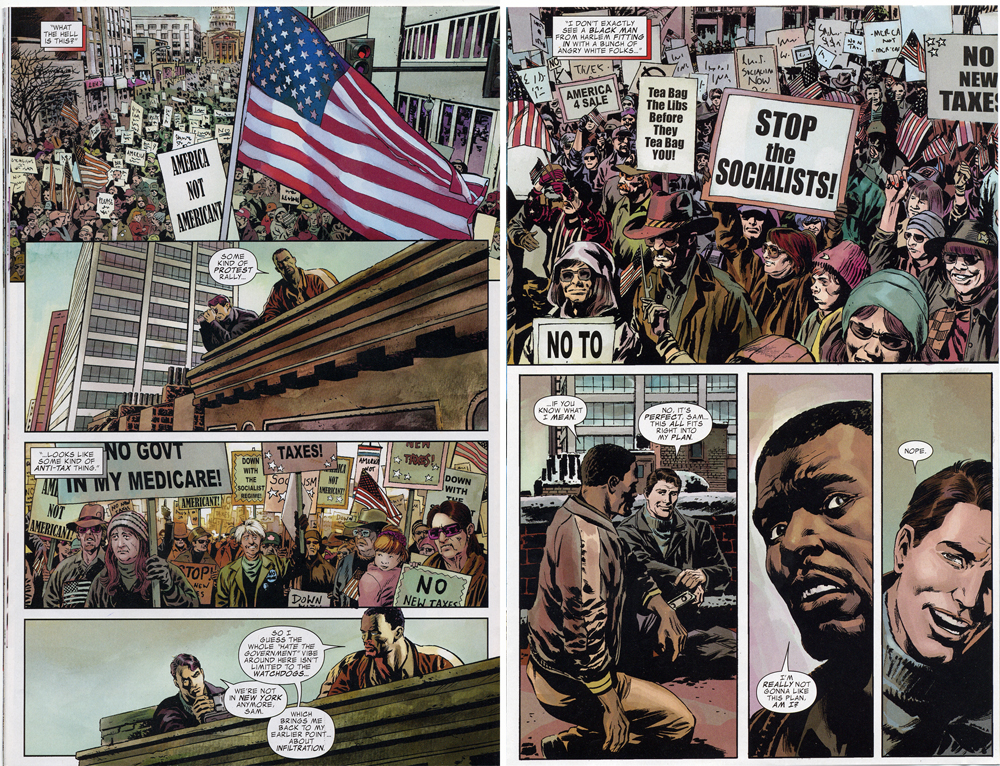
Marvel's Editor in Chief, Joe Quesada, apologized for the protest signs that clearly identified the protesters as Tea Party members. He explained that it was a last minute addition. Someone realized that some of the signs were blank and had a letterer fill them in quickly. He stressed that the letterer is apolitical and didn't realize how it would be taken.
That's fine as far as it goes but it completely misses a couple of other points. Since the Tea Party began last year, the left has characterized it as being a racist reaction to a black president. So what did Marvel do? They sent Captain America after some racists and he finds the streets of fly-over country full of anti-government, angry whites (at least they threw some women in). This comes across as an affirmation of everything bad the left has said about the Tea Party and Quesada didn't even realize it. Making the protest more generic would not remove the message that "red" states are full of angry white bigots.
I hate it when a general medium starts preaching or being judgmental, especially when they use someone like Captain America to do it. Steve Englehart did the same thing during Watergate. A master villain turned out to be Nixon (it was only implied but there was no doubt). After being revealed, he ran into the White House and killed himself. Steve Rogers gave up being Captain America for some time after that. It was a poor storyline.
After the Iran/Contra scandal, some operatives in the basement of the White House tried to force Captain America to take his orders. Steve Rogers refused and stopped being Captain America again. This plot was more balanced. Rogers got to be Cap again after President Reagan stumbled on the operation and ordered them to end it.
Wednesday, February 10, 2010
Blizzards and Global Warming
Washington DC is covered in snow. A new record has been set. Does this mean that global warming has stopped? Or is the unusual snowfall actually caused by global warming?
I'll take the second question first - did global warming cause the massive snowstorm?
Is that what happened here? No. A 2003 study has little to do with actual conditions in 2010. Remember, the northern hemisphere spent January in a cold wave unseen since the 1970s. But that isn't where these storms came from, anyway. They came from the south.
There are some problems in this statement, also. It conflated storms tracking further north than previously with warming air without bothering to establish any connection between the two. What we are left with is that these storms would ordinarily have tracked further south where they would have dumped their moisture as rain instead of snow. Was this caused by global warming or by natural, cyclical changed like the multi-decadal oscillations? You aren't going to even hear this as a possibility.
So what does this mean for global warming? Nothing. Its a weather event, not a climate. To quote RFK jr:
There is a very real possibility that we have been watching the tide come in and assuming that the land is sinking when it is just the tide. Kennedy will not admit it but there is some evidence that the tide peaked a few years ago and is on the way out. In the meantime, global warming alarmists are trying to have it both ways. A lack of snow in Canada and a surplus of snow in DC are both given as signs of global warming. They are not. Weather happens and records are broken.
I'll take the second question first - did global warming cause the massive snowstorm?
But as far as winter storms go, shouldn't climate change make it too warm for snow to fall? Eventually that is likely to happen - but probably not for a while. In the meantime, warmer air could be supercharged with moisture and, as long as the temperature remains below 32°F, it will result in blizzards rather than drenching winter rainstorms. And while the mid-Atlantic has borne the brunt of the snowfall so far this winter, areas near lakes may get hit even worse. As global temperatures have risen, the winter ice cover over the Great Lakes has shrunk, which has led to even more moisture in the atmosphere and more snow in the already hard-hit Great Lakes region, according to a 2003 study in the Journal of Climate. (Read "Climate Accord Suggests a Global Will, if Not a Way.")
Is that what happened here? No. A 2003 study has little to do with actual conditions in 2010. Remember, the northern hemisphere spent January in a cold wave unseen since the 1970s. But that isn't where these storms came from, anyway. They came from the south.
But there have been hints that it was coming. The 2009 U.S. Climate Impacts Report found that large-scale cold-weather storm systems have gradually tracked to the north in the U.S. over the past 50 years. While the frequency of storms in the middle latitudes has decreased as the climate has warmed, the intensity of those storms has increased. That's in part because of global warming - hotter air can hold more moisture, so when a storm gathers it can unleash massive amounts of snow. Colder air, by contrast, is drier; if we were in a truly vicious cold snap, like the one that occurred over much of the East Coast during parts of January, we would be unlikely to see heavy snowfall.
There are some problems in this statement, also. It conflated storms tracking further north than previously with warming air without bothering to establish any connection between the two. What we are left with is that these storms would ordinarily have tracked further south where they would have dumped their moisture as rain instead of snow. Was this caused by global warming or by natural, cyclical changed like the multi-decadal oscillations? You aren't going to even hear this as a possibility.
So what does this mean for global warming? Nothing. Its a weather event, not a climate. To quote RFK jr:
...If you sit on a beach for a few minutes and watch the waves come in, you'll see lots of waves of different sizes. If you sit there for six hours, you'll see the tides going in and out. ...
There is a very real possibility that we have been watching the tide come in and assuming that the land is sinking when it is just the tide. Kennedy will not admit it but there is some evidence that the tide peaked a few years ago and is on the way out. In the meantime, global warming alarmists are trying to have it both ways. A lack of snow in Canada and a surplus of snow in DC are both given as signs of global warming. They are not. Weather happens and records are broken.
Obama, the Campaign Worker and the T Shirt
This was part of a recent speech given by President Obama:
There is a lot more to this than the President is telling and these details tell us everything about Obamacare.
The missing details are that she did have some health care - she had catastrophic care coverage which has a very high deductible. Why didn't she have better insurance? Because she and her husband were using all available cash to start up a business. Like many young people, they took a gamble. They got enough insurance to cover a major illness and hoped that nothing else would come up.
She took a second, more serious gamble. She knew that she had breast lumps and she gambled that they were harmless. There are unknowns here. Would she have had the lumps checked in time if she had insurance that covered doctor visits and testing? Maybe so, maybe not. Regardless, by the time her cancer was diagnosed, it had spread all over her body.
She did have Medicaid by then but she was told that one treatment her doctor recommended was not covered. The article I linked to doesn't say what it was. It may have been an experimental program - lots of people enroll in these. It may have been something more mainstream. Whatever it was, she was already doomed. Once cancer stats invading multiple organs it is unstoppable by today's medicine.
So, where does Obamacare fit into this? If it had passed then she would either have put her money into insurance instead of her business or she would have still gone for the catastrophic policy and paid the fine for being under-insured. No one with enough money to start a business should be getting government assistance in paying for coverage. That might sound cruel, but that's how Obamacare will work. A very large percentage of the people it is aimed at will be required to purchase coverage but will not get any assistance for it.
I doubt that this is what she expected or why she wanted to be buried in her Obama T shirt. I suspect that, like many supporters of health care reform, she thought that the government would pay for her insurance. Since she government gets its money from other people, she wanted other people to pay for her insurance. That isn't going to happen with Obamacare for most of the uninsured. There just isn't enough money.
So we have a woman who died believing that Obama would deliver something that he will not and Obama is using her belief in him to try to shame the country into passing Obamacare.
Can we wrap this legislation in an Obama T shirt and bury it, too?
I got a letter -- I got a note today from one of my staff -- they forwarded it to me -- from a woman in St. Louis who had been part of our campaign, very active, who had passed away from breast cancer. She didn't have insurance. She couldn't afford it, so she had put off having the kind of exams that she needed. And she had fought a tough battle for four years. All through the campaign she was fighting it, but finally she succumbed to it. And she insisted she's going to be buried in an Obama t-shirt.
There is a lot more to this than the President is telling and these details tell us everything about Obamacare.
The missing details are that she did have some health care - she had catastrophic care coverage which has a very high deductible. Why didn't she have better insurance? Because she and her husband were using all available cash to start up a business. Like many young people, they took a gamble. They got enough insurance to cover a major illness and hoped that nothing else would come up.
She took a second, more serious gamble. She knew that she had breast lumps and she gambled that they were harmless. There are unknowns here. Would she have had the lumps checked in time if she had insurance that covered doctor visits and testing? Maybe so, maybe not. Regardless, by the time her cancer was diagnosed, it had spread all over her body.
She did have Medicaid by then but she was told that one treatment her doctor recommended was not covered. The article I linked to doesn't say what it was. It may have been an experimental program - lots of people enroll in these. It may have been something more mainstream. Whatever it was, she was already doomed. Once cancer stats invading multiple organs it is unstoppable by today's medicine.
So, where does Obamacare fit into this? If it had passed then she would either have put her money into insurance instead of her business or she would have still gone for the catastrophic policy and paid the fine for being under-insured. No one with enough money to start a business should be getting government assistance in paying for coverage. That might sound cruel, but that's how Obamacare will work. A very large percentage of the people it is aimed at will be required to purchase coverage but will not get any assistance for it.
I doubt that this is what she expected or why she wanted to be buried in her Obama T shirt. I suspect that, like many supporters of health care reform, she thought that the government would pay for her insurance. Since she government gets its money from other people, she wanted other people to pay for her insurance. That isn't going to happen with Obamacare for most of the uninsured. There just isn't enough money.
So we have a woman who died believing that Obama would deliver something that he will not and Obama is using her belief in him to try to shame the country into passing Obamacare.
Can we wrap this legislation in an Obama T shirt and bury it, too?
Subscribe to:
Posts (Atom)