Wednesday, March 22, 2017

Wonder Woman's Arm Pits

There's a controversy about Wonder Woman's arm pits. Some feminists are outraged that Diana shaves them. Here's some thoughts on that:

The character has been represented without excess body hair for decades.

Ancient Greek Women removed extra body hair (NSFW). Wonder Woman's culture is inspired by the ancient Greeks.

Many fashion trends, such as shaving, are as much about impressing other woman as they are looking good for men.

Men shave, too and much more often (and these days, men shave more of their bodies, too). I've seen speculation that both sexes are trying to preserve an adolescent look. Men shave world-wide including in cultures where women do not shave and this goes back thousands of years. There's something in the human makeup that makes us want to remove body hair. 

Thursday, March 16, 2017

Science and Dogma

Recently a student organization at Middlebury College invited Charles Murray to speak. Murray is considered a controversial speaker because he co-wrote the book The Bell Curve in the 1990s. His most recent work is about the effect that college recruitment has on income inequality. Rather than hear what Murray had to say or just ignore his talk, protestors shut it down and forced him to leave, injuring a professor in the process. The college paper published a letter from a guest contributor signed Nic Valenti '17 that gives some insight into the motivations of the protestors.

Nic begins with this:

I can understand the perceptions that would lead the AEI to invite a controversial speaker such as Charles Murray. Indeed, when I first arrived at Middlebury I was clueless to the systems of power constructed around race, gender, sexuality, class or ability, and found that when I talked about these issues as I understood them — or rather, as I didn't — I was met with blank stares and stigma rather than substantial debate. As a young bigot, I can recall thinking: "I thought at Middlebury I would get to have intellectual discussions, but instead it feels as though my views are being censored." However, as a first-year I had failed to consider a simple, yet powerful component of debate: not all opinions are valid opinions. I had fallen into the trap of false equivalence.

He then talks about a debate between Bill Nye and Ken Ham, a Young Earth Creationist, on the legitimacy of evolution. Naturally, Nye failed to convince Ham which seems to have infuriated Nic. That serves as a springboard into the controversy about Charles Murray:

And yet Charles Murray's views are even more dangerous than Ham's. Ham disavows a scientific theory; Murray disavows the fundamental equality of all human beings. According to the Southern Poverty Law Center: "In Murray's world, wealth and social power naturally accrue towards a 'cognitive elite' made up of high-IQ individuals (who are overwhelmingly white, male and from well-to-do families), while those on the lower end of the eponymous bell curve form an 'underclass' whose misfortunes stem from their low intelligence. According to Murray, the relative differences between the white and black populations of the United States, as well as those between men and women, have nothing to do with discrimination or historical and structural disadvantages, but rather stem from genetic differences between the groups."
This is an interesting juxtaposition and it shows how misguided Nic is about the world.

First of all, Nye didn't have a chance of convincing Ham. Nye was taking the scientific viewpoint which is that you go where-ever the evidence takes you. Ham was taking a dogmatic viewpoint that the Bible is to be taken as literally as possible and and evidence that says otherwise must be incorrect. I doubt if Nye ever expected to convince Ham. He was playing to the audience of people who might have been swayed by Ham.

So, on to Murray. Murray is not arguing dogma. He is a scientist and he is arguing in favor of an interpretation of the evidence. He uses genetics and statistics to make his case, both hard sciences.

Nic doesn't even bother to quote a dissenting scientist. Instead he quotes from the Southern Poverty Law Center which is not a scientific body by any stretch of the imagination. They are condemning Murray because they don't like the implications of his conclusions.

Nic doesn't realize it but he's in the same position as Ken Ham - he's spouting dogma against a scientist. If you look at Nic's earlier paragraph in this light you can see the parallels between it and a religious tract: "I was a sinner but I've received the word and I've been saved." Nic tells us that he came to college ready to debate issues but was indoctrinated.

This attitude explains the violence against a speaker. Science allows dissenting opinions to be voiced. They are then accepted or rejected on the soundness of their arguments. Dogma rejects all dissent out of hand and harshly suppresses heresy.

In late-17th century the Puritans in New England had a problem. The founders were sure they had been saved. But they weren't sure about their children. Salvation isn't hereditary and there's no visible mark to tell who is among the elect (the ones chosen by God). According to the Puritans. the only way to be sure was to constantly search your own soul and the souls of those around you for sin. That's what college campuses have become these days. The students are constantly searching each other's souls for and deviation from their dogma and engaging in ostentatious virtue signalling to prove that they are among the elect.

Friday, March 03, 2017

Kellyanne and the Gotcha photo

Earlier this week President Trump had a meeting with over 100 leaders of historically black colleges and universities. The press didn't run a picture of that. And pictures were taken. Here's one of Kellyanne Conway taking a picture with her phone.


Here's the picture that was run


Which was followed by criticism for Kellyanne for having her feet on the couch and fir sitting in the presence of the visitors. This is a "gotcha" picture. It had two purposes:

1) It keeps the press from having to report on Trump's outreach to a large group of black leaders.

2) It helps to discredit Kellyanne. The left hates her with a passion for orchestrating Trump's winning campaign.

Contrast this with eight years ago when CNN had a group of black kids singing and dancing in support of Obamacare.

That's why the press is no longer trusted.

Sunday, February 12, 2017

The Two Year Myth

Ever since the election I've been seeing people on the left talking about how Trump will be president for two years. The highest profile version of this I've seen to date is a column by former conservative Kathleen Parker. She says:

My "good" prediction is based on the Law of the Pendulum. Enough Americans, including most independent voters, will be so ready to shed Donald Trump and his little shop of horrors that the 2018 midterm elections are all but certain to be a landslide — no, make that a mudslide — sweep of the House and Senate. If Republicans took both houses in a groundswell of the people's rejection of Obamacare, Democrats will take them back in a tsunami of protest.

This is a total fantasy. There is no way that the Democrats can remove Trump from office, even in an unprecedented landslide. No chance at all.

Because Senators server six year terms, the people coming up for reelection in 2018 are the ones who last ran in 2012 with Barack Obama at the top of the ticket. The Democrats who won were riding on Obama's coattails and the Republicans who won were bucking a headwind. The numbers show that. The Democrats and independents who caucus with the Democrats are defending 25 seats. The Republicans are defending 8. That's long odds for the Democrats.

But, let's assume that the Democrats manage a clean sweep and win all 33 seats. That would give them 56 seats. Assuming that they also take the house and pass a bill on impeachment, then the Senate would have to vote on removing President Trump and that takes a 2/3s super-majority. They'd have to have 67 votes. Does anyone seriously think that 11 Republicans will join the Democrats in ejecting a Republican president? The best guide we have to go on was the impeachment of Bill Clinton which failed in the Senate because the Democrats refused to vote to remove him, even though there was no question that he was guilty of perjury.

And, even if the Democrats did manage to remove Trump, that just elevates Pence to the presidency. Are we to believe that they will find cause to impeach him, too, so that nancy Pelosi can be president (it goes without saying that they will also refuse to confirm a replacement vice president after Trump is removed).

So any hopes of removing President Trump involve a lot of wishful thinking.


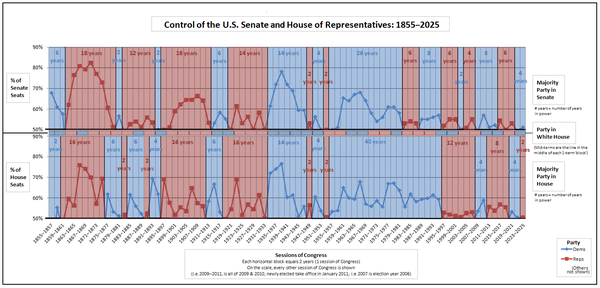
But is it even rational to assume that 2018 will be a Democratic wave election? The White House changes parties regularly. Since World War II, it's switched every 8 years with two exceptions, both involving Reagan (Reagan defeated a sitting president and his successor was elected but only held the White House for a single term). The Senate has changed hands several times since the Republicans took it in 1980 but its shifts tend to take 6 years or longer. The Republicans have only controlled the Senate since 2014.

The House is a different animal. The Democrats controlled it continuously from the 1930s until 1994 with the exception of the Republicans controlling it twice, both times for single term in the 1950s. The Republicans finally won control of the House in 1994  after 40 years and kept it until 2006 then won it back again in 2010.

It's instructive to look at what was going on when the House changed hands. 1994 was partly a reaction to Bill Clinton's presidency but it also featured the Contract With America - a set of issues that the Republicans promised to vote on in their first 100 days. They delivered on their Contract, also, but it was mainly symbolic since the Democrats still controlled the Senate.

The Democrats took the House in two wave elections. The first, in 2006, was largely a reaction to the war in Iraq. The 2008 election was a reaction to the financial crisis. The Republicans formed the Tea Party in 2009 and took the House back the following year. Considering that the Democrats controlled the House for 58 out of 62 years then the House may be in a similar, long-term Republican period with short interruptions because of external events. If this is true then there is no pendulum to swing back.

There is good reason to believe this. The country in general tends to be center-right but in the last two decades people have self-selected so that the country is a sea of red with small clusters of urban-dwelling liberals. This makes it nearly impossible to draw competitive congressional districts. Ohio continues to be nearly 50/50 but the graphic below shows how the Democrats have retreated into only a few counties.


​

Even if we assume that it is possible to swing Congress back so soon, what will the Democrats' message be? Their post-election analysis rejected and moderation in favor of doubling down on progressive policies and identity politics. They have sworn to to all that they can to resist President Trump at every level. That satisfies their base but they already have the base's vote. A lot depends on how Trump's policies play out but the Democrats are taking a huge risk. They are convinced that Trump is a terrible president and that the rest of the country will eventually realize it. They have no plan B. If Trump succeeds or even muddles through then the Democrats will fail. 

Tuesday, February 07, 2017

Elizabeth Warren (sort of) Gets It.

In a speech to the Democrats last weekend, Elizabeth Warren had some genuine insights.

Our moment of crisis didn't begin with the election of Donald Trump," she said. "We were already in crisis. We were already in crisis because for years and years and years, Washington has worked just great for the rich and the powerful, but far too often, it hasn't worked for anyone else."

"People don't just wake up one day and elect leaders like Donald Trump because 'hey, everything is awesome, but what the hell, let's roll the dice and make life interesting,'" she added. 

Democrats frequently enabled or participated in these trends, Warren said.

"Republican politicians have pushed one policy after another that has favored the rich and powerful over everyone else, and far too often, Democrats have gone right along," she said. "And no matter how extreme Republicans in Washington became, Democrats might grumble or whine, but when it came time for action, our party hesitated and pushed back only with great reluctance. Far too often, Democrats have been unwilling to get out there and fight."

She's exactly right when she says that people didn't elect Trump because they are satisfied. But she missed some important points.

Her biggest problem is her insistence that it's all the Republicans' fault.

This country is in an economic crisis. For more than 30 years, working families, middle class families, poor families, students, seniors have been squeezed harder and harder, and now they are at the breaking point. Republican politicians have pushed one policy after another that has favored the rich and powerful over everyone else, and far too often, Democrats have gone right along. And no matter how extreme Republicans in Washington became, Democrats might grumble or whine, but when it came time for action, our party hesitated and pushed back only with great reluctance. Far too often, Democrats have been unwilling to get out there and fight.


Warren needs to take a close look at her own party. They like to tell themselves that they are the party of the working people and not the rich and powerful but that's not how people outside the party see them. Who are their biggest donors? Wall Street, Hollywood and Silicon Valley. The super rich. And why do these super rich people donate to the Democrats if the Republicans are the ones pushing policies favoring them? Are these people crazy? Or maybe the Democrats have become the party of the rich while telling themselves that they still represent the poor.

Former President Obama likes to brag that he saved the economy but what he saved was Wall Street. No one went to jail. All of those companies that are too big to fail weren't broken up. Instead they were buttressed. Income inequality kept rising. The Fed pushed billions into Wall Street by lowering interest rates to an effective 0%.

Ideology rules the Democrats. When given a choice between jobs and ideology, ideology always wins. The XP pipeline may not produce all that many jobs but it is symbolic of how the Democrats think. Even after studies showed that it was safe and would not contribute measurably to global warming, the Democrats still killed it because it made the ideologists feel good.

First Obama and then Hillary came out against coal. Hillary actually said that she was going to put coal miners out of work. yes, she went on to say some platitudes about finding them new jobs in clean energy but they knew better than to believe that.

In every other recovery since WWII, small businesses have lead the way but not this time which is probably why the recovery was so weak. What happened to the small businesses? No one is sure but it's very possible that the mountain of new regulations the Obama administration created has something to do with it.

Then there was the Trans-pacific Partnership which Obama decided to call an agreement instead of a treaty so that he wouldn't have to get the Senate to ratify it. He did the same with the Paris Accords, too. Both were unpopular among working-class Americans.

So Warren is correct that people feel left out of the economy but she missed the fact that they blame the Democrats - on every level. The Democrats have become the party of the wealthy and the city-dwellers.

Trump is trying to change the economy and put jobs first. He may be wrong-headed but he's trying to help Americans.

And here's where Warren gets it completely wrong,

We are not the minority party. We are the opposition party, and we need to talk about the key difference between us and them every day—and we need to say it in the plainest possible way

She goes on to talk about all of the regular anti-Trump talking points. But she never talks about what the Democrats will do for the average worker. She never proposes a new economic agenda, just doubling down on the current platform. She never thinks about how that will look to the people who voted for Trump.

So she learned nothing from the election.


Friday, February 03, 2017

The Democrat's Dilemma

The Senate Democrats have a huge dilemma. They spent years complaining about Republican obstructionism in general and the last several months complaining that the Senate Republicans needed to "do their Constitutional job" and approve President Obama's nominee for the Supreme Court. But now that President Trump has nominated someone, the Democrats suddenly turned obstructionist.

There is no good reason for opposing Judge Gorsuch. He is eminently qualified and he will not tilt the court further to the right. There are some ruffled feathers on the left because Obama's nominee didn't get a hearing but the precedent of the opposing party stopping lame duck appointments goes back to 1992 and both Barack Obama and Joe Biden supported it as senators.

The main reason there is any controversy is that the left hates President Trump with a white hot passion. They don't want to see the Democrats in Congress cooperating with Trump on anything.

The problem for the Democrats is that it makes what the Republicans did against Obama look mild by example. The Democrats are raising the level of obstruction. This will haunt them in two ways. When they inevitably return to power, the Republicans will use every trick that the Democrats have used. In the meantime, the Republicans have every excuse to throw away the rule book and use the "nuclear option" - changing the rules by a simple majority vote. The Democrats already did this for everything except Supreme Court nominees, something they are surely regretting right now. Doing away with the filibuster for Supreme Court nominees will make it easier to confirm more polarized justices. That's one of those things that's only good when your side can do it.

So the Senate Democrats have strong reasons to allow Judge Gorsuch to be confirmed. But that will anger the base and will probably lead to some primary challenges.

For many Senators, there is no good choice. Doing the right thing will hurt them and doing the wrong thing will hurt the country. So they have a dilemma.

Saturday, January 21, 2017

Obama to Trump

A had a few thoughts during Donald Trump's inauguration about the difference between him and former President Obama. The quick version is that Obama's main priority was trying to transform America while Trump's seems to be trying to help Americans.

The XP Pipeline is a perfect example. Studies said that it imposed no significant risks and that the amount of oil produced from it would not affect global warming in any measurable way. Blocking the pipeline stopped American jobs and hurt relations with Canada. But Obama did it anyway for symbolic reasons.

After the Sandy Hook shootings, there was a major push for gun control. None of it would have stopped the tragedy. It was just an excuse for gun control.

The regulatory state went into overdrive during the Obama administration with the EPA claiming control over such diverse things as automobile mileage which had previously been under Congressional control.

Obama claimed that he was forced to use executive orders to reform immigration law because Congress refused to act. The reason Congress didn't act was because the legislation was highly unpopular. Pressure from illegal immigrants depresses wages of American workers.

Obama seemed to give more support to the Black Lives Matters movement than to police officers who were killed directly because of BLM protests.

Obamacare may have insured millions who didn't have insurance, but it also stifled tens of thousands of small companies. In every previous recession, small businesses were responsible for most of the new jobs during the recovery. Without the hiring from small business, the recovery has been, at best, tepid.

The Obama administration and the Democrats in general went out of their way to be as harsh as possible on dissenters. In 2008, Obama felt that he could not be elected if he admitted he favored gay marriage and the State of California passed an anti-gay marriage constitutional amendment. Regardless of that, any business that refused personal services for gay weddings was fined enough to put it out of business.

The same was true for religious exemptions for birth control under Obamacare. The Obama administration was very unforgiving in awarding exemptions.

I could go on. These are just examples off of the top of my head but they illustrate my point - that Obama and his administration valued conformity with its principles over the desires and well-being of the populous. This was especially true in coal country and managed to push a solidly blue state (West Virginia) to being solidly red.

All I have to go on so far from Trump is his campaign promises and his inaugural speech but he seems to desire to put American workers first, ahead of ideology. That is a huge change from the previous administration.

Sunday, January 08, 2017

Obama's Legacy - Foreign Policy

Obama opposed the Iraq war. This gave him a big advantage in the 2008 primaries since Clinton and Edwards had both voted in favor of it. Of course, he was a state senator at the time but it gave him credibility when he made ending the wars in Iraq and Afghanistan the center of his campaign. During one of the debates he stated that he was willing to meet with the heads of hostile countries without pre-condition and spoke disparagingly of treating a presidential visit as a reward to foreign countries. THis was met with disbelief by Clinton and others with foreign policy experience. Regardless, Obama doubled down, implying that nations were hostile to us only because we hadn't approached them properly.

Although never stated publicly, this was the main thrust of Obama's foreign policy: approaching hostile nations and trying to forge friendly relations. He also was a proponent of nuclear disarmament. 

This sounds good in practice but requires careful implementation and care that traditional allies are not slighted.

The Obama years were not a good time to be a friend of the US, especially one who had good relations with the Bush (43) administration. The Obama administration decided that Germany was more important to us than England. India, which had been growing close to the US, got a cool reception from the US under Obama. Israel received the worst treatment as Obama put "daylight" between the two countries culminating with a UN resolution that declares that Judaism's holiest spots are illegally occupied conquered territory.

The various policies are so interconnected that it's hard to know where to start. An easy one is Cuba. The best policy would have been to wait fo the Castro brothers to die of old age and strike a bargain with their successors to lift sanctions in exchange for liberalizing Cuba. But that meant that a different president would get credit for reopening ties with Cuba and Obama wanted that to be part of his legacy. So he opened relations on nothing more than a vague promise from the Castros to release some political prisoners in the future. Unsurprisingly, the opening of Cuba was accompanied by government crackdowns instead of liberalization and Fidel Castro never softened his anti-American speeches until his death.

Iran is a more difficult case. Obama dreamed of being responsible for Iran being accepted back into the brotherhood of nations. He planned for it to take it's place as a regional power and to take our place as the peacekeeper in Iraq. The first step to that was to conclude the talks that were supposed to stop Iran's nuclear program. This cast a long shadow over all of Obama's other dealing in the middle-East. It was obvious to Iran that Obama wanted a treaty more than they did so they were able to dictate his actions elsewhere, particularly Syria. Syria is a client state of Iran and they let it be known that any actions we took to dispose the Syrian government would end the treaty negotiation.

This gave a sanctuary for the radical groups who had been forced out of Iraq to come together to form Isis. When he was finally forced to fight, Isis, Obama limited his efforts to Iraq. There was an effort to find and train Syrians to fight Isis but it was nearly impossible to find people who would promise not to take part in the raging Syrian civil war.

Since Obama had no intention of sending American combat troops to fight Isis, he had to rely on the Kurds. This caused tension with Turkey which has a Kurdish minority that wants to join with the Iraqi Kurds to form their own state. Obama's refusal to establish a no-fly zone over Syria caused more tension (the no-fly zone was vetoed by Iran). Eventually Turkey turned to Russia.

The Syrian civil war has caused humanitarian disaster. Hundreds of thousands are dead and millions displaced. Obama keeps saying that there is no military solution to Syria, only a diplomatic one and engaging in his favorite rhetorical device the straw-man choice (doing nothing vs a full scale invasion which no one has asked for). At this point, the Russians have proved that there is always a military solution if you are ruthless enough.

Libya is another humanitarian disaster, one we were responsible for. Obama supported a rebellion that overthrew a corrupt but stable government. The result is that Libya became a failed state.

The refugees from Syria and Libya are streaming into Europe and threatening to break apart the European Union. Anti-immigrant parties are on the rise in several countries across Europe and resistance to Europe's open border policy was a factor in the Brexit (Obama made things worse by threatening Great Briton that they'd go to the back of the queue in trade talks if they split from Europe. The Brits resented being lectured on their future by an American president and probably helped the leave faction).

We had a chance to change the governments of both Iran and Syria. After a rigged election, the Green Revolution broke out. We could have helped it. The CIA had a group that assists in organizing groups pushing for democratic reforms. Rather than assisting the Green Revolution, Obama ordered a hands-off policy. Later, the Iranian government was on the verge of collapse because of sanctions so he lifted some and lifted even more after the nuclear treaty was signed. He even shipped pallets of cash in small bills to Iran to pay for a hostage release.

At one point, early in the Syrian civil war, Russia offered to force the Syrian government out but we passed on that offer because we were sure it would collapse on its own soon.

Relations with Russia were already strained when Obama took office. He sent Secretary of State with a symbolic "reset button" then followed up personally. Instead of improving, relations continued to deteriorate. The Ukraine was invaded and the Crimea annexed. During a 2012 debate, Obama mocked Romney for calling Russia our biggest geopolitical rival. By his last month in office he was sanctioning them for interfering in the presidential election. Along the way Obama managed to convince Putin that we were planning on overthrowing him.

Egypt has had two revolutions on Obama's watch. In both cases, we started by supporting the current government, then supporting the revolution. The Obama State Department allowed the Muslim Brotherhood to take over Egypt because they were curious to see if it could turn into a responsible government. They couldn't and we supported a military coup which has turned out to be at least as repressive as the two previous governments.

One indirect benefit of Obama's pro-Iran policy is a stronger Israel. The Saudis and their allies are worried by Obama's support for Iran and see Israel as a strong ally, one that the US has similarly turned it's back on.

All of this for a treaty that was supposed to stop Iran from getting nuclear weapons but instead gives them a timetable for becoming a legal nuclear power. Like Cuba, Iran was far from grateful. Instead they are working on ballistic missiles capable of striking all of Europe with the nuclear bombs that they are allowed to build in just a few years. And they have already declared that the US is in violation of the treaty which allows them to do anything they want (and can now afford after sanctions were lifted and billions of dollars delivered).

In 2004 Obama accidentally drew a red line for Syria - no chemical weapons. By 2005 it was obvious that they had been using them. Obama and Secretary of State Kerry promised that we would retaliate but it would be "unbelievably small". Then, after Britain's Parliament voted against taking action, Obama decided that he would not act without Congressional approval. Keep in mind that he had already expended his drone war into a half dozen countries and overthrown the government of Libya without Congress but he needed their approval for an unbelievably small retaliation. Congress refused. Russian intervened and Syria gave up its chemical weapons stockpiles and resorted to using chlorine gas instead. This was a terrible outcome. Obama and the US looked weak for making threats that we had no intention of following through on and for needing Russia to clean up after us and it didn't even stop Syria from using poison gas.

That sums up the world's view of the US under Obama. We talk a lot, often talking down to other nations, but we fail to follow through in any meaningful way. The world has stopped looking to the US and now goes it alone or looks to Russia for support.

I've rambled on long enough so I won't even mention China's incursions into the South Sea or Korea's weapons program.

Saturday, January 07, 2017

Obama's Legacy - Obamacare

Early in his presidency, Mr. Obama announced to his staff that he needed something big as his legacy. "Isn't saving the world's economy enough?" they asked. "No, it has to be bigger than that," the President told them.

Obama wanted to be remembered as the Roosevelts are for national parks and Social Security, respectively or LBJ and Medicare/Medicaid. He wanted something big.

Surprisingly, health care wasn't the first thing that came to mind for him. The Democratic party had been waiting impatiently since the early 1990s when Hillary Clinton's proposed health care reform collapsed under it's own weight. But health care reform was never a priority for Obama. He'd only included it in his platform to counter Hillary's proposal in the primaries. He'd even mocked her individual mandate. But health care reform was big - big enough to be his legacy.

Since he wasn't that interested in it, he left the details up to Congress and provided no guidance at all except that it should be something to address the uninsured instead of a total overhaul of the health care system. Even that was going to be a hard sell. And it was. Several Congressmen cut deals in exchange for their votes. It was decided early on that the Republicans would be cut out of writing the legislation which meant that they were unanimously against it. The Democrats had enough votes to go it alone but just barely.

The result was a mess but that was acceptable since it could be cleaned up during the reconciliation process with the Senate's version.

Then things got difficult.

Most Americans were happy with their insurance and worried that they'd end up with worse coverage. Opposition started to show up during the August recess when Democrats held town hall meetings to try to sell the legislation. It got worse when it came out that the Congressional leaders had no intention of actually reading the legislation. Public opinion turns against the bill. The final blow came when Ted Kennedy died and a Republican was elected to replace him on an anti-Obamacare platform.

That should have been the end of it. But Obama needed his legacy and the Democrats were convinced that the legislation would eventually become popular and assure them generations of majority status. With only 59 votes in the Senate they could not get past a filibuster so they used a legislative sleight-of-hand and used the House's bill, as written which only required a simple majority vote.

Obamacare became the law of the land without a single Republican vote and with more than half of the country against it.

The bill was flawed and they knew it but Obama and the Democrats preferred to pass something than nothing and they kept telling themselves that it would pay off in the long run.

It didn't. Obamacare never became popular and while Obama was reelected in 2012, the Democrats lost everywhere else.

As different parts of the law went into effect, left-leaning writers bragged about the number of people who were covered but neglected to mention that enrollment was always millions short of projections. This was an important shortfall. In order to work, a lot of young, healthy people needed to be enrolled to pay for the older, sicker ones. The program had no problem signing up the sick ones but the shortfall of healthy members meant that the participating insurance companies had huge losses. This lead to several insurance companies pulling out and others raising their rates much faster than inflation.

In selling the program, Obama promised "if you like your doctor, you can keep your doctor". This was named the lie of the year.

One rather cruel part of Obamacare was the Cadillac Plan tax. If your employer-provided plan was too good then it was taxed at a punitive rate to pay for subsidies. This meant that millions of people (and I'm one of them) had their insurance cut because their employer couldn't afford the taxes. In my case, the cuts amount to hundreds a month in out-of-pocket costs and I'm not alone.

Obamacare called for the states to set up insurance exchanges. Many Republican-controlled states refused so Obama simply ordered that the federal government would provide an exchange instead. The roll-out of the federal system was a complete disaster and it was months before the exchange was working properly.

The states that did set up their own exchanges had similar problems and several of those have since folded.

There was an employer mandate in Obamacare but Obama used an executive order to push that back, regardless of not having any actual authority to do this.

Despite being 2,000 pages long, a lot in Obamacare was left to bureaucrats to write. That included what birth control methods would be mandated. At first the Obama administration wanted this mandate to be universal but religious institutions objected. A waiver was allowed for them but the definition of who could get a waiver was very strict. A church could but a school run by that same church could not. This lead to two court cases. In one, Hobby Lobby objected to three out of fifteen types of mandated birth control on the grounds that they caused abortions. The Supreme Court ruled in their favor. The Little Sisters of the Poor, a group of Catholic nuns, objected to providing any birth control. This is still pending after being sent back to the lower courts. When no one in the Obama administration or the Democratic party noticed was that these administrative choices sent a clear message that the Democratic party was anti-religion. This cost them in the 2016 election when Evangelicals and Catholics turned out heavily for the Republicans.

As of this writing, it is unclear exactly what will become of Obamacare. The Republicans have vowed to Repeal and Replace Obamacare. Even if Hillary Clinton had won and the Democrats had swept back into office, the program couldn't survive without a major overhaul.

Obama saw Obamacare as his legacy, something that future generations would look back on. Instead, it will be looked back on as a cautionary tale against rushed, unpopular legislation.


Wednesday, January 04, 2017

Obama's Legacy - The Financial Crisis

No other president in my lifetime entered office worrying about his legacy as much as Barack Obama. As his second term ends, I'll look back at his tenure and rate his legacy.

The financial crisis of 2008, also known as the Great Recession, was a terrible thing for most people but it helped President Obama in many ways.

The crisis itself was not very well understood. During the 2016 campaign, Hillary Clinton insisted that it was caused by the Bush tax cuts. Even the left-leaning fact checkers rated this one false. The reason for Hillary's prevarication is that the crisis had its roots in Bill Clinton's presidency. During that period, it was decided that increasing home ownership, especially among minorities, would be a good thing. As part of this, many of the qualifications to get a mortgage were eliminated. Previously you needed a large down-payment and the mortgage could be no more than 15%-20% of your income. That made it unlikely that you would default.

At the same time, a weak-dollar policy designed to reduce the trade deficit and historic-low inflation pushed mortgage rates to the lowest in generations. Variable-rate mortgages pushed the rates even lower. All of this created a housing boom. Rising home values allowed people to constantly refinance their house for more than they paid for it while keeping payments low. The Bush administration continued these policies.

All of these mortgages were used to create something new. They would be bundled together and sold as a package along with some insurance against default. With stocks and bonds paying so little because of the low interest rates, these financial instruments were the best way to get an easy return on investments.

The problem was that the whole thing was a house of cards that depended on rising housing values and those couldn't rise forever. That should have been obvious but people were making so much money on all levels that no one seriously questioned  the bubble that they were creating.

The crash was inevitable but not the timing. This is where Obama had an amazing stroke of luck. The crisis hit after the conventions, just in time to derail Senator McCain's campaign as the voters blamed the Republicans. But the worst of it hit before Obama was sworn in. The parts where the world economy were in danger were handled by President Bush, who usually gets the blame for causing it but little credit for saving the world's economy. Many of the steps taken were unpopular, such as bailing out banks. Obama was there  as Senator and president-elect and supported Bush's actions but was able to distance himself from it.

By the time Obama was sworn in, his main job was to not mess up the recovery. But that's not how he was received. People expected him to work miracles. Some (including New Your Times Columnists) called on him to suspend Congress for a year so he could just fix things from the way Bush messed them up.

Congress acted on a stimulus bill that was supposed to save the economy by financing "shovel-ready" jobs that were already planned but needed funding. These didn't really exist and most of the $700 billion went for a grab-bag of programs as well as for propping up cash-strapped states.

Obama also had a free hand to save GM and Chrysler. He did that by having them go through bankruptcy but, in what would become an Obama trademark, by ignoring bankruptcy laws and dividing GM up by executive fiat.

Obama moved to shore up the banks, forcing them to take funds so no one could tell which banks actually needed the money then telling them that "he owned them" and that he was all that stood between them and the crowd with pitchforks.

Obama also announced a program to help people who defaulted on their mortgages. This provoked a backlash by people who felt that Obama was rewarding those who broke the rules and ignoring the ones who followed by the rules. The backlash gave rise to the Tea Party.

After the 2010 election, the Republicans took back the House. There would be no second stimulus. Without that, Obama relied on the Federal Reserve which cut interest rates to as close to zero as is possible to get.

How did all of that work out? Not so well. The recovery was the slowest since the Great Depression. Years later the interest rates are still near-zero. Unemployment has dropped below 5% but the participation rate is the lowest ever and a large percentage of the workforce is under-employed. Given that the Fed is still keeping the economy on life-support, it can be argued that we never actually recovered at all.

It's quite possible that the underlying problem is increased regulation. This is the only recovery ever where increases in employment came from large businesses instead of small ones. The Obama administration has issued a record number of new regulations and those might be dragging down small business. Or it may be other factors. Regardless, Obama's claim that he saved the economy rings hollow to large sections of the economy.

As a final exercise, let's imagine what would have happened if the crash had come a year earlier or later to see why Obama was so lucky.

McCain seemed totally out of his depth when the crisis hit. Had it hit earlier, then either he'd have managed to come to terms with it or a different candidate would have won the nomination - possibly Mitt Romney. The shock of the hundreds of billions in bail-outs would have passed, too.

Obama may not have even managed to capture the nomination if the crisis had hit in 2007. Hillary Clinton was the presumed candidate and her message of returning to the prosperity of the Clinton years would have resonated. Obama was a dark horse until after Super Tuesday when he dominated the news by winning caucus after caucus, giving him a sense of inevitability. An earlier crisis may have crowded that out of the news.

Had Obama managed to overcome all of that, he still would have taken office well after the crisis was passed and the recovery had begun. He'd still have been able to take credit for it but he wouldn't have had the same urgency.

Think how much worse it would have been for Obama if the crisis had struck after he was in office. Just as many Democrats blame Bush for not stopping 9/11 (Michael Moore is still going on about it), many would have blamed Obama for not stopping the economic melt-down. Far from having people clamoring for him to save the economy, he'd be trying to cobble together the same bi-partisan group that Bush needed to save the economy. But, Bush was much better at bi-partisanship that Obama. Obama barely gets along with the Democrats in his party. He might not have been able to salvage things. Or he might not have been willing to rescue banks given his antipathy to the wealthy.

It's very likely that the country would have been willing to elect a turn-around artist in the 2012 election and elect Romney.

So, like I said, Obama was very lucky that the crisis hit exactly when it did.

Friday, December 23, 2016

If Only...

Hillary supporters have been slow to accept that they simply had a bad candidate who ran a bad campaign. They prewfr to blame outside influences, usually the Russians and the FBI. Let's examine those.

Many are acting as if Russian involvement in the election was a complete surprise. Actually, the White House was sating that the release of DNC emails came from the Russians well before the election. The White House knew about it in July and Congress was briefed in September. No one made a fuss, probably because we've been hacking their emails, too. We've also been influencing elections for decades. Just last Summer, President Obama warned the British to vote against the Brexit.

What are the Russians accused of doing? Making private emails public. They didn't change vote tallies or remove voter registrations. They let us know what the Clinton campaign said in private. What did we learn? Mainly that the Democratic party and the MSM were biased in favor of Hillary Clinton. We also found out that highly-placed people in the Clinton campaign have a low opinion of Catholics and Evangelicals. These groups were already supporting Trump (which is why the low opinion) so that did little damage.

I have a challenge to Hillary supporters: show me which email or set of emails you think did the damage. I want actual proof meaning a drop in the polls after those documents were released or later polling naming the contents of those emails. Without that, then the talk of President-elect Trump being a Russian puppet and the election being a bloodless coup is just silly (I'm looking at you, Keith Olberman).

Remember, the RNC was not hacked. Apparently the Russians didn't try as hard. That may be because they wanted Trump to win but it might also be that they, like the rest of the world, assumed that Hillary would win and wanted to hurt her. Even if they had hacked the RNC, they kept the Trump campaign at arm's length. The Republican establishment was against Trump. Any emails from the RNC servers would probably have helped Trump by showing that the establishment was against him.

As for the FBI, let's remember that the FBI probe didn't happen in a vacuum. We already knew that Hillary had used a private server which was poorly-secured and contained classified information. The FBI investigation was to see if any laws had been broken. It was Hillary's decision to use a private server and to delete 35,000+ emails from it before turning the rest over to the State Department. This tainted her candidacy from the start. If the FBI hadn't gotten involved then Congress would have pressed for a Special Prosecutor and that would have looked worse.

A lot of information leaked about the investigation. The rumor was that agents who worked on it felt that Hillary should have been charged. The private meeting between Bill Clinton and Loretta Lynch just days before the results were given gave the impression that the fix was in. That was Bill's mistake and a majority of the country was unsatisfied with the FBI's ruling that Hillary should not be charged.

Reportedly there was an open revolt in the FBI when more emails came to light. It may have hurt Hillary when the case was reopened but it would have hurt her even more if it got out that there was a trove of letters and they hadn't taken due diligence. The way it played out was probably the least damaging.

Let's face it, Hillary's use of a private server was a terrible lapse in judgement and there was no way it wasn't going to hurt her. If it hadn't been the FBI then it would have been leaks that evidence was suppressed. The only way to stop it would have involved a huge conspiracy including threats of retaliation to whistle-blowers. And wouldn't that be a great way to win the election.

Wednesday, December 14, 2016

Bubble Bubble

After being told that they live in a bubble, the left's response has been, "Oh yeah? So do you and ours is bigger!" One of the more prominent versions of that comes from WaPo columnist, Richard Cohen. The argument is that the left is more inclusive and multi-cultural compared to the mainly white Christians who voted for Trump.

As with most things about the election, this shows the Left's ability for self-delusion. The bubble analogy fits them far better than it fits the right for two reason.

If you look at a map showing which counties were carried by Hillary Clinton then you see small blue patches surrounded by a sea of red.


It looks like bubbles doesn't in. It's really hard to say that all of that red in-between is a bubble. But that's only part of the reality.

When we say that the left lives in a bubble, we mean a mono-culture. Think of the movie about the boy in a bubble who was shielded from contact with the outside world because of a weak immune system. That's how the Left lives. They cluster in cities and, as shown by their reaction to Trump victory in the election, they want to be protected from the outside world. There are stories of women having their hair cut or the color changed because of the election and of people in an organic food store being distressed at hearing Sweet Home Alabama.

And it's easy for them to avoid contact with the other half. They control most media. Their control of campuses is so strict that pro-Trump statements were ruled hate crimes.

The Right can't isolate itself like that. They are constantly exposed to the Left. All they have to do is turn on any mainstream news broadcast, read a major newspaper, or watch late-night TV and they are bombarded by Trump-haters. The Left even leaves its cities and drives an hour or more in order to find people who don't match their values to hold up for ridicule. (1)

Until the people of the Left recognize how much they isolate themselves they will continue to live in a bubble, happy in their ignorance.

(1) I'm thinking of the time a reporter drove 50 miles and asked a pizza restaurant if they would cater a gay wedding. The owners said that they were happy to serve gays but would not cater a gay wedding because of religious beliefs. This was quickly spread nation-wide earning them death threats. What was not mentioned was that they had never catered any weddings so the chances of it coming up were zero.

Wednesday, December 07, 2016

The Democrats in the Age of Trump

Currently the Republicans are at a historic high point and the Democrats are at a low point. The Republican dominance isn't guaranteed. Sixteen years ago Republicans controlled the White House and both houses of Congress. They managed to lose this in wave elections in 2006 and 2008, ending talk of a permanent Republican majority. With Barack Obama's election, the Democrats controlled government and the began to dream of a permanent Democratic majority. There was talk that demographics and a national swing to the left doomed the Republicans to being nothing but a regional rump party. 2010 and 2014 turned into Republican wave elections. The predicted 2016 Democratic wave never materialized. There are different ways of looking at this.

One is that American politics regularly swing back and forth. The White House certainly does. Since FDR, the White house has changed parties every eight years. The only exception to that was Ronald Reagan who defeated a sitting president and whose vice-president succeeded him with a convincing majority.

The party that controls the White House often looses support in Congress during the mid-terms so the Democrats may be one election away from starting to recover. If we assume that the national spirit is sort of a pendulum then it is likely that the Democrats will retake Congress during the Trump administration and will take the White House in 2024.

There is another possibility. Democratic control during the Obama administration may be an aberration caused by anger at the Iraq war in 2006 and the financial melt-down in 2008. In fact, a strong case can be made for this.

In theory the House of Republicans is the most sensitive to public mood. Every member stands for election every two years. In practice, change is slow. The Democrats controlled the House for decades from 195l to 1994. The Republicans began making gains under Reagan and finally took Congress in a wave election in the wave election during Bill Clinton's first mid-term. They held both houses of congress until George W. Bush's second mid-term in 2006. They started making gains again, taking the House in 2010 and retook the Senate in 2016. Looked at this way, the long-term swing has been Republican.

How does this work?

The country has become increasingly polarized. The coasts and cities are strongly liberal and the rest of the country is conservative. America is developing two cultures with little in common with each other. Regardless of demographics that are supposed to favor Democrats, it hurts them to be so tightly clustered. For all the talk about gerrymandering, it's very difficult to draw competitive districts when part of the population is widely spread out and part is tightly clustered.

It's been a truism among the Democrats for more than a decade that the Republicans have moved so far to the right that President Reagan would no longer be welcome. The truth is that both parties have changed over the years but it's instructive how they changed.

Reagan set the tone for the modern Republican party - a mixture of social conservatism and libertarianism with strong national defense. It's widely believed that President George H W. Bush's tax increase cost him reelection so Republicans have been anti-tax ever since. George W. Bush introduced "compassionate conservatism" meaning support for a strong safety net. He was influenced by no-conservatives who were socially moderate and strong on defense. Under Bush, the Republicans abandoned fiscal prudence and spent heavily. The TARP and President Obama's spending shocked the Republicans out of that, giving rise to the Tea Party movement. This was largely a return to the principals that Reagan ran on in 1980 with a heavy dose of social conservatism thrown in. Yes, the Tea Party was unforgiving of the sorts of compromises that President Reagan made but they would have welcomed candidate Reagan. The Tea Party eventually merged with the party in general only to run into Domald Trump's populism. What the results of this will be on the party have yet to be seen.

In contrast to the Republicans zig-zags, the Democrats have had a pretty straight trajectory. Bill Clinton was part of a moderate movement but since his election the Democratic party has moved further to the left than at any point in its history since FDR traded tips with Mussolini. They no longer even call themselves liberals. They are now progressives. This is an important distinction.

During the early 2000s, the Democrats made an effort to recruit moderates. This paid off in the wave election in 2006. But after that they lost the moderates. Some were purged and the rest lost their seats to Republicans. By the 2016 election, the party had moved to far to the left that a socialist was seen as a viable candidate. Hillary Clinton was actually running against Bill Clinton's biggest achievements. The party has moved so suddenly and so sharply to the left that candidate Barack Obama would be unacceptable. In 2008, Obama claimed to be against gay marriage and neutral on guns. Those positions have no place in today's Democratic party. He even made fun of Hillary Clinton for suggesting a manditor health care system comparable to Obamacare.

Today's Democratic Party places environmentalism and identity politics ahead of anything else. It has embraced the Black Lives Matter movement which regularly calls for killing cops. It is willing to put thousands out of work in the name of global warming, even if it's only a symbolic gesture. The hip city-dwellers are contempuous of blue collar workers and their values. They seem to attack every part of American life. Even the concept of gender is being eliminated with 32 or more genders recognized.

The Democrats have embraced identity politics. Individuals no longer matter, all that matters is the group they are part of. The assumption is that they can cobble together a winning coalition by appealing to various ethnic groups, particularly women, blacks and Hispanics. Even after their defeat in 2016, they believe that demographics are the key to their future political domination. This is quite a gamble and may not work. The groups they are counting on came together for Obama but not Clinton. It may well be that the first black president whose father was a foreign national was a once-in-a-lifetime uniter and that his coalition won't be duplicated.

The Democrats have one final problem. They have been too successful. They have a national health care. Obamacare may be replaced but it will not be removed. They also have gay marriage and a number of other achievements. Naturally, they have new goals but those have little support. Free college and an end to gender will not take back Congress. Even gun control has lost its edge since some states like California have enacted strict new gun laws that will blunt the desire for national action.

It is a given that the Democrats will oppose everything that Trump does but it's questionable if the country will follow them or if they will be willing to moderate some of their more extreme positions. Considering that Ralph Ellison, one of the furthest left members of Congress, is the next likely leader of the party, they seem set to follow the English Labor Party's march to the left and irrelevance.

Thursday, December 01, 2016

The Big Problem With Calling on the Electoral College to Elect Hlllary Clinton

Daily I see people urging the Electoral College to ignore the results of the election and select Hillary Clinton as President. The reasoning is that she won the popular vote by over two million votes so she represents the will of the people.

There is one huge flaw with this argument: while it's true that Hillary did get more votes than Donald Trump, she failed to get 50% of the votes. Think about that. We're supposed to throw the Constitution and the Electoral Collage out the window over someone who failed to capture a majority of the popular vote. She only won a plurality.

Friday, November 25, 2016

The Electoral College and the States

There is a lot of frustration right now because Hillary Clinton won the popular vote but Donald Trump won the Electoral College. There are also complaints that every state gets to elect two Senators regardless of size and that even members of the House of Representatives represent different numbers of voters.

This is not a bug, it is a feature and it is working exactly as intended when the Constitution was written. In fact, this disparity in representation is more vital not than ever.

Disparity of population goes back all the way to the convention when the Constitution was first written. Small states wanted an equal voice in the federation. Large states demanded more power. The eventual compromise was two houses of Congress, one that gave proportional representation to the states and the other that gave equal voice to them. At the same time, the Electoral Collage was created with states getting electors for each member of Congress. This gave the small states a slightly larger voice in selecting the president.

The fear was that a few large states would trample the smaller states by constantly choosing a chief executive who only represented their interests. The small states were given a slight advantage in order to be sure that their concerns were also addressed.

Because of the rise of highly dense cities, the original concern is even more relevant. There are more than 3,000 counties (and equivalents) in the US but half of the population resides in just 15. This correlates to votes for Hillary Clinton vs Donald Trump as shown in the graphic below.


If the election was based solely on popular vote then most of the nation could safely be ignored. That translates into actual policies. Trump won among people who feel that governmental policies are already against them. The elimination of coal mining and the off-shoring of manufacturing were both caused, at least partially, by environmental concerns of city dwellers who are unaffected by these policies. Similarly, a huge hike in the minimum wage an be absorbed much easier in large cities where the cost of living (and therefore the median wage) is already higher than in outlying areas where such an increase would cause major unemployment.

So the outlying areas are given slightly more say in selecting the President than the high density areas because otherwise they would end up with no say at all.
​

Wednesday, November 23, 2016

How I Learned to Stop Worrying and Love the Donald

Donald Trump was not my first pick for President. I shuddered a bit when he announced. After all, the man was a Democrat during the Bush administration.

I expected Trump to fade like the other outsider candidates. Failing that, I expected him to reach his ceiling and be passed be a more viable candidate when the crowded field narrowed down. None of that happened.

Going into the conventions, I was totally conflicted. Lots of columnists and pundits gave varying advice. Some supported Hillary because she was a known quantity. Others supported Trump for the same reason. The best description of this was that voting for Trump was like playing Russian Roulette but voting for Hillary was like playing it with a semi-automatic.

I watched the Republican convention and felt left out. This was not my party. I resigned myself to voting for Hillary, knowing that she'd likely be a disaster and defeated in a Republican wave in 2020.

Then came the Democratic convention. If Trump's Republicans seemed like strangers, Hillary's Democrats were people I knew all too well. There was no way I could vote for this crowd. So I resigned myself to voting for Trump or a 3rd party candidate.

In late August there were rumors about Hillary's health. Her campaign denied them until she collapsed during a 9/11 ceremony. At first her campaign insisted that she was just dehydrated. Then they admitted that she had pneumonia. So Hillary was caught in yet another lie. What's more, she blamed it on society. Women aren't' allowed to be sick and have to "power through" illness.

Imagining 4-8 years of Hillary lying when she didn't need to and playing the woman card made me warm to Trump a lot.

The debates helped, too. In the first debate, Trump spent his first question laying out an economic plan. Hillary spent the debate giving facile answers and trying to bait Trump.

In the second debate she left her seat and walked in front of Trump, positioning herself between him and a camera. The next day her campaign sent out a picture of it with a comment about hostile men looming over successful women's shoulders. That sort of staging irritated me.

Hillary's entire campaign irritated me. She never gave me a reason to vote for her. She dredged up a dozen Trump quotes, some of them real some of them taken out of context and some taken from decades ago and ran them constantly. She ran a few ads for herself but they were general feel-good ones.

Let's look at the shocking tapes of Trump's locker room talk. Several double standards were being applied there. Trump apologized but that didn't slow anyone down. No one even mentions his apology. But at the same time, Hillary apologized for her private email server and expected us to drop the matter. These tapes were 22 years old. Trump is being held to current standards but at the time that he bragged that women allowed him to touch them, Bill Clinton was sticking a cigar into an intern's vagina. When it came out, no one said that disqualified him for the presidency. Instead they insisted that oral sex isn't really sex.

I'm no fool. When someone is attacked unfairly, I feel the need to defend him. Too many of the attacks on Trump have no basis. He's been called a racist but you have to go back to 1980 when his father was still running the family business to find any anti-black actions. His statements about illegal immigrants are often given but he made it clear that he was only talking about illegal immigrants and they are not a race. Islam is not a race, either, it is a religion. Accusations that Trump is anti-semetic are just dumb and quickly disproved.

Between the weakness of the attacks on Trump and the attacks on Romney four years ago, I have to conclude that any Republican candidate would have been demonized. It's what the Clinton campaign does. Hillary is an uninspiring candidate so she tries to drag her opponents down. Even her debate coaching was on how to bait Trump instead of how to appeal to the voters. So I discount a lot of the anti-Trump animosity. It's fake outrage. If Trump was still a Democrat then the people who protest him now would be defending him.

So, by election day I was willing to vote for Trump and cheer when he won unexpectedly. But I wasn't a real Trump supporter until after the election.

There are daily protests. Some of them turn into riots. People are working themselves into a frenzy insisting that Trump's election is causing a wave of violence. This is repeated by the MSM without question. It was national news that incidents of Islamophobia are up. There were 257 incidents in 2015 (with the implication that Trump caused the increase instead of multiple terrorist attacks). Keep in mind that this includes a number of mild incidents that would never make the local paper to say nothing national news if it wasn't for the religious aspect. To put this in context, Chicago has had 487 homicides as of August. By the end of the year Chicago will have had twice as many homicides as nationwide non-fatal incidents involving Muslims. But the MSM never puts this in context.

Two things really made me think I voted the right way. The first was the whole safety pin thing. The idea that random people are going to be attacked and need someone safe to turn to. That's pretty offensive - the idea that half the country is about to attack anyone who's not a cis gendered, straight, white. The insistence that Trump supporters are all alt-Right white supremacists is also offensive.

The other was the protests. There was one close enough that I could see it from my front porch. While this one was peaceful, I could hear them chanting Black Lives Matter. That's a movement that regularly calls for killing cops. What would the marchers have done if they knew I was a Trump voter? Would they respect the individual right to choose who to vote for or would they react violently. A protest march downtown started peacefully but turned violent. I'd be surprised if there weren't marchers in common from the two events.

Regardless of how well Trump does, I can't associate with Hillary's supporters. They are too quick to shout down opposing opinions and demonize anyone they disagree with. They suppress speech and act like infants when they don't get their way. They are even trying to overthrow the election results by threatening the members of the Electoral College. This is the real threat to America and freedom and the real road to a totalitarian government. Each time I hear about the left acting out it makes me support Trump a bit more. He may not be much but he's our only defense against the crazies.


Monday, November 14, 2016

Stop the Hate

Stop all the hate. Now.

No, I don't mean Trump voters. I mean the people marching in the streets and the ones wearing safety pins. I know that you're telling yourselves that you're accomplishing something but all you're doing is dividing the country.

There was a march in my neighborhood tonight. They assembled a couple of blocks from my house. I could see them marching by, 1/4 block away. That one was fairly peaceful but I really wonder if I'd have been roughed up if I'd gotten closer and let people know I voted for Trump?

And while this one was peaceful, other rallies weren't. Some involve throwing rocks or calling for dead police. The one I saw was chanting "Black Lives Matter". Several police deaths have been attributed to that movement. This is peace?

By the way, Trump spent some time campaigning in black inner cities, promising to help blacks.

Some marchers have called for raping Melonia Trump. A major newspaper printed nude pictures of her and people have been sharing them on Facebook. There is no excuse for this. It's as bad as anything Donald Trump has been accused of doing. The only reason for doing anything like this is spite because your side didn't win.

As for those safety pins, I know they are supposed to show that you are a "safe", tolerant person. That's what you were told. That's not the point of wearing them, those. They are really just virtue signalling. They're a way of announcing to the world that you are a good person and everyone else is evil. It's "othering" people who don't wear them and divisive. It's a visual way of dividing the world into us and them - so that you know who to hate.

There were a lot of reasons to vote for Trump or to vote against Hillary but your side assumes the worst. You haven't bothered learning anything about Trump's positions besides the wall. You've convinced yourselves that he's Hitler reincarnated but you probably don't know much about Hitler's rise to power either. Note - he was a socialist.

Unless your name is Hillary Clinton, this was not the most important election in history. Despite President Obama stretching presidential powers, we still have countless checks and balances in place. America was designed to resist dictators and strongmen. You'd know that if they still taught civics in high school.

I realize that the election result came as a shock but it's no excuse. You are whipping yourselves into a frenzy, telling yourselves that you are the epitome of virtue and everyone else is evil. Then you tell yourselves that you have to act.

Of course there's nothing you can do yet. Trump won't take office for more than two more months. He and his staff are still figuring out which campaign promises to keep and how to do it. Protesting now accomplishes nothing except making you feel good.

But as you sooth your tender sensibilities, you are alienating the rest of the country. How can you persuade anyone to take your side after protesting against them.

So it's time to act like rational adults. Put away the coloring books and PayDough and safety pins and start judging Trump's actual proposals as he makes them. Remind yourself that Trump is the most liberal Republican elected in decades and he is surrounded by his party's most centrist members. Take the time to look things over carefully and decide for yourself instead of following whatever meme is popular on Facebook today.

One final thought - how would you feel if people were rioting because Hillary won? What if people were marching in the street calling for her arrest? How threatened would that make you feel? That's what you're doing to us.

Stop it.


Thursday, November 10, 2016

Take a Deep Breath and Calm Down

Trump is not Hitler. He's not even Musolini. Even if Trump was a dictator-elect, our system is set up to stop anyone from taking over. The power is too spread out.

Trump is not Hitler. Hitler joined and eventually led a movement by national socialists dedicated to overthrowing the German government. Trump is part of a mainstream party that's been around for 150 years and is full of people who believe in limited government.

Hillary Clinton, her campaign and her sympathizers spent months pushing a caricature of the real Trump, taking statements made over decades out of context and stringing them together to convince voters that Trump was worse than Hillary. Don't be fooled by election propaganda.

Trump is supposed to be ineligible because of the way he talked about women and because he did some inappropriate touching. So far, no one has suggested that Bill Clinton, who was accused of raping multiple women should have resigned.

Trump is supposed to be too unstable to be trusted with nuclear launch codes but he only engages in late-night tweets. Bill Clinton engaged in purple-faced rages, regularly. Hillary throws lamps and vases. The Secret Service had plans for how to respond  if they needed to save Bill from Hillary.

Trump engages in course talk. So did LBJ who once pulled his penis out of his pants to answer a reporter.

Trump was asked if he would accept the results of the election and criticized when he said, "We'll see." Hillary's supporters are rioting in the streets rather than accept that she lost.

The most insightful analysis I saw said that the press takes Trump literally but not seriously while his supporters take him seriously but not literally. He's even admitted that to editorial boards. Now, with his election, the anti-Trumpers are taking him seriously and literally.

Take a deep breath and remind yourself that the president has limited powers and Trump, despite all the protests, is the most liberal Republican president since Teddy Roosevelt.


Wednesday, November 09, 2016

Trump's Victory

When Republicans named Donald Trump their candidate, the Democrats rubbed their hands with glee. They predicted that not only would Hillary Clinton win the presidency but Trump's election would also trigger a wave election that would give them control of both houses of Congress. It didn't happen. None of it did. Trump won and the Republicans kept control of both houses.

Donald Trump's victory over Hillary Clinton shouldn't have been a surprise. History was against Hillary Clinton. It's unusual for the same party to win three Presidential elections in a row. It's only happened once since FDR/Truman.

It's also uncommon for a candidate to win the general election after having trouble in the primary. Hillary's weakness as a candidate was obvious when she had problems against an aging socialist. Trump, by contrast, wrapped the primaries up months before Hillary did.

Most of the polls showed Hillary leading. She may yet win the popular vote although Trump has a 1% lead as of this writing. His margin of victory was razor-thin in multiple states. At least four states that had been predicted for Hillary flipped for Trump.

What happened?

The traditional wisdom is for a candidate to move to the right or left (depending on the party) in the primary and move to the center for the general election. Neither candidate did this. Trump mainly went with positive campaign ads while Hillary relied on a series of Trump quotes repackaged multiple ways. This probably cost her the election. She started these ads before the Republican primary when she was still running against Bernie Sanders. And punch they had wore off months ago. Finding a 22 year old tape of Trump discussing women added a couple of new quotes to the mix but Hillary never made a case for herself. Her strategy seemed to begin and end with making Trump the greater of two evils.

Narrative is everything in a presidential campaign. In 1992, her husband, Bill, was "the man from Hope" who felt people's pain. George W. Bush was a compassionate Republican. Obama made himself into a mythical creature. Trump promised to make America great again.

And Hillary? In her first campaign launch, she released a video of a bunch of women starting new projects. At the end she appeared announcing that she was a grandmother and she was going to run for president. It was so inspiring that she had to relaunch her campaign multiple times. She never did come up with a message. In a leaked email she complained that her staff had never created a message for her.

I'm sure that the Democrats will blame the FBI for Hillary's loss but that ignores the fact that it was her decision to have a private server in the first place. Was she hiding pay for play deals from FOIA requests or just keeping emails about yoga classes private? We may never know but without that decision, there would never have been anything for the FBI to investigate.

That was just one more piece of baggage dragging her down, along with Bill's treatment of women.

So, Hillary was a weak candidate with history against her and lots of baggage. That doesn't explain why the polls were wrong.

The pollsters made a lot of mistakes. Polls are based on models of expected voters. The models that most pollsters used were wrong. They overestimated the pro-Hillary turnout and underestimated the pro-Trump turnout. They also assumed that Hispanics would be solidly against Trump. While his numbers with Hispanics were worse than Bush's, they were better than McCain's or Romney's (or to put it differently, Obama did better with Hispanics than Hillary did).

It's also possible that Trump had closet supporters. Everyone on the Left from Hillary on down referred to Trump supporters as racist, sexist, xenophobes. Who's going to admit to that when a pollster calls?

I'm sure that the Democrats will also blame sexism - people being unwilling to vote for a woman. I'm sure that some people voted that way but Hillary got a boost from being a woman. Eight years in the Senate and four as Secretary of State does not make you the best qualified candidate ever. Hillary was only taken seriously because she was married to a former president - which does not qualify you for the office, either. (Note - George H. W. Bush was probably the best qualified candidate of my lifetime having been in the House, Chairman of the Republican Party, Ambassador to the UN, Envoy to China and Director of the CIA before becoming Vice-President.)

Money played an interesting role in the election. Hillary had a lot more money and was much better organized. But it wasn't enough to buy her an election. Most of Hillary's money came from the wealthy, too. Trump spent a fraction of what Hillary spent and a much higher percentage of his contributions came from small donors. This is ironic since Hillary included campaign finance reform in her platform.

One last thought - in winning the election, Trump defeated the two major political dynasties of the generation: the Bushes and the Clintons. In the 9 elections starting with 1980, only one didn't have a Bush or Clinton running for national office, either Vice-President or President. He dispatched Jeb Bush early on before running against Hillary.

Trump shouldn't be underestimated.

Tuesday, November 08, 2016

Election Day

As of this writing, Hillary Clinton is expected to win the presidency but it's not a sure thing. The polls are consistent in showing her ahead but they also show the two within the margin or error and there's a huge disincentive for Trump voters to refuse to be identified. Assuming that Trump loses, the natural reaction will be to blame Trump himself. Early polling showed that nearly every other potential candidate could have done better. This overlooks how Democrats and the media destroys Republican candidates.

It doesn't matter what a candidate is really like, if he's a Republican he will be painted as a regressive who wants to repeal the last 50 years of civil rights accomplishments and who peppers his speeches with dog whistle code words that most people will miss but deplorable supporters will catch.

The most recent charges against Trump are antisemitism. Several days ago one of his supporters was heard chanting "jew-S-A, jew-S-A" as a rally. More recently, the Washington Posts' Dana Milbank wrote:

On Friday, [Trump] released a closing ad for his campaign repeating offending lines from that speech, this time illustrated with images of prominent Jews: financier George Soros (accompanying the words "those who control the levers of power"), Fed Chair Janet Yellen (with the words "global special interests") and Goldman Sachs CEO Lloyd Blankfein (following the "global power structure" quote). The ad shows Hillary Clinton and says she partners "with these people who don't have your good in mind.

To Milbank, this is overt antisemitism.

The reality is quite different. The person crying "Jew-S-A" was hispanic and saying "U-S-A" with an accent.

The campaign ad that Milbank complained about spends 4 seconds in a 2 minute ad showing these three jew and only identifies two of them.

Many, many charges have been leveled against Trump during this election cycle but antisemitism is a hard one to make stick. Trump has a Jewish son-in-law (as does Hillary) and Trump's daughter is a converted Jew.

This happened in 2012 with Mitt Romney. One of Romney's grandchildren is adopted and black but Romney, being a Republican and a Mormon, just has to be a racist. MSNBC actually mocked a picture of the Romney family for including the black grandchild.

So, if Trump hadn't been the candidate, someone else would be tarred as the next Hitler in his place. And if Hillary wins, then in 4 years the Left will be admitting that Trump was the most liberal Republican candidate since Nixon and be wishing they had him on the ballot again instead of whatever monster the Republicans nominate that cycle.